
I first sensed the enchantment of storytelling while perusing a Jules Verne adventure. The protagonists had just crash-landed their balloon in a desert under a brutal sun. The heat pressed in on them, they were out of rations for days, and the last sip of water had been quenched at dawn. My tongue stuck to the roof of my mouth. Then, cutting through the sultry air, I heard my grandmother’s voice summoning me to dinner.
Dinner? We have food? There’s water?
It gradually dawned on me that the shelves of my late grandfather’s library were portals. Some opened onto landscapes that felt forbidding, almost aggressively opaque, while others were straightforward enough to read but left a curious eight-year-old with a sense that something mischievous was happening beyond the page. Verne’s balloon journeys and submarine quests appeared, and though the results were hit or miss, those shelves broadly reflected the world itself—stretchy enough to accommodate, across decades, both a grown lawyer and his granddaughter in the same space.
I was about to learn that the magic did not end there. Irving Stone’s Michelangelo novel, The Agony and the Ecstasy, introduced me to the idea of the creator—the miracle of a person bringing something entirely new and astonishing into existence. To a child, it seemed like pure conjuring. It challenged how people are defined: we are not simply our jobs, nor our belongings, nor even our school grades. We are this other wondrous thing, this latent creative power. From coal to diamond, that is how I began to see myself. I recall wandering in a daze after finishing the book, feeling exasperated with my grandmother for wasting her limitless potential on cooking and washing dishes.
We are not defined by our careers, nor by our belongings, and certainly not by the marks we earned in school. We carry within us something else entirely—this latent magic, a creative spark.
My family eventually relocated to Sweden, and literary success followed. I was eleven, and I endured taunting at school for my curly hair. The initial fix—a headband to flatten the curls—did little to quell the bullying and earned me the nickname “Björn Borg.” But one Friday afternoon, during our weekly recreational class, the teacher asked me to read the opening chapter of the “novel” I had been crafting. Suddenly, the same classmates who had teased me were begging for the next chapter. For months, those in my class chose to spend Friday afternoons listening to a story instead of playing games or watching films. This did more than boost my confidence; it convinced me that writing could be a form of magic. Of course, I owed this triumph to my old love Jules Verne—and I mean this in the sense of ownership: my tale featured a journey into a volcano and an intriguing main character whose passport, if anyone bothered to check, would read Captain Nemo.
It was around that period that I grew so weary of switching languages from book to book that I resolved to read only in English. The plan was that wherever life took us, English books would remain a constant. The snag was that everything up to then had unfolded in a tapestry of languages: I was born in Transylvania, a region with a sizable Saxon minority, and I attended a German-language kindergarten and primary school. Textbooks were in German, classmates spoke a Saxon dialect, while my grandfather’s novels were in Romanian. My father was Yemeni (we spent most of a year in Sana’a), and he kept attempting to teach me Arabic, which mostly ended in laughter and confusion. Finally, we emigrated so I could be subjected to the same kind of hair-related bullying in Swedish. In my mind, the choice was made: one language is good, many languages are not. I would learn one more—the one that would safeguard my reading against future migrations.
The choice to read exclusively in English would have seemed pointless in most places—we couldn’t afford to straighten my hair, let alone acquire foreign-language books. But in Sweden, the public library system is excellent, and there were long shelves of English literature even in our small town. It was also possible to request books from other libraries. So, throughout my adolescence, I devoured books in my chosen tongue, and it felt only natural that, in the final year of high school, I gathered my mother and grandmother on the sofa and declared that I would study literature. I had no idea what I was getting myself into. Through tears, my mother lamented that she had left two countries and a hopeless husband so her children wouldn’t starve, and now I had decided to pursue exactly that. Grandmother, invoking rather dramatic scenarios of wars and blizzards, muttered that we might have failed in some fundamental way. I walked into that room as an aspiring writer and emerged as something like an accountant.
I didn’t enjoy economics. In truth, I held the profession in such low regard that for years I entertained the notion that perhaps I could glide through life as a duck—waddle, quack, yet still manage to be a writer. I believed that if I kept reading and writing in my spare time, that might suffice, and I wouldn’t need a circle of like-minded people. Even the childhood decision to glorify English above all other languages suggested that not only was I in the wrong career, but I was in the wrong language. The turning point arrived when I muttered something to a friend along the lines of “in another life I would have been a writer,” and the blunt reply came: “Everyone is what they are and nothing else.” It startled me because it was true: nothing stood between me and becoming a writer except my own choices. A duck is, after all, a duck.
London, that’s where I imagined I would finally find my people. It felt like the most obvious answer, so I boarded a plane with no job, no lodging, and no network other than a kind woman I had happened to meet years earlier on a train. I had enough savings to survive a month in a cheap hotel. And it happened: a friend helped me secure a modestly priced apartment, and that economics degree led to a freelance job that paid the bills while leaving ample time for writing. For several years I was incredibly fortunate to be poor in a big city rather than living in poverty, and there were free creative writing classes at the local library, followed by City Lit courses where I met peers who would become my writing community. I wrote furiously and terribly, with no sign of progress, yet this relentless pace somehow proved to be the formula for happiness.
What I would tell a child stuck with her nose in books is that the creative impulse is not just an activity. That if she persists, writing won’t be a thing she sometimes does, but will become the driver and backdrop to everything else.
If aspiring writers are often a touch ridiculous, immigrant aspiring writers are full-blown comedies in motion. One consequence of learning a language from books is that your pronunciation remains uncertain. Spoken English is merciless: “tomb” does not rhyme with “bomb.” My grasp of English culture is not anchored in a formal curriculum or in a well-educated family background; it is a haphazard mix, and people react as surprised by what I have read as by what I have not. Astronaut!, which I began composing around that time, is set in a world shaped by the Iron Curtain and now feels alien even in everyday interaction. Fortunately, London was full of people who did not consider these quirks to disqualify me from writing in English.
After seven years in London, I felt so certain that my vocation was fixed that I moved again, this time to a Greek island. In a moment of questionable judgment, my sister and I decided to purchase an old house with money we didn’t have and turn it into a business we knew nothing about. The plan was to gain more time for writing, but by early 2020 I found myself near the end of a grueling, financially precarious renovation, living in debt, and running a small hotel on an island that hardly anyone had heard of. My sister kept asking, “Was this a good idea? Have we made a terrible mistake?” and I kept replying, “We just need to finish it. If nothing catastrophic happens, we’ll be fine.” Then the catastrophe did arrive, and we were far from fine. For that, too, I blame my grandfather’s books and the childhood insight that humans are essentially bundles of creative potential. It had turned me into a Wile E. Coyote, certain that no boulder—let alone the boulder of bankruptcy—could dent my inner Michelangelo.
In the end, we survived when an international newspaper published a piece about our Greek island escapade, and the farcical sequence of failures under the Aegean sun somehow resonated with readers. Because of the power of words on the page, we would go on to face whatever came next. So, what I would tell a child who spends her days with her nose buried in books is this: the creative impulse is not merely an activity. If she persists, writing will stop being something she occasionally does and will instead become the engine driving and the context for everything else—migrations, jobs, relationships. That her mother and grandmother were partly right: writing will both doom and save her, and not necessarily in that order. I would warn her that a writer risks treating the world as subservient to her imagination, and that some of us are prone to cherishing that illusion too much. In grown-up terms, I would spell out what the eight-year-old already suspects: writing truly is magic.
____________________________
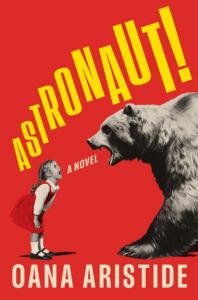
Astronaut! by Oana Aristide is available from W.W. Norton & Company.