

This piece was originally published in Lit Hub’s Craft of Writing newsletter—subscribe here.
My journey as a writer began in an unexpectedly stark way, triggered by a patient’s death that shook me to the core. I had just started nursing a few months prior, and nothing in training had prepared me for what occurred: a patient who seemed ready to go home began coughing up blood and died. The memory stayed with me, and I wondered if putting the experience into words would ease the ache. It didn’t fully ease it, but I found I liked the piece I produced enough to share it with The New York Times. When the Times ran the essay, the most common reaction I heard was, “This is a voice we rarely hear—the perspective of a bedside nurse.” I felt incredibly fortunate that a single column could launch a writing career. Yet I also worked diligently and embraced writing as a mission: to tell the story of a profession I adore, one that often lacks the recognition or respect it deserves.
But how? How does someone become a writer of narrative nonfiction after earning a PhD in English, becoming a mother, and then returning to school to train as a nurse? My background lay in academic writing, polished when literary theory was fashionable. Much of the “theory” I grappled with in graduate school remained opaque, and even as I wrestled with terms like “deconstruction” and “episteme,” my own prose began to assume that same dense, jargon-laden style that frustrated me in the first place.
In nursing, however, I gladly left that verbal ornamentation behind. Nursing is fundamentally concrete. Patients depend on their daily medications, and clinicians must listen to the rhythms of their hearts, lungs, and stomachs. Some patients need supplemental oxygen for shortness of breath, while others require strong pain relief. There is nothing abstruse about nursing, and I did not give much thought to writing as I concentrated on mastering the job.
Until a death occurred so sudden and brutal that I felt compelled to write to make sense of it. The essay opens with the line, “In my job, people die,” and traces the experience of standing at the bedside, watching a resuscitation team futilely strive to save someone. The event was intensely painful and bewildering. I knew death was part of the work, yet witnessing it firsthand—someone gazing at me with pleading eyes—was something I had never endured. My emotions poured out into words, and the piece unexpectedly ended with a thread of optimism: “What can one do? Return home, love your children, try to avoid squabbles, eat well, walk in the rain, feel the sun on your face, and laugh loudly and often, especially at yourself.”
Some kind of alchemy unfolded when I began narrating as a nurse. I converted the job’s intellectual and emotional complexity into lean, direct, human prose, opting for straightforward language that mirrored the essence of caregiving. I also resolved not to clutter my storytelling with abstract verbal flourishes.
The only aspect of my doctoral training in English that I did not abandon when I became a nurse-writer was my deep appreciation for literature. The very first essay that set my nursing-writing journey in motion revolved around John Donne’s poem “Death Be Not Proud.” I had cherished that poem, but after my patient’s abrupt death I found it lacking resonance. My second book, The Shift, almost didn’t happen without a few lines from William Blake. The book centers on a single shift during which my assumptions about two patients proved utterly wrong. From that shift I learned a cardinal truth: a nurse has twelve hours—twelve hours only—to care for each patient. One blustery day, a friend and I paused to discuss the idea for the book. She quoted Blake in response: “To see a World in a Grain of Sand / And a Heaven in a Wild Flower / Hold Infinity in the palm of your hand / And Eternity in an hour.” Those lines convinced me that the project could work, that I could illuminate not merely a day in a hospital, but all the life contained within a day there, and Blake’s poetry threads through The Shift.
People often asked whether I regretted leaving teaching English and academia to become a nurse. My answer, and it remains true, is no. I deeply love the work. Yet I also recognize that without becoming a nurse, I would not have done the writing that my nursing career made possible, and I cherish that writing just as much. Moreover, without my writing, I might not have become a prominent advocate for this vocation I treasure. So the mission endures. While I provide care, I will continue, to the best of my ability, to tell the story of nursing.
__________________________________________
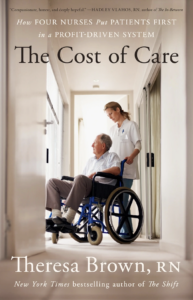
The Cost of Care by Theresa Brown is available via Algonquin Books.
