
Shakespeare and his companions would refer to punctuation as “distinctions,” drawing on a Latin heritage, or as “pointing,” a nod to the medieval habit of placing points at various levels of a line. The earliest usage of the term “punctuation” surfaces in the French dialogue manual Orthoepia Gallica from 1593, penned by translator and pedagogue John Eliot, whose lively exchanges in paired columns on the page influenced Shakespeare’s witty repartee. Eliot challenges London-based French instructors to “find fault” with his “pricks, nicks, and tricks,” a nod to his signs and rhetoric.
He was undoubtedly a flamboyant and imaginative writer and a provocative educator; yet his seriousness shines through here: the “pricks” carried “tricks” as punctuation evolved into a tool for reflecting the sweeping technological shifts of the era, shifting gender dynamics, and literary genres that mirrored social and historical concerns such as monarchy or voyages of exploration.
Punctuation also served as a conduit for venturing into interior realms: the mind, memory, and feelings. Especially when something seemed off: in a culture that valued eloquence above all, writers became more drawn to portraying hesitation, interruption, or even the failure of speech rather than its triumphant delivery. Perhaps the offspring of humanists—sons and some daughters alike—were growing cautious about placing unqualified trust in language as in previous generations.
Yet, given how his own life was dramatically shortened at the pinnacle of his social and literary fame, it’s tempting to read the interrupted sentence as a haunting omen.
And perhaps the opposite was true: writing had become so formidable a force of expression that it could turn against itself without losing its spell. A master of deliberately suspended speech emerged as the unmistakable sovereign of brackets: Sir Philip Sidney.
On October 16, 1586, a young man sends a desperate note to a friend: “My dear Weyer: Come. Come. My life is in danger and I long to see you.” Weak from a festering wound in his thigh, he writes these lines in a trembling, barely legible hand. Will the renowned physician be able to help him? When Weyer arrives the following day, the writer is already dead. Sir Philip Sidney, courtier, poet, and fervent Protestant soldier under Queen Elizabeth I, had been fighting Catholic Spain in the Netherlands when a bullet found its mark in his thigh. The life of the dazzling Tudor luminary was cut short at thirty-one, in a manner that eerily echoed his own writing: just as he was about to leave for a holy war, Sidney interrupted the grand narrative about errant knights that he had been shaping for years, pausing the action in the midst of a fierce engagement, leaving the scene suspended—within a parenthesis.
Anaxius lept away. Whereat ashamed (as having never done so much before in his life)
Readers, much like the sentence and the plot, hang on, waiting for what will come next. The work remained unfinished, yet the parenthetical openness acted as a magnet for countless later authors, inviting them to graft their own visions of how the book should proceed. Sidney was simply following a widespread compositional habit: pause mid-sentence or mid-thought, then use the parenthesis as a memory springboard when it was time to resume writing (or quill, rather).
Yet, given how his own life ended so tragically at the height of his social and literary triumph, it’s hard not to entertain readings of the interrupted sentence as an eerie omen.
Regardless of his death’s timing, Sidney wielded the twin oral-visual boomerangs with remarkable poise in his brilliantly stylish and dizzyingly chaotic Arcadia. Two princes encounter two princesses, and a cascade of complications follows: disguises, poetry contests, shipwrecks, abductions, a courtroom confrontation, warfare, and, far more perilous than all these adventures combined, love and desire. There are shepherds, pirates, kings, queens, and love triangles (or perhaps even polygons), including escapades involving men dressed as Amazons (no need to ask—just read). What’s not to adore?!
To complicate matters for the Arcadia’s characters, readers, and later editors, Sidney produced two markedly different versions of the tale, one created between 1577 and 1581 and a revised (some would call nearly a new) edition produced between 1581 and 1584, just before his departure across the Channel to his premature end. In 1590, four years after Sidney’s death, his closest ally, Fulke Greville, released the “new” Arcadia with its abrupt ending.
In 1593, Sidney’s beloved sister Mary issued a rival edition in a larger, more ornate format, beginning with the “new” version and attaching a heavily edited finale drawn from the older edition, resulting in a clumsy, incongruous centaur that nobody appreciated. Crucially, in the portions of the new and old Arcadia that correspond, nearly all 2,400 brackets are identical. We lack a definitive autograph manuscript from Sidney for a single fused final version, so this is as close as we get to his own punctuation. Sidney clearly loved to bracket.
On the one hand, the parenthesis is disposable. It’s useless. Stuff. Waste.
Though many writers of his era also used parentheses extensively, none did so as prolifically or as proficiently as Sidney. The popularity of his Arcadia helped propagate the use of brackets and the perception of their sophistication. After all, the Renaissance celebrated intricate structures in all spheres—from architecture and textile patterns to language. The more elaborate the better. Sidney’s brackets offered a template for elevated expression, and later authors eagerly imitated him.
Indeed, some were so inspired by the provocative unfinished sentence that they seized the narrative thread of the new Arcadia from where Sidney had left off! Gervase Markham published an ending in 1607, and Sidney’s niece Lady Mary Wroth (the Sidney family was remarkably literary) produced a lengthy two-part prose novel called Urania in the 1620s, which likewise employed her uncle’s distinctive parentheses as a subtle assertion of his legacy.
Long before Sidney, Coluccio Salutati had devised the parenthesis nearly two centuries earlier, revealing a longstanding rhetorical habit of inserting a fragment of a sentence into a larger whole. Remember that the Roman rhetorician Quintilian called it interpositio, highlighting the act of placing something in the middle of another thought. The question remained: how long could the mini‑digression extend before it hijacked the main sentence (or narrative)? There were no formal rules governing a parenthesis’s length; it was up to the writer’s discretion to determine a reasonable delay.
Thus it makes sense that Sidney’s contemporary, the schoolmaster John Hoskins, wrote in his Directions for Speech and Style (1600) that a parenthesis “in extremities” could become a (dis)grace: it can work both for and against the surrounding text, depending on how skillfully the bracket is used. This paradoxical potential fostered a certain anxiety in stylistic guidance. In his 1589 Art of English Poetry, George Puttenham offers an exaggerated example, noting, “This insertion is very long and utterly impertinent to the principal matter, and makes a great gap in the tale, nevertheless is no disgrace but rather a beauty and to very good purpose, but you must not use such insertions often nor too thick, nor those that be very long as this of ours, for it will breed great confusion to have the tale so much interrupted.” On the one hand, the parenthesis is disposable. It’s useless. Stuff. Waste.
Inserted here, there, or anywhere—somewhere in the middle. On the other hand, it is “grafted” onto the main sentence, as Puttenham argues, as if it were a branch from a different tree that becomes enhanced by its new stem precisely because it is foreign. The challenge is not merely that a parenthesis intrudes on a sentence—it does; that’s undeniable. The question is rather how to manage it.
In The Garden of Eloquence, Puttenham’s colleague Henry Peacham contends that meandering along the syntactic and narrative line is permissible provided it serves a useful purpose, that is, when one steps away from order for the sake of a pertinent sense. He adds that one must proceed with a well-planned strategy, so that any departure is purposeful and not a reckless detour. If a writer intends to diverge, they should do so with intent, spanning the interior parenthesis as if it were an arch that connects both sides of the sentence.
The parenthesis both cuts and stitches, bridging the before and after and radiating outward from the punctuation’s edges.
Parentheses, turning the inside of a sentence out and the outside in, invite readers to shuttle back and forth, exercising mental agility that nurtures a flexible set of thoughts and feelings.
At the outset of Arcadia, one of the princes, Musidorus, wooes Pamela, one of the sister-princesses, by insisting that his shepherd’s garb is merely a disguise. Or so he tries to tell her:
In the country of Thessalia, (alas why name I that accursed country, which brings forth nothing, but matters for trag dies? but name it I must) in Thessalia (I say) there was (well may I say, there was) a Prince (no, no Prince, whom bondage wholly possessed; but yet accounted a Prince, and named Musidorus.
Why employ so many parentheses? He could simply have stated, “In the country of Thessalia there was a prince named Musidorus.” Instead, he interrupts himself almost obsessively, trapped within his own feigned identity, not only in the story but within the sentence itself. The bracketed interludes dramatize the delays he experiences in his own life due to his affection for Pamela and the disguise he maintains to pursue her.
Parentheses, turning the inside of a sentence out and the outside in, encourage readers to move back and forth, sharpening their mental agility and fostering a flexible range of thoughts and feelings. Sidney’s brackets enrich the thrust of the main clause with qualifications, comparisons, doubts, metaphors, and examples, expanding the narrative into a multidimensional tapestry that accommodates countless viewpoints and interpretations. The bracket, in word and deed, serves as an ethical practice: it invites pause for contemplation.
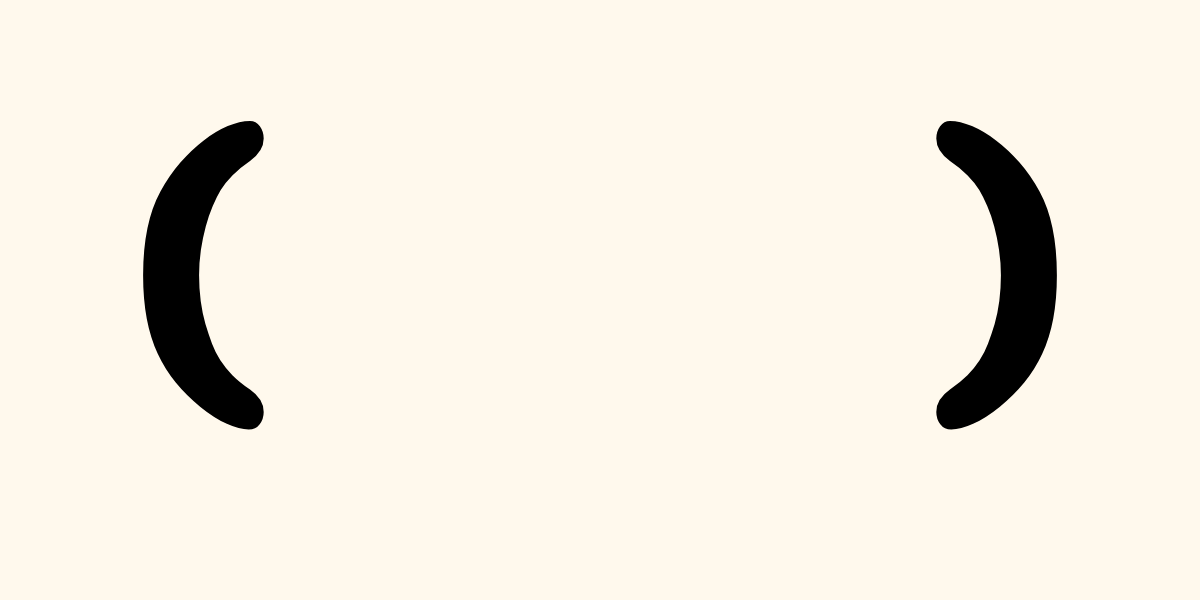
There is something enigmatic about the “little moons,” as Erasmus described them. The moon stands for creation and destruction, renewal and eternity, femininity, the passing of time, mystery, night, and secrets. So too does the parenthesis. The convex-concave curves of open and closed parentheses cradle something spoken softly, whispered into the reader’s ear, murmured beneath the author’s breath.
For Renaissance writers, punctuation belonged to both the visual-grammatical and the spoken-rhetorical realms. Headmaster Richard Mulcaster categorized parentheses as “creatures to the pen and distinctions to pronounce by”: they belong to both the sonic world and the visible page. The two walls of punctuation make meaning distinct, even as they remain porous enough for the eye to slip in and out. A bracket cannot be ignored, yet it can also be read straight through. How does one read a bracket? How should it be spoken? Mulcaster advised that the words enclosed by them should be spoken with a lower, quicker voice than the words surrounding them. Visually and aurally, what lies inside sits securely between the protective hands of the bracket, safeguarding intimate expressions.
Brackets create a particular magic between reader and author. Perhaps that explains why Sidney chose to dedicate his work to his sister Mary, herself a skilled translator and accomplished poet:
Here now have you (most deare, and most worthy to be most dear Lady) this idle work of mine: which I fear (like the spider’s web) will be thought fitter to be swept away, than worn to any other purpose. For my part, in very truth (as the cruel fathers among the Greeks, were wont to do to the babes they would not foster) I could well find in my heart, to cast out in some desert of forgetfulnes this child, which I am loath to father.
Sidney is continually hedging his words with delaying parentheses. He adds similes (“like the spider’s web”) and classical allusions to Greek myth, and he appeals to the reader (“most dear Lady”). Parentheses wrap around words, shielding vulnerable admissions in a private, visible form. An open bracket always has a matching close bracket—the inner words are never left alone; the incomplete crescent always comes with its counterpart. The parenthesis is a gentle, reliable interruption, steady and balanced.
Punctuation, it turns out, not only helped writers and printers enliven dramatic reading but also offered added value precisely because it belonged to the world of books.
__________________________________
Excerpted from On the Mark: From Periods to Interrobangs, How Punctuation Remade the World by Florence Hazrat, copyright ©2026 by Florence Hazrat. Used with permission of Basic Books, a division of Hachette Book Group, Inc.