
This first appeared in Lit Hub’s Craft of Writing newsletter—sign up here.
The novel has long maintained a fixation with technology and its influence on human life. If you trace the evolution of realist fiction, you’ll notice it bending in response to breakthroughs in belief systems, finance, machinery, and urban development, since each of these innovations reshaped how people perceive themselves and navigate the world. The rise of large-scale urban centers, for instance, brought Baudelaire’s flâneur into sharper focus just as transcontinental trains made narrative leaps across space and time easier to grasp. As industrial efficiency grew to the point where any single person could not grasp the entire machinery of production, attention shifted inward, giving rise to free indirect discourse—a mechanism modern novelists have been refining for decades.
Which brings us to the internet. My novel Blow Yourself Up commences at a moment when smartphones take hold in high schools and traces the ascent of platforms and influencers, concluding just prior to the emergence of AI. It felt natural to weave in texts, alerts, replies, and spoken commands. But how should a textually rendered fiction that is about the internet also accommodate digital media within its pages?
Contemporary writers have tested this terrain in a variety of ways, some even constructing entire narratives out of digital artefacts. Think of Calvin Kasulke’s humorous Several People Are Typing, built from Slack conversations, or Jennifer Egan’s “Black Box,” an 8,500-word short story originally released through 607 tweets. Then there are novels that evoke an online atmosphere more through cadence and layout—punchy paragraphs, generous white space, a juxtaposition of the mundane with the incendiary, the lyrical, and the absurd. Patricia Lockwood and Jenny Offill stand out as adept practitioners of this vibe.
Yet these strategies didn’t sit well with Blow Yourself Up, because even though digital media is omnipresent, the narrative remains firmly in traditional prose, advancing through sequential scenes. For this kind of book, some authors have introduced typographic treatments, distinctive sections, chat bubbles, or timestamps to signal a text versus the text, a device I didn’t care for, as it implied a stark boundary between real life and screen life. While explaining this to my editor, I came to an overarching idea: the world moves so quickly that everything intermingles. Memes slip into conversations. A message from a friend carries equal weight to what they say in person. We weave the digital alongside the physical into the fabric of everyday life.
I’m not arguing that glancing at art on a phone will ever replace the experience of standing before it in a museum. Nor that photographing a peak on a hike equals remembering it later (recent studies have shown otherwise). I’m firmly on the side of embodied reality, a label that occasionally weighs on me. Still, the digital ephemera in Blow Yourself Up is rendered with minimal adornment, because I don’t think we actually notice the little bubbles that surround our messages. We simply read them. My aim is to complicate the supposed divide between digital and physical, drawing them into the characters’ interior lives, because that is how the internet truly feels. It represents cognition at its most authentic, in my view.
There’s a moment when my protagonist, Payal, goes on a date with a pleasant match from a dating app. The evening is shaping up as ordinary—no immediate danger, only the ache of boredom—until a notification arrives: a video she posted has been reshared by a massive account. Anyone who has lived through that knows the aftermath rarely goes smoothly. She must juggle the torrent of likes, comments, and new followers while sitting at the dinner table. She inhabits two realms at once, the online environment and the real world around her. Since her date remains unaware of the online storm, I could capture the gulf between them. As he signals for the check, he remarks on how close his apartment is to the restaurant. The poor guy’s misfortune is hard to miss.
Readers will decide if this approach was successful. Blow Yourself Up is a love story that traces the internet’s journey from toy to tool to nightmare, the defining leap of our era. If I have managed to pull it off, the internet should feel as ordinary as the glass portals in our pockets, enabling fiction to interrogate who we are and how we have changed because of it.
__________________________________________
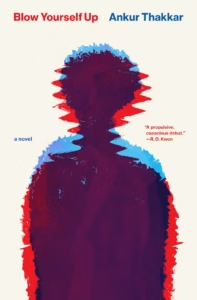
Blow Yourself Up by Ankur Thakkar is available via Triquarterly Books.