
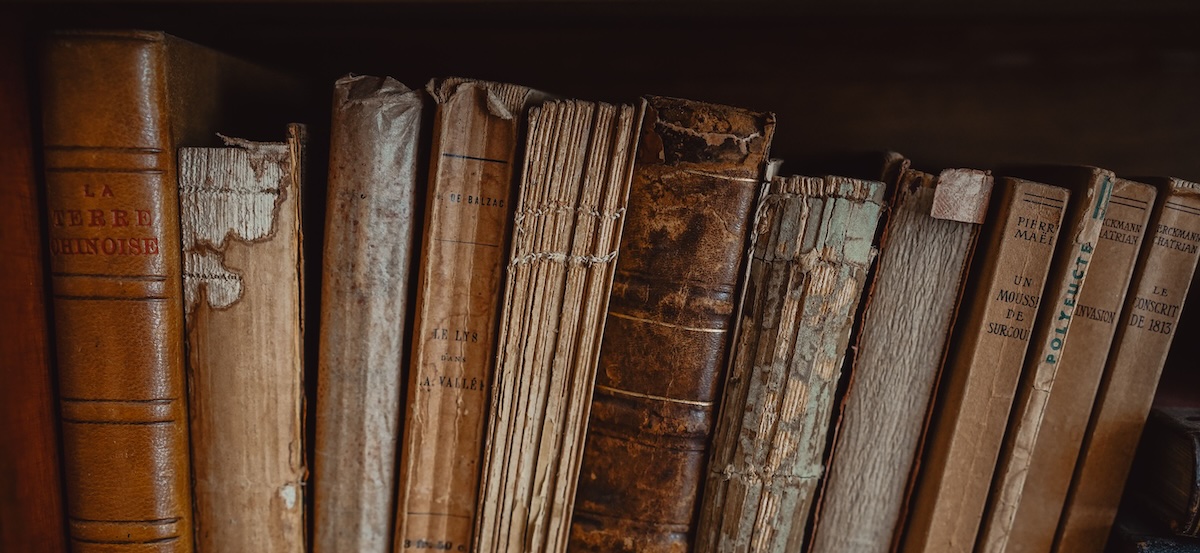
In 1345 the English book lover Richard de Bury described the libraries and booksellers of Paris, medieval Europe’s great center of learning “as more aromatic than stores of spicery.” In Bury’s Philobiblion, a celebration of all things bookish, he described reading as sweetening the belly of one’s memory. Collecting books was akin to gathering “sweet-smelling flowers.” The knowledge obtained from them would allow you to shed a perfume of learning like a panther, which, according to medieval writers, “all other Beastes love and follow…for his sweete smell.”
Ideas about the scented nature of knowledge could be found across the medieval world. The Persian polymath Al-Ghazali compared those who collected and shared ideas to “a pot of musk which is full of fragrance and gives fragrance to others.”
Yet philosophers from the Greeks onwards might have found the idea of fragrant learning fanciful at best, and misleading at worst. Intellectual luminaries ranging from Aristotle to Hegel and beyond have argued that human noses are prone to prejudice, insensitive compared to those of other animals, and therefore unreliable. Immanuel Kant was summarizing a set of long-held ideas when he argued that smell was ungrateful, dispensable, and more subjective than objective. It must have seemed to him that his fellow Enlightenment thinker Jean-Jacques Rousseau was damning with faint praise when he described smelling as the “sense of the imagination.” Smell might offer insight into the soft world of feeling, but it would broker no entry to the hard archive of rational facts. In hierarchies of the senses, smelling was traditionally located either in the middle (between the distance senses of vision and hearing, and the proximate senses of touch and taste) or at the bottom (associated with animality, childishness, femininity, and racial others). Seeing, rather than sniffing, was the source of knowledge.
That sniffy attitude has surfaced in satiric barbs directed at those whose bookishness was held to be all surface and no substance. The seventeenth-century Frenchman Jean de La Bruyère mocked collectors and recalled almost fainting at the scent of a library full of untouched volumes bound in Moroccan leather. Seeking to bring the fashionable owner down a peg or two, La Bruyère compared the stink of the library to the proverbially foul smell of the tannery. Likewise, the Victorian dramatist Douglas William Jerrold satirized those who, amassing shelves of books that they subsequently left unread, believed that they could “take a good sniff” and breathe in the “aroma of learning.” In the early twentieth century the Japanese literary critic Uchida Roan compared bibliophiles to illiterate, book-eating insects who delighted in the “sweet scent of old ink.”
When we lean in and sniff, we are plucking a book from the shelf and diving into the memories contained within.
Yet Bury has not been alone in evoking the perfume of erudition. In Chinese, the word shuxiang means both “knowledge” and “the scent of books.” In seventeenth- and eighteenth-century China, collecting books became a common pastime for the elite. The possession of a well-stocked library conferred considerable respectability. A fine collection of books “perfumes the family line with the scent of ink,” but if “the fragrance of books dies, the family’s reputation will gradually fall into the base.” The scent of books symbolized an investment in learning and tradition.
Perfume was no mere metaphor. The avid collector could distinguish the best manuscript by their scent. As early as the eleventh century, Chinese book collectors were sniffing out forgeries that had been artificially aged. The Song-era painter-poet Mi Fu advised that volumes “aged by exposing them to smoke will retain an odor,” whilst a “genuine old paper or silk has a peculiar fragrance of its own.” Nearly seven hundred years later, in 1781 one collector was visited by his friend, who had obtained a new medieval volume of poetry on his travels to the eastern city of Suzhou. On being shown the book, an “ancient fragrance assailed the nose,” which confirmed that it was a fine Song-dynasty edition.
The smell of books also linked Bury’s medieval Parisian perambulations with another visitor to the city. In 1920s Paris the Japanese philosopher Kuki Shūzō detected the smell of knowledge on a springtime stroll. Through he enjoyed French perfumery—the earthy, animalic, woody notes of Guerlain’s Bouquet de Faunes were his favorite—Kuki was in Paris to learn. In the French capital he met up weekly with Jean-Paul Sartre to share his knowledge of Heidegger. In one of Kuki’s rhyming poems, the itinerary briefly brings him to the center of the city’s print trade, where Bury had breathed in the balmy odors of medieval booksellers nearly six centuries before, and he inhales in the “fragrance of past wisdom.”
Returning home, Kuki would pen one of the most influential treatises in Japanese aesthetics on the concept of iki (which comes close to the modern sense of the word “cool”). In the introduction Kuki explored the inseparability of scent and memory. When we bring a rose to our nose and breathe in its scent, “it is not that the fragrance triggers the memory,” but that “we smell in the fragrance the memory of the past.” Here again Kuki is echoing Proust, who had believe that “the better part of our memory exists outside ourselves.” The latter wrote that the material world around us—especially smells—acted as a rich store of memories that we have deposited beyond our person for want of space in our heads, “just as an author deposits in the National Library a copy of a book which might otherwise become unobtainable.”
Exploring the smells of the world around us involves opening up a library in which scents are the bindings and pages. When we lean in and sniff, we are plucking a book from the shelf and diving into the memories contained within. This is not merely an unbidden, shocking return of the past. If we so wish, we can sit with and explore the memories contained within the fragrance. Although contemporary psychologists and neuroscientists often use the term “trigger” to describe smell memories—with its connotations of bolt-from-the-blue immediacy—their studies of smell memory ask participants to sniff and then deliberately engage in the work of building recollections.
On occasion, the idea of the world as a library of scent, across which one might travel by sniffing, has been rendered rather literally. Books are made of absorbent materials—paper, ink, leather—and this means that they have been thought of as paper alembics that distill the scent of a culture.
On June 25, 1900 the Daoist monk Wang Yuanlu was busy with his great project. Fascinated by the statues and paintings of the Mogao Caves, an ancient Buddhist temple complex located at Dunhuang in north-western China, Wang had taken it upon himself to preserve and restore them. As his hands and eyes worked over the wall of one cave, he discovered a small hidden door. Pushing it open and peering inside, Wang found a secret library. There was barely room to stand in the middle of the space. Manuscripts filled the floor. Stacked high along each wall, piled on top of each other, were thousands of documents. Wang had rediscovered a bibliographical bounty that had been walled up since the eleventh century. He showed what he had found to local officials, who ordered Wang to reseal the cave and await the transportation of its contents to Beijing. However, when the British archeologist Aurel Stein and French sinologist Paul Pelliot reached Dunhuang in 1907 and 1908 respectively, Wang was still waiting. He showed the Europeans the cave. As might have been predicted, Stein and Pelliot beguiled the monk into accepting a paltry payment and then shipped thousands of the manuscripts back to Europe. Parisian archivists cracked open the boxes and the
pungent odor which…pervades all things Tibetan was perceptible: a smell which is a mixture of that of rancid butter, smoke and grime. That alone would be sufficient to show the antiquity, originality and remarkable continuity of Tibetan culture.
Dunhuang, close to the Tibetan plateau, had been occupied by the Tibetan Empire during the temple caves’ golden era, and contacts between the two cultures stretched far back in time. Europeans had crossed the border into Tibet as early as the seventeenth century, but these visits had been few in number and short in duration. Even in the twentieth century this mountainous land was relatively inaccessible to Westerners. Those travelers who did venture as far as Lhasa, the administrative capital, picked out a particular smell: yak butter. Buddhist temples were lit by butter lamps, Tibetans were known for their love of tea with butter in it, and some of the populace were said to cover their bodies with butter to protect against the freezing climate. To European noses, Tibetan temples, homes, and bodies all smelled of smoke and putrid yak butter.
Early twentieth-century accounts, written by European diplomats and missionaries who were attempting to fill the power vacuum left in the region by the fall of China’s Qing dynasty in 1911, were less than flattering. A British account of the “well known Tibetan odour” from 1917 claimed that the garments of Tibetans—exposed to smoke, butter, and incense—smelled “not unlike smoked hams.” The Frenchman Fernand Grenard wrote that Tibetans, covered with butter, “give out a characteristic smell, not so much agreeable as penetrating and persistent.” The combination of smoke from yak-manure fires and rank butter was sarcastically described as forming a “wonderful compound, which so far has not been named or classified.”
These reactions were clearly clouded by colonial condescension. Not all Europeans were quite so negative. In 1914 Rudyard Kipling argued that there were only “two elementary smells of universal appeal.” The first was wood smoke, but the other smell best suited to “waking rampant ‘wanderlust’” was the “smell of melting grease.” The “choking” butter lamps in Tibetan temples and the “bouquet of smells” outside London’s fish and chips shops shared this universally enticing cooking odor.
Yet, for Tibetans, the same smells were far more meaningful. In the fourteenth-century Bardo Thodol, known to many as The Tibetan Book of the Dead, an inability to “sense the smell of a dying butter lamp” was an indicator of one’s imminent decease. Texts discovered in the same period by the lama Sangye-Lingpa revealed a tradition of butter-lamp divination, in which the smell of the burning lamp could offer insights concerning the future. A sour or “burnt food offering” smell was negative, an absence of odor indicated neutrality, and “a pleasant smell” indicated that “whatever you do will be successful.”
Whilst Europeans reacted with disgust to yak-manure fires or butter lamps, Tibetans were offended by the scent of tobacco-smoking westerners. In the purification ritual known as bsang, Tibetans would burn incense, herbs, butter, and other foodstuffs as a smoke offering to gods and spirits that fed on scents. By contrast, the smell of tobacco smoke was offensive to Tibetans because it polluted the stones of temples and thereby displease spirits, who would respond by inflicting disasters on humans. Since the sixteenth century, Tibetan monks had been banned from smoking tobacco and, in 1918, a decree by the 13th Dalai Lama prohibited the smoking of cigarettes throughout the city of Lhasa.
This complex culture of scent was lost on European writers. For them, Tibet neatly encapsulated the fragrant sensuousness and the uncivilized filthiness that modern westerners had long projected onto the “East.” From Egypt and Syria to China and India, the “Oriental nose” was said to be without “the line which divides mere smells from stinks.” Unlike Europeans, who declared a preference for perfumes, but uncommon with dogs, who were thought sensitive to scent but indiscriminate in their enjoyment thereof, the “Oriental” supposedly enjoyed both the “hottest” spices and the most “nauseating” smells with an obtuse equanimity.
The mix of the “smell of incense and burning butter,” with its “greasy warm stench of mingled sweetness and putridity,” was believed to have soaked into every object that returned with expropriating explorers from Tibet. The archivists and librarians who subsequently looked after the manuscripts in European and American libraries felt that to inhale that smell was “to have a bit of another age or culture rubbed off on you.” Of course those same noses, whether anthropologists’ or archivists’, seldom reflected on whether their own culture might be similarly boiled down to such stereotyped components.
Books can soak up scent, but their paper, ink, and bindings also have their own odor that matures over time. For some the scent has been simply irresistible. In January 1991 the trainee book-binder Peter Lawson from Stepney pleaded guilty to stealing three volumes from a shop in London. Before an Old Bailey judge, Lawson claimed that an obsession with the smell of books had tempted him to take them, but he could keep his urges under control “as long as I don’t get a whiff.” The judge took the hint and put Lawson on probation for two years, during which he was asked to stay away from all bookselling premises. Lawson was not the first of his kind. In October 1978 the Italian lecturer Bruno Pagono was fined for stealing £25,000 worth of books from the University of Oxford’s Bodleian Library. He told the police that “the smell of the books made me want to take them,” adding “people who love old books will understand.” Whilst few have reached Lawson’s or Pagan’s extremes, for many, books breathe a nostalgic odor. In 1860 one Englishman, who recalled the “peculiar smell” of cheaply printed religious tracts he had pored over as a child, described such smells as “every-day ghosts” that “haunt us in spite of ourselves.”
Sniffing the scent of an old paperback, you may feel that you are inhaling the scent of the past. You are not wrong. The vanilla-like odor is related as the chemicals in paper break down and decay. You are breathing in the passing of time. Try sniffing books, glossy magazines, and newspapers of different ages and you will find that different papers have different scents. But the smell of old books is in fact a relatively new smell. The methods for preparing the pages have altered over time. Modern paper, since the late nineteenth century, is both less chemically stable and thus smellier than earlier publications.
Sniffing the scent of an old paperback, you may feel that you are inhaling the scent of the past. You are not wrong.
In the medieval and early modern period European paper was often made from old textiles and clothes. Rag-picking was a job often undertaken by the old, the poor, and women. The pickers collected up the malodorous mass of material and transported it to water-powered paper mills, where the fabric was sorted, fermented, cut, washed, and ground into pulp before moulding, pressing, and drying into paper. To contemporary minds there was something miraculous about this transformation, whereby “filthy ragges, raked out of a dunghill, which to view, cannot but provoke the stomacke, and procure vomite, yet…maketh very white, smooth, and fine paper.”
Sorting through these rags was dusty, hot work. The “olfactory senses” of a tourist visiting a Württemberg paper mill in 1842 were “much offended” by the room where old clothes were sorted. Old rope and cordage were also used, for making coarser brown paper. In Britain a higher duty was charged on the “first-class” paper made from rags, and excise officers would sniff sheets to determine, by the telltale presence of the ropey tar smell that persisted in the final product, if they were of the “second class.” But by the early nineteenth century the common use of bleach enabled less-than-honest manufactures to pay the lower duty for—now deodorized—second class materials whilst still producing the white finish of first-class paper, much to their competitors’ chagrin.
The smell of bleach was so strong that it permeated the surroundings of nineteenth- and early twentieth-century paper mills. The materials had to be placed into vast vats of chlorine, sulphuric acid, and water that let out a “suffocating odor” that was “injurious to the human system.” The workmen, who had to wait for the “well-known odor” to disappear, would then have to wash the chemical mix out of the rags. If any lingered, the resulting paper would turn yellow and emit the pungent scent of chlorine.
But washing the chemicals out of paper also created liquid waste that found its way into streams and rivers. In 1866 the Scottish surgeon Dr. John Falconer was 58 years old. Falconer was a passionate angler and he had fished the waters of his home nation’s North Esk river for most of his life. As a teenager, Falconer had caught plenty of trout and he had even drunk from the river. But in 1832 he started to spot dead fish lining the banks, the water began to darken, and a curious smell began to appear. As a medical man familiar with disinfectants, he knew the scent at once: chloride of lime. This substance was used as a disinfectant in hospitals, prisons, and workhouses. However, it was also used to bleach paper. Falconer was not the only local to notice the smell. He was one of many witnesses brought before the Scottish courts as landowners tried to take the polluting paper mills to task for ruining the river that ran through their lands. After an 1841 case, the mills were forced to control the effluent that ran from their business into the Esk; the river began to lighten in color and the bleach scent began to disappear.
However, in the 1860s, events far away in America caused a stink to emerge once more. Scotland’s paper industry had relied on cotton rags imported from North America, but the American Civil War now cut off the supply. The mill owners therefore turned to a new material: esparto grass imported from Spain and North Africa. Esparto was cheap and plentiful. The problem was that, in order to remove the lignin that produced brittle, yellowish paper, the grass had to be boiled in vast vats of caustic soda. The resulting waste liquid was far fouler than anything the paper mills had previously produced. At a new trial in 1866, local residents described the evil smell that was emerging from the waters of the river. They wanted to make it clear that this was no ordinary “ammoniacal” smell of human sewage. This was something far more pungent. This was a stagnant, offensive, dank, nauseous, loathsome, corruptible smell that reminded them of stale soap suds, an ill-kept washing house, senna, tar, rotting vegetables, decaying seaweed, flax pits, and the air of a gasworks. The jury found against the paper mills but, in the 1930s, a report to Scotland’s Department of Health lamented that, thanks to ongoing pollution, the Esk continued to emit foul odors.
With each new innovation in paper production came different pollutants. From the chill of 1860s Scotland we now journey to the heat of a North American summer in 1941. In Lewiston, Maine, another conflict, this time a global one, had pushed the production of paper to new heights. Paper mills lined the Androscoggin river that flows through Lewiston. These mills used the sulphite process, first commercially deployed in Sweden in 1874, in which wood chips are turned into pulp by treating them with sulphites or bisulphites that untether the cellulose needed for paper from unwanted lignin. By the 1930s, the waste from these processes had endure that the Androscoggin was a seething swill of hydrogen-sulphide-emitting liquor; and in 1941 the air was thick with stench from the bubbling waters. Locals who refused the clothes pegs sold by children as makeshift prophylactics buckled as they crossed the water and added their vomit to the dark liquor below. Black and white photos showed a scummy surface, more like marbled fabric than flowing water. The stench was everywhere. A poem printed in the Lewiston Evening Journal in 1941 captured the all-pervasive nature of the resulting stink, blaming failed corps and poor health on the “odor from the River” that had percolated into every aspect of daily life.
_______________________________
From Sniff: A History of Smells by Will Tullett. Copyright © 2026. Available from Yale University Press.
