
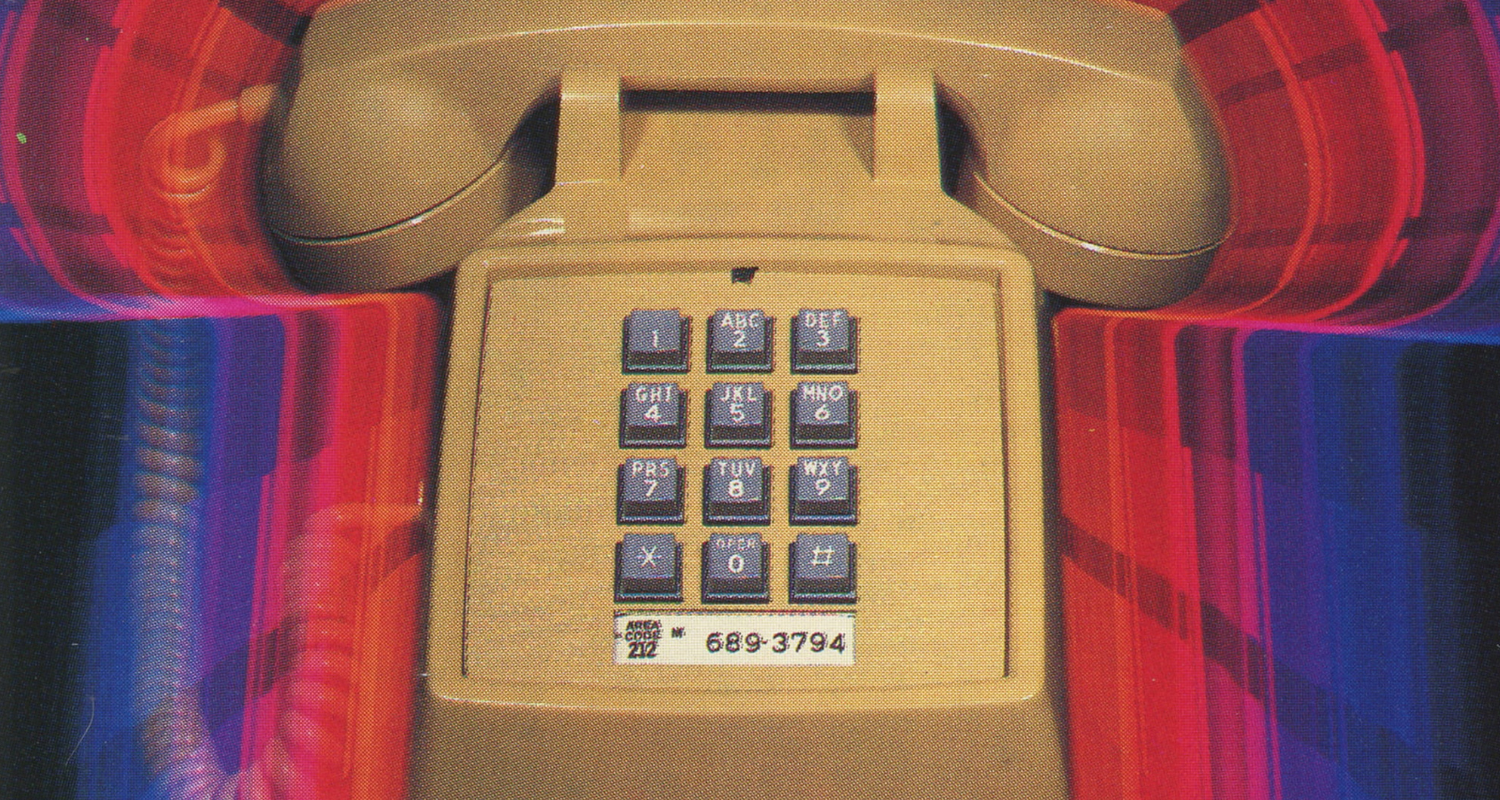
A beige plastic telephone rests on a wooden table, its handset connected by a coiled cord and cradled in place. The base displays a clear dial with ten finger holes. Although it is an ordinary household object, its presence on the surface hints at something looming—an impending ring that will change everything.
And then it does: a metallic brrrrring, sharp and unmistakable. On the carpet nearby, a cheerful girl with pigtails and a frilly dress darts up, grabs the handset, and presses it to a stuffed duck held to the receiver. Quack! Quack! Quack!
“That isn’t the right way to answer a phone,” an older boy with neatly combed hair and a shirt buttoned to the neck interrupts, stepping into view. He snatches the handset from the girl and shows proper protocol: “Hello. Matthews residence. This is Jimmy.” He listens, then speaks again. “Just a minute, please.”
In strides a grown man, equally neat, wearing a button-down shirt and khaki pants. “Uncle Bill,” Jimmy explains earnestly, “Captain Adams wants to speak with you.”
“Thanks, Jimmy,” replies Bill. He accepts the phone, stretches the cord, and says, “Hi, Captain, this is Bill. No, the duck isn’t ours to answer the phone—Susie’s friend.” Yet there is little room for humor: Captain Adams needs Uncle Bill to come right away. These are the whitest white people you’ve ever seen performing a fantasy of middle-class American life that television shows once popular—think Wally and Beaver, Mike and Robbie, Chip.
Nearly nine decades into the telephone era, this wholesome scene inaugurates a film titled We Learn About the Telephone, produced in Technicolor on behalf of American Telephone and Telegraph (AT&T) by a famed Hollywood producer, Jerry Fairbanks. The short was distributed as a public service to schools nationwide and played for classrooms full of children. By 1965 the United States boasted one phone for every four people; the ratio had tripled since the end of World War II. It already seemed to be a universal appliance. Yet the telephone company—essentially a single entity—still believed its customers required guidance.
Back in the classroom, Jimmy asks: “What did people do before the invention of the telephone? How did they transport messages quickly?”
The paradox of the telephone was its plainness, its tendency to hide in the background while changing everything around it.
Thus prompted, Uncle Bill conjures a cartoon figure named Mister Man, who begins to speak. (If his voice sounds familiar, that’s because AT&T hired a top talent: Mel Blanc, the vaudeville veteran who voiced Bugs Bunny, Daffy Duck, and a raft of other beloved characters.) Mister Man escorts viewers through a brisk history of human communication, starting with cave dwellers and the ancient Egyptians. “The only way Mr. Caveman could move a message from one place to another was by sending a runner,” Bill explains. Greeks and Romans used runners too, until horses joined the scene. “That’s a Pony Express rider!” Jimmy interjects. “That’s right,” Bill agrees. “But people wanted to send messages faster than a runner or a horse could travel.” A cartoon Indigenous figure demonstrates smoke signals; sailors communicate between ships with flashing mirrors and blinking lights. Then the telegraph appears. “People have always solved problems by inventing new tools… The telegraph was, and remains, marvelous,” Uncle Bill explains. Still, the telegraph did not satisfy their longing. “Mister Man wanted to transmit his voice across distances, to hold a real conversation,” he continues. “Then, in 1876, a man named Alexander Graham Bell found a way. He invented the telephone.”
This tale, in essence, captured the sponsor’s origin myth—the most prosperous business venture in modern history. AT&T, known as the Bell System, boasted greater capital and revenue than many nations. Its scientific arm, Bell Telephone Laboratories, stood alone in the world and ultimately yielded eleven Nobel Prizes in physics and chemistry. Mister Man correctly placed the telephone at the head of a chain of increasingly powerful information technologies. Humanity could now send its voice—its many voices—disembodied across vast distances, dissolving barriers, linking towns and rural areas, and inviting conversations with strangers previously unseen.
No single genius crafted this transformation, and it did not happen overnight. The absence of telephones was not keenly felt before their emergence, and initially people hardly recognized their potential. Much that now seems obvious required people to explore, experiment, and learn as they moved forward into the future.
*
AT&T had little trouble weaving its compact history into the education of millions of children. After the history lesson came practical lessons on using the device. It hardly required instruction for most households: the Western Electric model 500 was ubiquitous across the United States. Debuted in 1949 and scarcely changed over the years, it featured a thermoplastic shell mounted on a metal base, a transparent plastic dial wheel, and a handset connected by a coiled cord. The phone weighed about four pounds, yet one could cradle its handset with the shoulder while lifting it by the cradle, which, once a person adjusted, proved comfortable. If one opened the base by removing a few screws, brass bells and a small clapper lay visible, along with a handful of colored wires. Plain as it was, this device spoke of modernity through its sculpted plastic design. There was nothing else in the home quite like it, and the dial was unlike any other gadget in households.
When the telephone rang, it did not chirp, chime, or play a tune; it produced a uniform sound across the country and much of the world: an electromechanical bell ringing for two seconds, followed by a four-second pause. (Older generations will always remember that sound, and it still appears in vintage films and TV shows. Some nostalgic folks have even assigned “Old Telephone” as the ringtone for their smartphones.)
At first the telephones were black; then AT&T allowed customers to choose among ivory, gray, beige, and a few other shades. The devices remained modest, unostentatious, and unremarkable in appearance. Yet they cut invisible conduits through space—more tangible than any legend, like wormholes that truly existed.
More than eighty percent of American households owned a Bell System telephone—owned by the company yet lent to the customer. No other firm was permitted to manufacture telephones, and everyone’s device looked the same. People assumed this was normal: it had always been this way and would always stay so.
The phone was a simple instrument with no on-off switch, but the Bell System never stopped teaching the public how to use it properly. Uncle Bill and Mister Man offered a series of do’s and don’ts. Do not shout into the mouthpiece. Do speak in a normal voice. Do speak directly into the receiver. Speak clearly. Do not leave the line ringing for too long before answering—“but if you’re the one placing the call, let it ring eight to ten times.”
There was even instruction on dialing, guiding children to turn the dial fully to the finger stop and let it return to rest after each number. “For every digit, rotate the dial all the way back by itself. Each and every number. All the way. Then release. See?”
Everyone knew how to dial; it wasn’t harder than tying one’s shoes. But the Bell System was relentless in shaping behavior. It was more than a company; it carefully authored its own story. It financed books by apparently independent writers, sponsored articles, speeches, and pamphlets, and arranged lectures in business and law schools on subjects such as public-utility regulation. The polished Jerry Fairbanks film was just one of many instructional productions and cartoons. Teachers received a twenty-four-page booklet, also titled We Learn About the Telephone, filled with practical material. A section called “The Telephone Brings Everybody Together” illustrated the people you could call: the repairman, shopkeepers, the fireman, the policeman, and the doctor.
Even earlier, the Bell System branded itself as “The Sign Board of Civilization.” Its full title was the American Telephone and Telegraph Company and Associated Companies. Its emblem was a great bell, evoking the Liberty Bell, bearing the phrase “Local and Long Distance Telephone.” Advertisements in magazines and newspapers proclaimed:
Wherever you see this sign, it stands for civilization. It is the sign of one of the most powerful influences for broadening human intelligence…
Bell telephone service has brought the entire country up to the same instant of progress.
It has unified the Nation…
You can observe this march of progress right in your own neighborhood. Each time a neighbor receives a Bell telephone, your own network of contacts expands.
The marketing copy could not resist a predictive claim: “If you do not have one, every new subscriber makes you more isolated.” This lay at the heart of the company’s business model: every new customer increases value for every other customer.
*
In 1965 children grew up in a transformed world that felt normal to them. They carried an instinctive awareness of an invisible web of voices that could bring distant things near. It was hard to imagine the earlier era when a shout could barely carry to the next room. The paradox of the telephone lay in its plainness, its capacity to hide in plain sight while remaking every surrounding detail. Even in the early days, Marcel Proust in France observed the thing growing old and familiar, calling it “a supernatural instrument before whose miracles we used to stand astonished, and which we now employ without a second thought, to summon our tailor or order an ice cream.”
By 1965, teaching children how to dial had become unnecessary. Yet in the century ahead, that knowledge would fade again, and YouTube would host clips of youngsters baffled by antique rotary phones. “Is this like the phones my mom used as a kid?” “How does this even work?” “It looks like a phone, it has numbers.”
The telephone was not the invention of a lone genius; it was not conceived by a single flash of inspiration. Even with the new device in hand, the most seasoned entrepreneurs and government officials struggled to foresee its uses. The president of the Western Union Telegraph Company dismissed it as a mere “electrical toy” and failed to foresee his own company’s decline. It could be said that the telephone was invented by its users—shaped by new habits and a new language formed as people adapted. Alternatively, one could say the telephone invented itself: it arrived as an inevitability, and once it appeared, it could not be halted, like an invasive species weaving its way through an established world.
We have learned by now that gadgets can have a life of their own and an influence we cannot evade. Using a technology changes a person. Using a technology changes a culture.
What began as a curiosity or luxury eventually became a basic necessity. In 1965, roughly 100 billion calls were made annually, a figure that would multiply a thousandfold in the years to come. Even then, the telephone had already accelerated humanity into a wired collective, where news, rumors, public intelligence, and private chatter mingled. The telephone company could guide users in understanding the device, but it could hardly explain the new patterns of life and the psyche of those who pressed their ears to the mouthpiece and spoke into it.
The telephone enabled urban expansion and the rise of suburbs by decoupling work and residence from proximity. It nurtured a sense of nationhood by softening regional disparities. “The service of the telephone in binding our Union was a historic achievement,” wrote Michael Pupin of Columbia University in 1930. “No other nation embraced its unifying power as much as this one did. No other nation needed it as much.”
The telephone also opened doors for women to join the workforce in unprecedented numbers. The operator’s role—a vocation without precedent—demanded intellect, manual skill, concentration, and an affable patience, and society broadly agreed that it should be filled by women.
In cultural terms, the telephone signaled a rebalancing of the senses. It re-centered auditory perception after centuries in which text had dominated as the most reliable, most esteemed way of communicating. “If there was an Enlightenment, there was also an ‘Ensoniment,’” argues Jonathan Sterne, a scholar of media and culture. That shift continues to unfold.
Was the telephone a connector, a unifier, or a disruptor of intimate solitude? Sociologists debated how a single device might shape social evolution, habits, and relationships. Some doubted whether a technology could possess agency at all, arguing that people create and use tools, rather than being dictated by them. “No single invention—and no collection of them in isolation from nontechnological factors—ever redirected a society’s course,” wrote George Daniels in 1970. “Habits tend to emerge from other habits more than from gadgets.”
Yet we have learned that devices can acquire a life of their own and exert influence one cannot easily escape. Using technology alters both individuals and cultures.
After the telegraph established the possibility of near-instant long-distance communication via networks of wires, the telephone became the first component of what would later be called mass media: a ceaseless, ubiquitous exchange of information conducted point-to-point through telephones and facsimiles, broadcast via radio and television, and stored and shared as phonographs, photographs, and cinema. The concept of media, separate from mere machinery, required theorists such as Marshall McLuhan, who famously claimed that “the medium is the message.”
The telephone evolved into a cultural artifact and a generator of further artifacts. Its ability to convey speech across space transformed business enterprises, military strategies, social etiquette, and the rituals of romance. Each occupation adapted in its own way, from journalism to sex work. (McLuhan’s wry aside from 1965—“The prostitute was a specialist, and the call-girl is not”—still echoes today.) Other powerful technologies appeared alongside the telephone and followed after it, yet the telephone remained singular. It endowed every individual with the agency to communicate, a cornerstone of modern life.
Its legacy extended into a suite of accoutrements: the party line, the busy signal, the dial tone, the collect call, the wiretap, the answering machine, the telephone directory, and the telephone booth. Public sidewalks across the world hosted booths, boxes, kiosks, and cabins designed solely to house telephones and shelter their users. Anyone old enough to recall telephone booths can conjure a mental image of their distinctive form—British examples often being a red cast-iron box with a curved roof, a single door, two pane windows, and a pediment bearing the royal crest. Some children of cities imagined their coins slipping along underground pipes to a central repository. Besides offering a measure of privacy, telephone booths fostered idiosyncrasies of their own. Mid-century pranks saw people try to squeeze as many people as possible inside one booth. The comic-book hero Superman used telephone booths as a secret identity switch; this trope became so familiar that a 1978 film depicted Clark Kent running toward a phone booth only to find a modern pay phone mounted on a post. Iconic heroes demanded specialized phones: Dick Tracy with his wrist radio, Batman with his Bat Phone, Maxwell Smart with his shoe phone. Star Trek’s explorers carried sleek “communicators” long before such devices existed in real life. And Doctor Who traveled the universe in a craft that took the form of the British telephone box—a structure that seemed larger on the inside than on the outside. All telephone booths had this characteristic grandeur.
Then, in an instant, phone booths faded, phone books stopped arriving at doors, and the busy signal and the party line faded into memory. The telephone transformed into something entirely different.
______________________________

From The Telephone: A New History by James Gleick. Copyright © 2026. Published by Farrar, Straus and Giroux, a division of Macmillan.
