
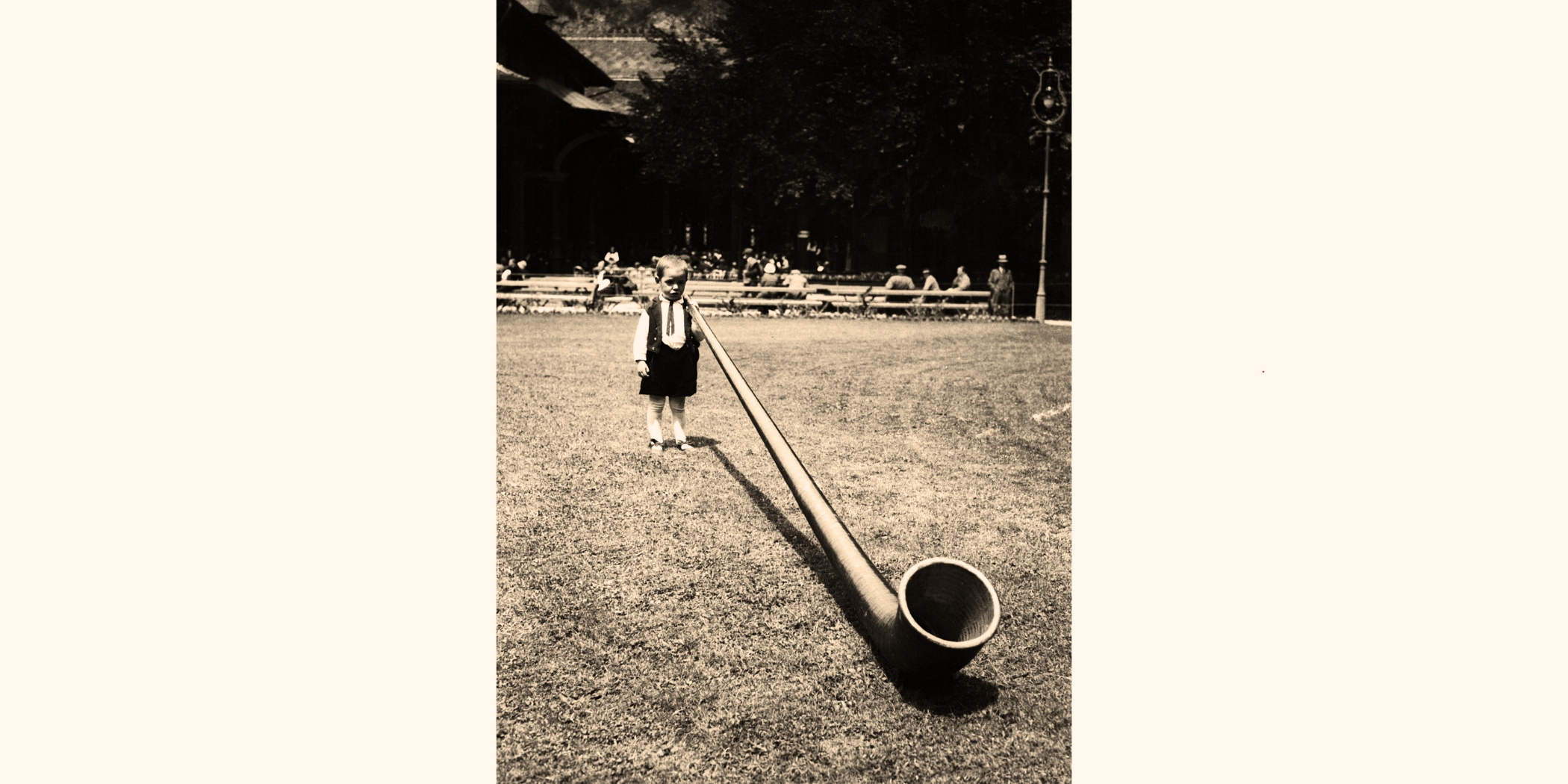
The yodel stands as the precise confession of what has finally escaped concealment, and thus of what we have long kept out of sight.
The yodel: the flickering Adam’s apple. It mirrors a sound we sometimes slip into unintentionally—a small croak, not so much created as emitted, then often, quite forgivably, attempted to mask with a staged cough or a throat-clearing. And this is the point: the yodel must be forgiven. The yodel understands that seizing the rose entails exposing the skin to the thorn. We say ‘she croaked’ rather than declaring she died.
Like all prophetic modes of writing, the yodel dwells on the border between edges—between confinement and the reach inward toward the bird, a creature beating against its own enclosure. The yodel embodies both harm and gentleness in one. It is a young bird, a dying fledgling—a thrush by another name. It is striking that that term should signify both the passerine’s song and a mouth ailment. The yodel is perhaps the family’s most humiliating label.
It is a sound exiled from the center, an exhale trapped on the inhale, belonging to a voice that carries both the dead and the child.
We could turn to numerous volumes to hear the yodel crossing the ridge; among them, a compelling examination of how poets cast their voice or woo the quivering rift that is the yodel can be found in Murat Nemet-Nejat’s translations of Birhan Keskin’s Y’ol (I won’t linger on how closely the title mirrors the very term under discussion.)
You are too mortal for my taste, my dear, too mortal,
while I am a savage, a wild thing—
my speech chanting mercy, granting it freely, whereas yours speaks of justice
revenge.
Must I utter it, my love, say it now:
the sharpshooter I nurtured turned on me,
the snows of Klimanjaro, my love,
the snows of Klimanjaro,
sliding down
Within these translations, one senses the revenge that futility bestows upon the serenade’s longing.
Undoubtedly, the yodel is a stark departure from the familiar; a preposition that becomes a bridge blown apart, a stairway to nowhere that was once a destination, a far cry from that also carries a wry laughter, a croaking death that persists. It remains an exiled sound; an exhale captured on the inhale, tied to a voice that is both of the departed and the young. Consequently, the yodel is forever the voice of the departed child.
*
The farmhand who joined us had abandoned his entire town to take up yodeling with us. Our start wasn’t with yodels but with pages; we read, and at times wrote as well. He received Keskin’s Y’ol, and from that moment his voice opened into yodeling for the first time. Oh, how he sang! In Chinese opera, the cross-dressed role of the dan exists; Chinese theater is rich with its own yodel-like lament—an artful dirge that both whines and pulsates. The farmhand, reading Keskin’s Y’ol, embodied the dan as a white Midwestern man. He dragged the moon down to us, and not a dry eye remained when he finished. We all felt as if we had heard the last thrush in the land—the timbre of a voice that could be heard in the grain itself.
In Kim Gek Lin Short’s China Cowboy, she lingers between the fading frontier myth and the realities of modern logistics, connecting soybeans to the wholesome yet never nourishing American breakfast cereal:
“I begin with inquiry, then I close; something has happened—an event, recent or long past, I cannot recall who. I inhale; there is enough. Fear takes hold. I make vows. In a fresh life I will glow with white heat, I will rise clean. I promise. In this new life I will be ash swept, I will rise light. I grow afraid. Please, in this life to come I will repair this flawed seal of my soul, a bloated, rubbery patch. Please, I am afraid. In this life to come I will—he yanks the nebulizer from my face, a sunk-in space, it stretches. Please, it feels like hell. I promise. In this new life I will.”
The grain, the grain, the grain. From the mouth of a person whose body has become the last unclaimed frontier, the yodel turns into a space that seizes the seized from their own being seized.
*
The yodel, being a fractured sound, carries political weight. It is a nose left gauzed in a wound, a thing of strange wonder and deep shame, an orphaned sound that angles a serenade toward someone who would never hear it.
I have long held that poets must sing frequently if they are to understand how to compose and when to do so.
At a Nowruz gathering not long ago, a friend observed that no Iranian dinner party truly ends without dancing. Likewise, a Chinese family gathering feels incomplete unless it concludes with a yodel.
Revenge…
Throughout history, female-presenting spirits have been more inclined than men to employ poison as a method of harm. Governing the home, the kitchen, and the yard, they also possessed a dark, intimate knowledge: knowledge of the earth itself.
I contend that a revolution demands coordination, ingenuity, and a sensitivity to the body’s subtle energies. It calls for familiarity with pharmakon—the idea that a substance can heal in the correct measure and harm when misused. The oppressed have long wielded the ‘wrong dose’ to attain liberation. In CLR James’s Black Jacobins, the enslaved on a plantation orchestrate a rebellion by means of poison.
The covert character of poison—the manner in which it conceals itself, seeps in, is consumed, the deceit, the administration, revenge masquerading as concern and routine—the hush and secrecy that accompany it—not only render it indefensible but also mark it as grassroots at its core.
Whenever we dispense poison, or distribute minute doses of our mixtures, we sing in tandem. We soothe, we coo in return. The lull and the coo thus serve as a disguise. We present ourselves as indefensible. Those who care for children are destined to seem indefensible, and the sound embedded in that lullaby is the yodel, a voice extending beyond individual borders.
What would a language emerge from the grassroots sound like, especially one that is so intricately cellular?
You know where to locate me,
standing with the fallen to the left of
a blended San Miguel,
at the base of a vast history.
Little weighs more heavily in the gut
than the sway
back and forth
through obsolescence.
I feel blessed,
hidden from the gaze of foes
and of those who would
test me with their sharp tongues.
Always apart from my equals,
I shall dwell within your children
(–Jasmine Gibson, A Beauty Has Come)
Pharmakon. Indeed, Pharmakon itself yodels as well.
From the voice of the person whose body has become the last unclaimed frontier, the yodel turns into a place that seizes the seized from their own being seized.
Guest & host…
The diction of poets who navigate the exchange between guest and ghost, between vengeance and mourning, constitutes tremulous dwellings of the yodel.
My father once told me a tale illustrating a form of ‘Asian humility’—a fellow Taiwanese-Chinese exile in America apologized to my mother’s employer’s husband for bleeding on him. To yodel, one must be willing to abase oneself; there is no shortcut around humility.
Historically, hosting a guest meant mapping a landscape and assuming the duty to shield that guest. Nothing challenged the social order more than failing to protect a guest; indeed, permitting revenge to be enacted upon a guest would redefine the relationship entirely. Host and guest formed a mutual belonging, each to the other, and within that bond lay an unwritten sacred compact.
“There can be no hospitality without one’s sovereignty over the home. The guest becomes the host’s hostage as much as the host yields themselves to the guest’s presence,” as Derrida put it.
In a moment of carelessness, I could slip from this quiet confinement,
perhaps smirk at the jailer,
perhaps start living once more, beside you.
[…]
I am a candle whose flame illuminates a ruin;
should I fall silent, I will unravel a nest
(–Forough Farrokhzad, Let us believe in the beginning of the cold season)
The cry of the one who uncovers the poisoned body—whether the host’s wife or the guest’s child—always rings out as a yodeled lament.
____________________________
The pedestrian by Valerie Hsiung is available from Nightboat Books.