Last week the Third Circuit Court of Appeals—the court responsible for the districts of Delaware, New Jersey, Pennsylvania, and the Virgin Islands—affirmed and reinforced a lower court’s ruling in the ongoing AI and copyright dispute Thomson Reuters v. ROSS Intelligence Inc. Reporting for Courthouse News Service, Jackson Healy notes that the decision holds that works altered with a sufficient “creative spark” can be protected by copyright, and therefore cannot be lawfully used by an AI to build a competing business under current law.
This ruling largely preserves the outcome of the prior decision. A thorough analysis of that initial ruling by Yuanxiao Xu in the Authors Alliance provides a helpful framework for understanding the ruling and its consequences, which I rely on extensively. From my view, the ruling appears to be narrow in scope, addressing a non-generative AI tool, yet the way it treats copyright and the transformation of a work into something original could carry substantial implications for how AI firms source data going forward.
To set the scene first. In 2020, Thomson Reuters sued the AI company ROSS Intelligence, which has since gone out of business, accusing one of its “AI-driven products to augment lawyers’ cognitive abilities” of illegally ripping headnotes—summaries of legal issues at the top of judicial opinions—from Reuters’ Westlaw platform. Critically, ROSS was barred from using Westlaw’s writing directly and instead resorted to a third-party program to access and assemble the information it desired.
ROSS then used this data to construct a competing product, prompting Reuters to sue for copyright infringement. ROSS argued fair use (a defense that has been successful for other AI companies in the past), but in 2025 a judge ruled that ROSS’s use of the headnotes violated copyright law. The judge explained that although Westlaw’s headnotes originate from non-copyrightable judicial opinions, the way they are arranged and curated imparted a “creative spark” sufficient to render the compilation an original work. To quote the judgment, it “still has the minimum ’spark’ of originality.”
ROSS appealed, and the latest ruling in the Third Circuit by U.S. Circuit Judge Tamika Montgomery-Reeves affirmed the lower court’s findings: Westlaw’s headnotes possess a “minimal ‘creative spark,’” and are therefore original. ROSS’s uses, conversely, were “minimally transformative at best” and aimed at delivering a directly competing service. In short, illegal.
Although “this case appears to concern the future of AI legal technology… In truth, this is no more than an ordinary copyright case,” Judge Montgomery-Reeves wrote. The point matters to me because, just as much as these tech companies claim to upend everything with AI and to enjoy extraordinary privileges as a result, the rule of law still applies to curb their actions.
Yet the ruling is a mixed bag, particularly for books and publishing.
Why could this be concerning for other challenges to AI going forward? Xu again notes three effects: “First, it blurs the line between fact and expression… Second, it broadens copyright enforcement to intermediate copies… Third, it conjures up a new market for AI training data.” All of this suggests that the shift from fair to unfair use in text remains open to debate, potentially creating a lane for well-resourced firms to develop works that are original enough to be copyrighted and protected, thereby enabling new pathways for AI to use such material.
One point worth noting is that ROSS Intelligence is far from a heavyweight in the AI landscape. This is among the concerns Xu raises in her Authors Alliance piece: rulings like these may draw boundaries that AI firms must respect, but they might be barely prohibitive for AI giants such as Google, Meta, or Palantir—companies already exploiting vast quantities of books to feed their software.
My rather informal take is that many of these decisions hinge on a sense of what feels novel. This mirrors the backlash against AI outputs, which often hinges on the perception that the results are too smooth or inhuman at core—a sense that the Pope’s reading about algorithms lacking the spark of humanity captures: something essential is missing in AI-produced text and images, even if it’s hard to pin down, it’s often clearly discernible.
That kind of judicial intuition isn’t new in law—recall the famous “I know it when I see it” standard from the Supreme Court’s Jacobellis v. Ohio on obscenity—but it can feel almost capricious or archaic, left to the discretion of a single court. The idea that a case hinges on whether one can discern a “spark of creativity” seems like a legal bar that could be wielded in other contexts, perhaps even reminiscent of witchcraft determinations.
In short, I don’t expect the law to rescue us from an industry that shows no sign of slowing down. Law, inherently, is imprecise, tasked with extracting repeatable judgments from a string of unique cases. It calls to mind Sigfried Giedion’s analysis of slaughterhouses in Mechanization Takes Command: both are procedures designed to adapt mechanical processes to irregular, organically formed bodies so that they exit the system or assembly line in a standardized way, leaving little room for compromise.
And absent regulatory intervention or government action to rein in these firms, the decision falls to individuals or groups to weigh whether to use AI. What are you willing to sacrifice of your own humanity for promised profits or convenience? Is a moment of discomfort, misstep, or confusion so intolerable that it must be erased forever? Can you imagine a portrait of your family as Smurfs while acknowledging that this technology is simultaneously employed in acts such as Israeli genocide, America’s unlawful wars and kidnappings, and intelligence failures that nearly sparked a world crisis?
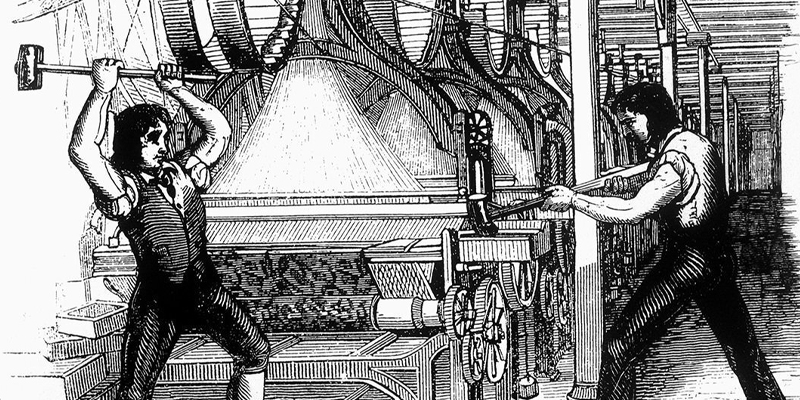
The only viable path forward, as it seems to me, is collective action and resistance. I’ve drawn some inspiration from movements where parents managed to push the nation’s largest school system to ban AI, or from the Summer of Ludd, which celebrates our shared human spark. For someone who wishes to safeguard art and creativity from AI, I worry that each court ruling of this kind acts as a pharmakon—a temporary relief that is weakened by loopholes.
The complete Third Circuit opinion is available here.