
This first appeared in Lit Hub’s Literary History newsletter—sign up here.
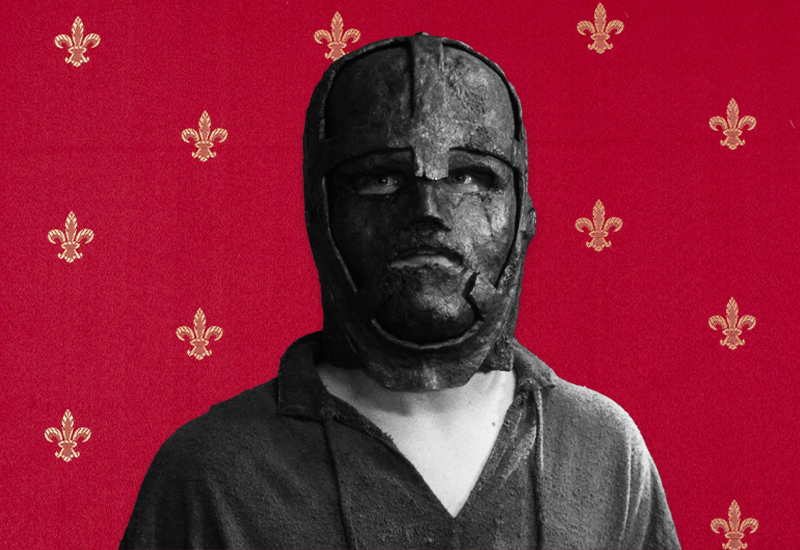
In 1669, during the reign of Louis XIV, a mysterious prisoner was brought into the annals of history; his name was never spoken aloud, and no one could discern his visage, for he perpetually wore a black velvet mask. He spent 34 years confined across four separate dungeons before his death, on November 19, 1703, within the Bastille’s walls.
This true account has ignited the imaginations of countless writers and visual artists across the centuries, most famously Alexandre Dumas. In his 1850 novel The Vicomte of Bragelonne, he imagines that the captive is Louis XIV’s exact twin. The tale also captivated Voltaire, who fretted over the story and promoted the notion that the prisoner was, in fact, Louis XIV’s elder illegitimate brother. It was Voltaire—and subsequently Dumas, following his lead—who cast the mask as iron rather than velvet.
So who was the prisoner, really? It may forever remain a mystery. Despite the concerted efforts of historians and authors, not to mention a well-known 1990s film rooted in Dumas’s narrative that has been described as “locking French history screaming in a dungeon,” the prisoner’s true identity remains unproven. Perhaps that enduring ambiguity only enhances the lure of the legend for future literary exploration.
