
Emma Cline’s Switzy, Francis Fukuyama’s In the Realm of the Last Man, and R.F. Kuang’s Taipei all feature among the best reviewed books of the week.
Brought to you by Book Marks, Lit Hub’s home for book reviews.
*
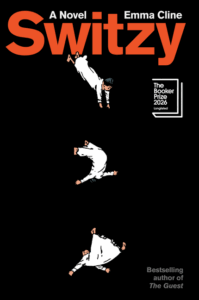
1. Switzy by Emma Cline
(Random House)
5 Rave • 3 Positive • 1 Mixed
“What’s hypnotic about this novel is the illusion that we’re watching a mind decaying even as it engineers its own expiration. Cline manages to pull the dramatic irony increasingly tight without letting us see the strings … She holds out her hand to the essential yearning in every human being, to that desire that persists until the very end.”
–Ron Charles Substack

2. Taipei Story by R.F. Kuang
(William Morrow)
4 Rave • 3 Positive • 1 Mixed • 1 Pan
Read an interview with R.F. Kuang here
“If Kuang’s early books often come across as the product of market research on what a certain type of reader wants in their fantasy fiction, Taipei Story has the authenticity of genuine self-expression.”
–Laura Miller (Slate)

=3. The Pirate Queen by Ariel Lawhon
(Doubleday)
3 Rave • 1 Positive
“Immersive … Through the novel’s engaging format, readers not only come to know Grace as the formidable historic leader, but also as an ambitious girl, passionate woman, and fierce mother.”
–Patricia Smith (Booklist)

=3. The Passing of the Dragon and Other Stories by Ken Liu
(Saga Press)
3 Rave • 1 Positive
Read an excerpt from The Passing of the Dragon here
“Ken Liu’s stories are not just about the future: they are the future … Liu is the kind of writer who can make such topics as viscerally thrilling as a Lee Child action sequence … The more I think about it, the more Liu reminds me oddly of Dostoyevsky … Whatever he writes next, I shall be first in the queue.”
–Stuart Kelly (The Scotsman)

5. The Living Realm by Jordan Tannahill
(Farrar, Straus and Giroux)
2 Rave • 1 Pan
“Slim but astonishing … Those expecting the novel to imitate the raunchy spark of the show will instead encounter a far more elegiac, contemplative work. Tannahill writes with equal beauty about nature and the human body … Extraordinary and sensitive.”
–Christopher Bollen (The New York Times Book Review)
**
Nonfiction

1. Ambivalence by Brian Dillon
(New York Review of Books)
3 Rave • 4 Positive • 1 Mixed
Read an excerpt from Ambivalence here
“Despite the elegance of Dillon’s prose—the book is a page-by-page pleasure—there is a risk of losing the reader. First because the writers he loves are a minority pursuit … So strong is his passion for his way of finding himself in the world, so dedicated is he to be true to his idols, that we long for him to make it. And this book is proof that he did.”
–John Self (The Financial Times)

2. In the Realm of the Last Man: A Memoir by Francis Fukuyama
(Farrar, Straus and Giroux)
5 Positive • 1 Mixed
“the most dramatic passages of his memoir describe Fukuyama’s break with his neoconservative milieu over the war in Iraq … Less…a personal memoir than as an inner monologue of post-cold war liberalism … The memoir is not the apologia of a prophet whose prophecy failed. It is the record of a moment when liberalism learnt to live in the present tense.”
–Ivan Krastev (The Financial Times)

=3. Frenchman Flat: The Rise and Fall of Atomic Bombs by Jon Else
(Belknap)
3 Rave
“Through absorbing, sharp-eyed prose, the book traces the entire history of atomic bombs … The historical and scientific narrative is punctuated by personal stories … Gripping.”
–Eileen Gonzalez (Foreword Reviews)

=3. Tower Hill: A Plantation on the Edge of Rebellion by Alan Taylor
(Random House)
3 Rave
“A rich and compelling new study of the Blow plantation … Reads like a nonfiction version of William Faulkner’s Absalom, Absalom! … A quietly devastating epilogue brings the story of the scarred landscape around Tower Hill up to the present.”
–Richard Kreitner (The New York Times Book Review)

5. Love Machines: How Artificial Intelligence Is Transforming Our Relationships by James Muldoon
(Faber & Faber)
5 Positive
“Existentially chilling … Muldoon warns of the dangers of ‘the synthetic social’, but also even-handedly suggests that the most awkward or wounded among us could benefit from the bots. I think not. The future that Love Machines sketches is a dehumanized hell. I advocate hitting control-alt-delete on the whole business.”
–Sarah Ditum (The Times)