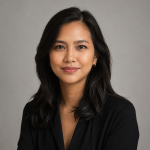
Dr. Sasha Dovzhyk is a Ukrainian writer, journalist and founder of Index: Institute for Documentation and Exchange. Her latest book Apocalypse Baroque: Tales from Ukraine at War will be published in the UK September 24th. She recently participated in Lviv Book Forum, September 11 to 13, in digital partnership with Hay Festival Global.
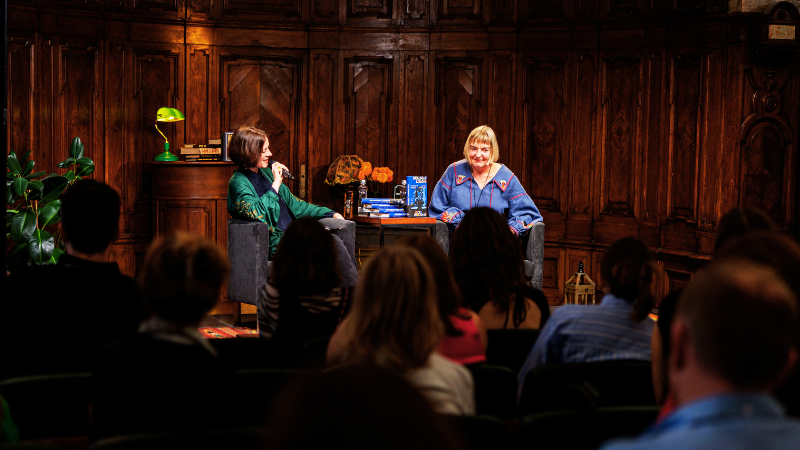
In its fifth year of partnership with Hay Festival Global, Lviv BookForum 2026 brought together writers from across the globe for three days of hybrid conversations exploring memory, displacement, grief and the enduring power of literature. Events from Lviv Book Forum are available to watch free from anywhere in the world on Hay Festival Anytime—sign up here.
*
This list below, of books written by Ukrainians in English or translated from Ukrainian into English, sheds light on what has long been overshadowed by empires seeking Ukraine’s erasure: the country’s rich literary tradition and its tradition of resistance. I have compiled this list when Russia targeted Ukrainian publishing infrastructure with missiles and destroyed more than 13 million books in a month—a third of the country’s annual print run. In this light, it is time to consider carefully why Ukrainian letters pose such a threat to the Russian regime.
From books by canonical Ukrainian authors silenced by the Russian empire to works by contemporary writers who have enlisted in the armed forces, these texts are a guide to the country’s past and present, its literary experiments and diverse cultural geographies. They range across genre and register—fin-de-siècle feminist mythmaking and poetry written in frontline trenches, testimony assembled from a war crimes investigator’s unfinished manuscript and postmodern fiction that watches an empire disintegrate from within. Reading these books is a form of restoring justice for a nation which has so long fought for the right to narrate its stories on its own terms.
*
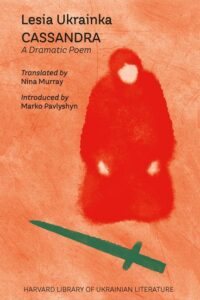
Lesia Ukrainka, Cassandra (HURI Books, 2024), translated by Nina Murray
Lesia Ukrainka is a writer from the turn of the century who engaged with the central Western canon through a feminist and anti‑colonial lens. Her choice to compose in Ukrainian, a language persecuted under the Russian empire, and her decision to voice her nation while it lacked a state have long kept Ukrainka out of full recognition in the global literary sphere. Nina Murray’s fresh rendering of her poetic drama Cassandra invites a contemporary reexamination of the Trojan war myth from the vantage point of a woman condemned to know the truth but never be believed.
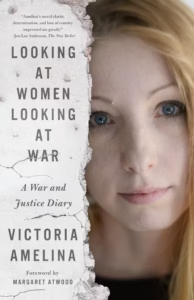
Victoria Amelina, Looking at Women Looking at War (Harper Collins, 2025)
A novelist who became a war-crimes investigator, Victoria Amelina journeyed across a war‑torn Ukraine, photographing cratered playgrounds and collecting testimonies from survivors, standing shoulder to shoulder with the women she called sisters: lawyers, soldiers, journalists, and museum workers striving for justice. She did not live to complete her narrative—killed by a Russian missile strike in 2023, two‑thirds through the manuscript of Looking at Women Looking at War. Compiled by close friends and family, the book’s elisions and vacant pages become a form of testimony: a verdict for her killers and a lasting voice for Amelina. The work earned the George Orwell Prize for Political Writing and the Moore Prize for Human Rights Writing.
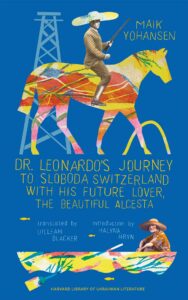
Maik Yohansen, Dr. Leonardo’s Journey to Sloboda Switzerland with His Future Lover, the Beautiful Alcesta, translated by Uilleam Blacker (HURI Books, 2026)
Maik Yohansen belongs to Ukraine’s so-called Executed Renaissance—the generation of cultural figures purged by the Soviet regime in the early 1930s. In 1937, he was arrested and executed alongside thousands of Ukrainian intellectuals. His playful modernist novel follows an Italian doctor and his “future lover” as they traverse the northeast of Ukraine, with the landscape taking center stage while human figures appear as modernist puppets. This landscape‑centered novel resonates today as the lands it traverses remain under threat from mining, explosive contamination and ongoing war, where the terrain itself stands as a protagonist.
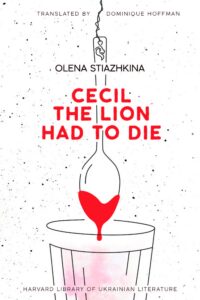
Olena Stiazhkina, Cecil the Lion Had to Die (HURI Books, 2024), translated by Dominique Hoffman
In 2014, Olena Stiazhkina, a writer and history professor at Donetsk National University, was compelled to flee her city as Russian occupation pressed in. Donetsk appears as a recurring anchor in her fiction and activism, earning her the Vasyl Stus Prize in 2026. Stiazhkina’s eastern Ukraine harbors multiplicities: her work challenges the reduce‑to‑a‑lump view of the region as a coal‑black, monotone space and instead highlights its intricate multi‑ethnic past—from Crimean Greeks to German settlers, and even Belgian and Welsh capital—before it became a Soviet industrial flagship with forced population shifts. Her Cecil the Lion Had to Die weaves together war, the east, and history, oscillating between Russian and Ukrainian and signaling the charged linguistic realities of eastern Ukrainian society.
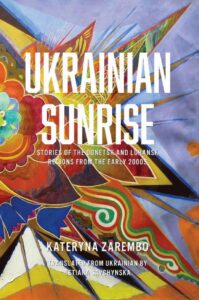
Kateryna Zarembo, Ukrainian Sunrise: Stories of the Donetsk and Luhansk Regions from the Early 2000s, trans. Tetiana Savchynska (ASP, 2024)
Kateryna Zarembo’s volume acts as a nonfiction counterpart to Stiazhkina’s novels, turning the lens toward the Donetsk and Luhansk regions that have long been subjected to mythmaking and erasure. Zarembo recovers the patriotic communities, writers, and football ultras who sustained Ukrainian identity in the east from the early 2000s up to 2014. A mother of four with a PhD in Political Science, Zarembo completed this work, then joined the volunteer Hospitallers battalion as a combat medic, and later enlisted in the Armed Forces—another educated Ukrainian figure who chose to protect the country with weapons rather than words.
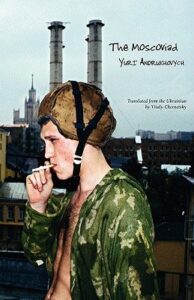
Yuri Andrukhovych, The Moscoviad, trans. Vitaly Chernetsky
Originally issued in 1993, The Moscoviad presents Moscow from the perspective of a colonized subject rather than a common Russian gaze or an enraptured observer. Set in 1991, the story begins inside the literary dormitory of Moscow State University and follows a Ukrainian poet haunted by KGB officers as the empire unravels on every level: in the plot, in its fragmented form, and in language itself, where Ukrainian, Russian, German, and crude slang mix. This postmodern, postcolonial, darkly humorous work captures the last gasp of the Soviet order from the vantage point of one of its subjugated peoples.
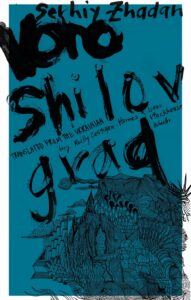
Serhiy Zhadan, Voroshilovgrad (Deep Vellum, 2016), translated by Isaac Wheeler and Reilly Costigan-Humes
Serhiy Zhadan’s Voroshilovgrad (2010) unfolds in a city that has vanished from maps yet lingers in the collective memory of its inhabitants. The protagonist Herman—an uprooted loser from a post‑Soviet generation—returns home to navigate a landmined memory landscape and to take responsibility for his homeland and its people. Though written before the current conflict, the novel reads as prophetic: it brims with violence, militarized attire, and men defending their territory from invaders. Immersed in the myths and light of the eastern steppe, it marks Ukraine’s eastern shift in identity. Since 2014, Luhansk/Voroshilovgrad has been occupied by Russia.
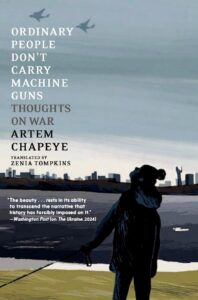
Artem Chapeye, Ordinary People Don’t Carry Machine Guns, trans. Zenia Tompkins
Artem Chapeye, who describes himself as a pacifist and leading male feminist, enlisted the day after February 24, 2022. Ordinary People Don’t Carry Machine Guns chronicles his memoir and the first three years of Russia’s full‑scale invasion. Throughout, the conflict, fear, grief and guilt it triggers are named simply as “gloom,” a term that encompasses both the fighting and the psychological toll. Chapeye’s exploration does not shy away from the tension between a progressive left intellect and the necessity of arming himself to defend his society and its values.
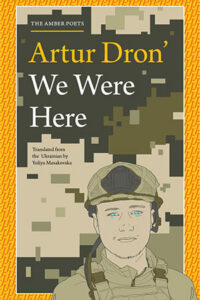
Artur Dron, We Were Here (Jantar, 2024), translated by Yuliya Musakovska
Ukrainian letters retain a potent poetic tradition, in part because short forms—such as poetry—are less dependent on heavy infrastructure and tangible resources: a poem can be composed in a trench, drafted in a labor camp, or whispered across resistance networks. The collection We Were Here was largely written on the frontlines, where the twenty‑four‑year‑old poet Artur Dron has served since 2022. Illustrated with children’s drawings sent to soldiers—an uplifting feature, as Dron notes—this volume asks why poetry matters in times of war when it cannot save everyone. Its answer lies in the work itself: beautifully rendered into English by the bilingual poet Yuliya Musakovska, it bears witness and declares that Ukrainian literature now holds more space for the silences between words than for the words themselves.
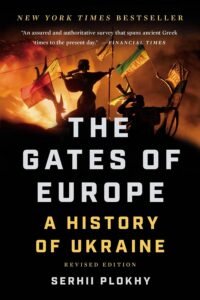
Serhii Plokhy, The Gates of Europe: A History of Ukraine (2021)
This volume by one of the leading historians of Ukraine offers a thorough, thought‑provoking guide to Ukraine’s long history and its pivotal position at history’s crossroads. Straddling Central Europe, Russia, and the Black Sea, Ukraine has repeatedly served as the strategic doorway through which empires—Roman, Ottoman, Nazi, and Soviet—sought to advance. Plokhy frames its history through the figures who attempted to seize or defend it, from Vikings and Cossacks to the architects of modern Ukrainian national identity.
__________________________________

Dr Sasha Dovzhyk is a Ukrainian writer, journalist and founder of Index: Institute for Documentation and Exchange. Her latest book ‘Apocalypse Baroque: Tales from Ukraine at War’ will be published in UK on 24 September 2026. She recently participated in Lviv Book Forum, 11-13 September 2026, in digital partnership with Hay Festival Global.
In its fifth year of partnership with Hay Festival Global, Lviv BookForum 2026 brought together writers from across the globe for three days of hybrid conversations exploring memory, displacement, grief and the enduring power of literature. Events from Lviv Book Forum are available to watch free from anywhere in the world on Hay Festival Anytime – sign up here.