
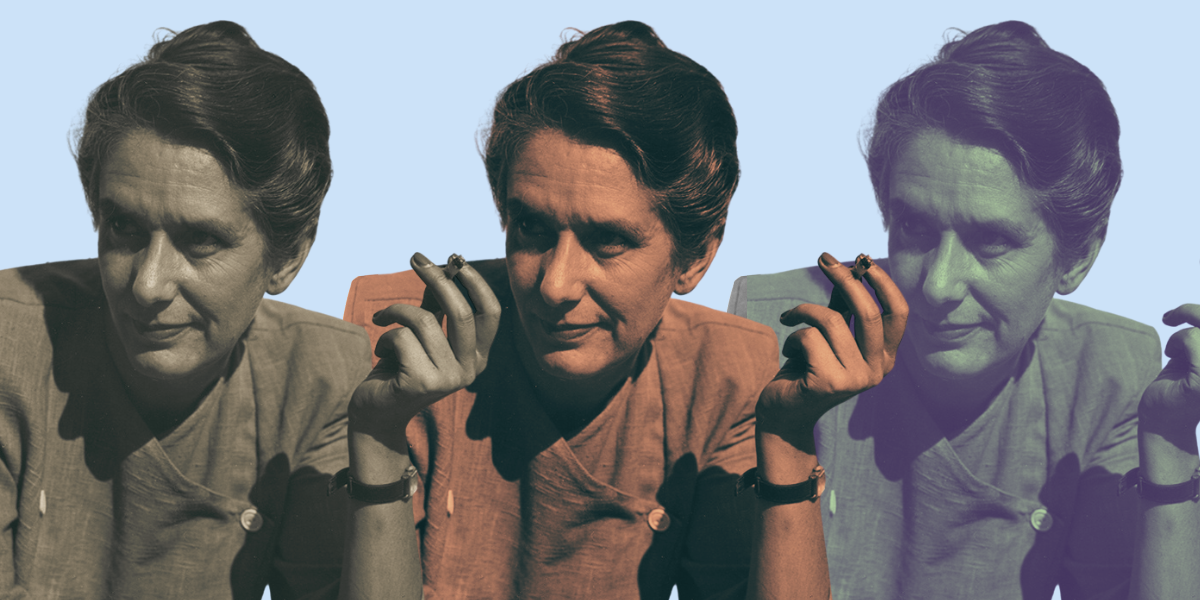
Erika Mann sped through the night toward the fifty-two men who had become the world’s most wanted. It was mid-August 1945, and she was only a few weeks from turning forty. Strands of gray were already appearing in her short brown hair. Her hands, gloved, held the steering wheel steady, while she lifted them periodically to spark cigarette after cigarette, smoking them from the corner of her mouth. She was slender, but not frail, dressed in her usual practical attire of trousers and flat shoes. As darkness swallowed the road ahead, her dark eyes bore an almost singular, unwavering focus.
The day before, in Paris, Mann had been tasked by London’s Evening Standard to craft a piece that would begin to make sense of more than a decade of collective suffering. Erika, the eldest daughter of Nobel laureate Thomas Mann, was a writer and performer of uncommon dedication. She had staged an anti-Nazi cabaret in Munich in 1933 and had been broadcasting for the BBC since 1940. From 1943 onward she aligned with the Allied forces, traveling with them as they pushed toward Germany. Even before that, she had established herself as a veteran conflict reporter, having gone to Spain in 1938 to cover the civil war for the New York–based German-language newspaper Neue Volks-Zeitung.
Would she be able to face the monsters who had shattered her family and torn apart her country?
Her qualifications for the assignment extended beyond formal credentials. Erika had lived in exile with her family since 1933, when they fled Munich for Zurich after Hitler’s ascent to chancellorship. The Manns were declared enemies of the state and stripped of German citizenship in 1935. Now she stood in a position to confront—and reveal—the men she had spent years denouncing.
Under the blue pre-dawn light, she could discern a chain of factories, blast furnaces, and workers’ quarters. She had crossed into Luxembourg. As the sun rose, a wave of unease washed over her. She loved driving in darkness, solitary at the wheel with her belongings around her, a sense of “extreme cosiness and security.” Yet the road soon filled with American jeeps and lorries. The air grew warmer, but she began to tremble with doubts about the mission. Could she face the monsters who had ruined her family and her homeland?
Her destination was Mondorf-les-Bains, a Luxembourg spa town where the surviving Nazi leaders had been imprisoned in an old hotel. The arduous task of delivering justice to the authors of history’s most atrocious chapters had begun. The German-born, liberal, cosmopolitan Erika Mann—whose world, country, and beliefs had been shattered by these men—would be among a small cadre of journalists and the sole woman to enter the camp where they were kept. She would require every ounce of personal nerve and professional tenacity to gain access to the imprisoned figures. The man in charge of the camp, Colonel Burton C. Andrus of the US Army, was a flashy dresser with a neatly trimmed mustache and clipped speech, famed for savoring his position. Dissatisfied with her paperwork, he sent her on a further 300-mile round trip to procure fresh documents in Frankfurt before she could begin her assignment.
The Palace Hotel, built in 1926 as part of a wider effort to revive Mondorf’s former grandeur, had been repurposed into a military facility. The new spa complex stood four stories tall with two wings jutting at angles, balconies at every window, and a terrace overlooking flower beds. Before the war it had served as a refuge for those fleeing the Nazis, and during the conflict it hosted Nazis seeking rest and recreation. Now, simple military cots occupied the rooms, and the windows were fortified with fiberglass and iron bars. Machine-gun towers watched over the grounds, searchlights dotted the fortifications, and barbed wire rose to fifteen feet. Erika circled the grounds, hoping for a glimpse of its inhabitants, but sheets of canvas hung from trees to obscure sightlines, and live current wires rested atop the high fence.
The former Palace Hotel bore a new designation: Central Continental Prisoner of War Enclosure number 32, or, more memorably, “Camp Ashcan”—a counterpart to the British-run “Camp Dustbin” in Frankfurt, where Nazi scientists, technicians, and administrators were detained. Throughout the summer of 1945, its rooms filled with names known across the globe. In Erika’s unpublished memoir, Alien Homeland, she wrote, “Germany’s great fifty-two were housed here, the core group of top Nazi war criminals from which the Nuremberg prosecutions would select defendants.”
Although debate still swirled over exactly who should be on the docket at Nuremberg, certain figures were expected to appear. Wilhelm Keitel and Karl Dönitz were, respectively, the heads of the Wehrmacht and the Navy high command. Hans Frank governed occupied Poland. Fritz Sauckel and Robert Ley played major roles in Nazi forced labor, Sauckel as general plenipotentiary for Arbeitseinsatz and Ley as head of the Deutsche Arbeitsfront (German Labor Front). Arthur Seyss-Inquart was the Reichskommissar of the occupied Netherlands, and Joachim von Ribbentrop was Nazi Germany’s foreign minister. The prisoner of highest profile, “prisoner number one,” was Hermann Göring.
To many observers outside Germany, Göring was chiefly known as the commander of the Luftwaffe—the title Reichsmarschall had been created for him—but his role in Nazi criminality ran far deeper. Since 1938 he oversaw Nazi “Jewish policy,” and in July 1941, acting as Hitler’s deputy, he directed Reinhard Heydrich to implement the “Final Solution to the Jewish Question”—the plan to eradicate Jews across Europe.
Erika had trained as an actress in Berlin, performing in Munich, Hamburg, and Bremen. Her earlier triumph with the anti-Nazi cabaret Die Pfeffermühle had driven her from Germany to Switzerland in 1933. Now she would need to refine her acting to mask the anger she carried toward men who had driven her country into such a ruin:
No theatrical role I had ever taken on felt as treacherous as that of the aloof, placid American lady journalist I was about to become… Would I be allowed to speak with them? To the “monstrous prisoners” in the Palace?…Should I even seek such interviews? Of course I would; I remained a reporter. Yet I fervently hoped my candidacy would be rejected. How could I possibly converse with those beings? How could I ask questions, coolly and civilly, when the claims were so violent and extreme as to seem inadequate?… If I were forced (as I thought) to listen in silence, could I keep my face from betraying the loathing that rose within me?
She was escorted into Ashcan by Andrus and a lieutenant colonel from the American guard. “No spookier adventure could be imagined,” she later wrote to her mother, Katia Mann, describing the journey through the double stockade and into the camp’s hotel. The phrasing may have carried a touch of levity, but the horror she faced was not merely literary; it would stay with her for life.
Andrus recounted stories as he guided her toward the prisoners’ living quarter. One man had claimed to be a regent and therefore required a necktie, an article of clothing neither rank nor status could grant him—necks ties, like many things, were forbidden to the inmates. For many who reached Ashcan, suicide appeared to be the only escape; Hitler, Goebbels, and Himmler had already chosen that path, leaving a grim precedent. Razor blades were taped to soles, cyanide sewn into clothes, and, in Göring’s case, even hidden inside a tin of Nescafé. Hans Frank, dubbed “the Butcher of Poland” for overseeing as many as four million murders, had inflicted four major wounds on himself—throat, arm, wrist, and stomach—yet survived, “allergic to suicide,” Erika noted dryly. A master of death, Frank had failed to finish the job personally.
Erika first glimpsed the top Nazis through a half-open door to their living room. She watched nearly two dozen men, reading, writing, or idly occupying themselves. They were quiet but with an electric tension. Dönitz and Walter Warlimont wrote feverishly; Ley, the former head of the German Labor Front, drafted memoirs—perhaps urgently, given his near-certain arrival at Nuremberg. Others drafted letters to President Truman and General Eisenhower protesting the supposed cruelty of their fate. Stripped of rank and insignia, they wore plain uniforms, civilian clothes, or fatigues labeled PW (prisoner of war). A five-o’clock shadow was common, and shoelaces were scarce—both neckties and shoes were easy targets for the prisoners to repurpose.
Accompanied by guards, Erika moved on toward the bedrooms, where she found more freedom to exchange glances with the inmates. Frank and Ribbentrop shared the first room Erika came to. Frank, apparently having abandoned his suicide bid, claimed to have had a number of prophetic experiences and to be converting to Catholicism. “The Butcher of Poland was reading the Bible to the ex–champagne salesman,” Erika would report in her first Evening Standard dispatch. To Erika, Ashcan resembled more a veritable insane asylum than a prison. In a letter to her mother she called the experience a “horror film,” noting with chilling understatement how it felt to visit the “spectacular inmates of the ‘big house.’”
When Erika confronted Hermann Göring, he was breakfasting in bed, a sight that sharpened her perception. He met her gaze silently, as did the others who noticed her. Göring received all his meals in bed after a protracted withdrawal from an opioid dependency—morphine and then codeine—that had lasted for more than twenty years. He had suffered a heart attack during withdrawal and had been granted a proper mattress instead of a military cot.
The Allied authorities—ranging from the camp’s administrators to the prosecutors shaping the Nuremberg case—were intent on keeping him healthy enough for trial. In her Liberty magazine piece, Erika detailed Göring’s addiction, as well as the fact that after losing about thirty pounds he was in better physical condition than he had been in years. Like the other prisoners, he received a modest monthly ration of tobacco, soap, toothpaste, and matches.
When rations came, most inmates acted “like children at Christmas,” but Göring groused: “My dog ate better.” “Your dog,” the waitstaff replied, “ate better than the German people.” Erika observed a disturbing aesthetic to his appearance as well: “His sunburned skin seems too wide for his frame, and his greenish eyes—normally protruding—now bulge, as if they were carp.”
She also noted his insistence on superiority and his preference for a certain display, insisting on wearing his hat during meals to assert his presence, a request not granted because a hat could not be used to take one’s own life as a necktie could. He was not the only one who perceived Göring as the preeminent figure; the first psychiatric examination of Mondorf’s prisoners, Major Douglas Kelley of the US Army Medical Corps, described Göring as an “acute narcissist,” although deemed sane enough to stand trial.
On October 20, 1943 the United Nations War Crimes Commission was established in London.
Erika’s visit occurred as the men were being readied for transfer to Nuremberg, scheduled for August 12. Her Evening Standard piece ran the next day. She was explicitly forbidden from interviewing the incarcerated men, who “had proven only too eager to plead their cases without a jury for publication.”
Nevertheless, she recalled in the draft of her Evening Standard article that Göring studied her with curiosity when their eyes met. Although the American authorities did not grant her permission to speak with the prisoners, she asked that the interrogators convey her identity after she left. The reports she received were enough to secure mention in both her Liberty article and in a letter to her mother. Her appetite for personal notoriety among the Nazis and Göring’s continued self-delusion is clearly evident:
Ley cried “Assez!” and covered his face with his hands; Rosenberg muttered “Pfui Diable!”; Streicher lamented “Du Lieber Gott; imagine that a woman has been in my room!” Göring, most excited, mused that if only he had introduced himself he could have explained everything; and, had he controlled the Mann case, he would have handled it differently. Surely a man of Thomas Mann’s stature could have adapted to the Third Reich.
What Erika did not include in her piece, nor in the letter to her mother, was that Streicher—famed for his looser view of pornography—saw her and sneered: “Ha! So you’ve come to gaze at all the wild beasts in the zoo!” and then exposed himself. Erika, clothed in suit and tie, remained unfazed. She flicked ash from her cigarillo, turned on her heel, and moved on to the next room.
As she departed Ashcan, the prisoners loaded their meager belongings for the next stage of their fate. Thirty-seven were bound for the Dulag Luft interrogation camp northwest of Frankfurt, while fifteen were destined for Nuremberg. Erika watched the jeep-escorted convoy roll toward the airport and noted some of the fifteen prisoners wearing gaudy hats adorned with Tirolian feathers. The last time they had reached Nuremberg, they had appeared in full Nazi regalia and enjoyed grand showmanship; now they faced an uncertain return to their homeland.
From Mondorf, Erika traveled to London, where critical debates about the nature and scope of the forthcoming prosecution were reaching a crucial point after years of legal and diplomatic wrangling. A trial, although not guaranteed, had become a real possibility. As early as January 1942, the Free French government and eight other exile governments had issued a joint appeal for war-crimes prosecutions in London, but the British and Americans had not yet offered explicit support. While the Soviets favored a postwar legal process, Stalin at the Tehran Conference had even proposed mass execution for tens of thousands of German officers. The pivotal turning point came a little earlier, at the Moscow Conference in October 1943, when Franklin D. Roosevelt, Winston Churchill, Joseph Stalin, and Chinese foreign minister T. V. Soong issued a joint declaration condemning German atrocities and calling for accountability in liberated countries.
On October 20, 1943 the United Nations War Crimes Commission was established in London.
That London declaration marked a step toward accountability within an international framework, but support for prosecuting war crimes under international auspices differed from the idea of prosecuting men under the laws of liberated nations. Although the United States quickly embraced an international tribunal, Britain balked for longer. By the Yalta Conference in February 1945, Churchill still argued that the Big Three should compile a list of German leaders to be shot on capture, arguing that their guilt was so overwhelming as to lie outside ordinary judicial processes.
What finally tipped the balance was a preemptive move by the Americans. When Soviet forces reached Berlin in May 1945, newly elected U.S. President Harry S. Truman unilaterally announced plans for an international military tribunal and appointed Justice Robert H. Jackson to head the prosecution, effectively taking the initiative from the Soviets. “We must bind up the wounds of a suffering world,” declared Truman, “and fashion a lasting peace—peace grounded in justice and the rule of law.” Instead of exacting a blanket vengeance, the Allies hoped to build a durable peace by extending criminal law to the international arena and by administering punishment accordingly. Britain joined the initiative, agreeing to a joint decision by the four Allies on the prosecution.
It wasn’t until late June 1945 that the London Conference brought the four powers together. Erika met and interviewed Lord Wright, then chair of the United Nations War Crimes Commission. He explained that the commission acted as a kind of clearinghouse for war-crimes cases, providing guidance, coordination, and classification of suspects into national and “major” criminals during the preceding year and a half.
Erika never returned to Mondorf, and the Palace Hotel where she had come so close to the Nazi war criminals disappeared in 1988.
The conference signaled the final, decision-making phase of an ambitious bid to secure justice for victims and to establish a framework for how nations would conduct themselves in wartime. The decision was to prosecute before an international military tribunal. Numerous questions remained, from procedural matters—adversarial versus inquisitorial formats, whether judges should wear robes, wigs, or uniforms—to the core charge questions themselves.
More provocatively: which crimes would be charged? Jackson sought to anchor the case in existing treaties, including the 1928 Kellogg–Briand Pact and the Geneva Conventions. Meanwhile, legal theorist Hersch Lauterpacht championed the concept of “crimes against humanity.” To demonstrate the case’s basis in prewar law, prosecutors would lean on conventions, pacts, and treaties, though the unprecedented scale of Nazi atrocities necessarily demanded some novel framing. Debates about the legal foundations of the trial—between precedent and innovation—are evident both inside and beyond the prosecution teams.
Erika recorded all of this in her Liberty article. The American plan to “hold the trials at Nuremberg, shrine of Nazism” had been accepted by Britain and France, though the Russians preferred trying major criminals in Soviet-occupied territory. Courtroom procedure would lean toward British practice, and the way indictments were structured would align with American practice rather than Soviet, where the indictment plus evidence were laid out for consideration in court.
Even though the number of defendants initially appeared modest—fifteen to forty in total—the indictments would reach beyond individuals to cover six organizations, including the General Staff, the Nazi Party leadership, and the Schutzstaffel (SS). With nearly two million members, the SS’s inclusion carried far-reaching implications for accountability. For Erika, this approach offered a means to offset the relatively small number of personal indictments and to demonstrate the broader complicity of the German people. The London Charter—signed on August 8, just as Erika arrived—enshrined Lauterpacht’s “crimes against humanity” concept and asserted that actions taken under orders from a superior could still incur responsibility.
From London, Erika hurried back across the continent in her aging car—affectionately nicknamed Libby, the liberated one—racing from Munich to Vienna and onward to Czechoslovakia, often too preoccupied to pen home to her American parents.
Although she had hoped to return to the United States for a major lecture tour, illness and overwork had cost her her voice. A new plan began to take shape: “I may cover the Nuremberg trials, and then return home.” While she voiced it only as a tentative prospect, she had already resolved to report from Nuremberg in any way possible. The trial, she wrote, was “immeasurably important to the future of mankind.”
Erika never returned to Mondorf, and the Palace Hotel—the very place where she had drawn so near to those Nazi war criminals—was razed in 1988. The spa that now occupies the site markets its history back to the 1840s, but it scarcely mentions Göring, Ribbentrop, Frank, or the others who once crowded its rooms.
__________________________________
From The Nuremberg Women. Used with the permission of the publisher, St. Martin’s Press. Copyright © 2026 by Natalie Livingstone
