
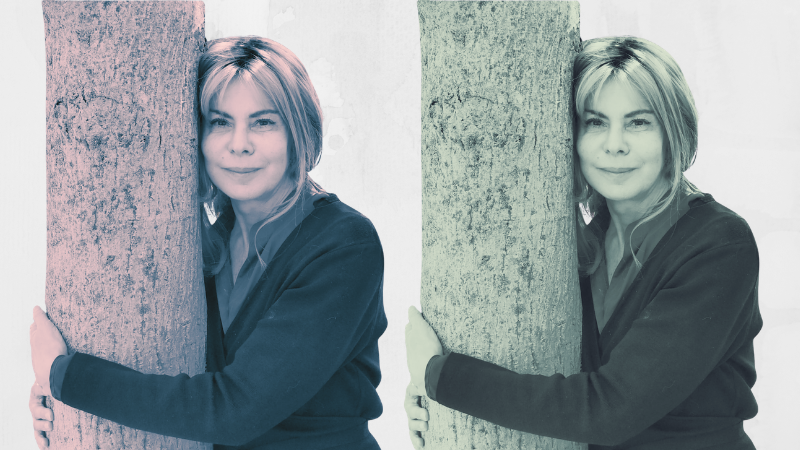
“In my poetry,” she stated, “the emphasis has always been on tangible specifics; in simpler terms, I think I fell for reality. When our curiosity about the world is engaged, our concern for ourselves tends to recede.” Rome-born Antonella Anedda, whose roots trace back through generations in Sardinia, demonstrates the results and artistic potential of this frank and impassioned relationship with reality in the bilingual collection of her selected works, Emerging from the Winter Sea, published by FSG in August 2026.
The release of this lush compendium gathers eight of her volumes, spanning from Winter Residences (1992) to Geographies (prose) (2021). It arrives at a moment when poetry needs air to help readers breathe more freely once they have engaged with it. Dismissing a single, imaginary lyrical voice, her poetry favors the beauty of everyday detail, suggesting that truth emerges from ordinary scenes and reveals complexity rather than simple lines. From political matters and environmental concerns to inquiries about the self, Anedda guides us toward multiple vantage points, letting language escape rigid, binary framing.
“If I wrote, it’s with concern because I worry about life—the happy people caught in the shadows of evening that suddenly fall upon them as night closes in.”
Anedda’s remarkable gift lies in shifting perspectives by narrating angles within a single story that have yet to be voiced. She frequently constructs a dialogue among the poem’s components and the reader, and her juxtapositions elevate the mundane to something more expansive, polyphonic, and newly imagined. Her poem “September 11, 2001” exemplifies her method of expanding reality. Alluding to the attack only in the title, Anedda notes a handful of scenes that reveal the effects, patterns, and tasks of an illustrator, the men pursuing martyrdom, and even the creatures—earthworms, gnats, snails—tending the soil. She herself kneels, inviting us to a quiet space as we contemplate an alternate, underlying narrative.
*
“September—the calendar speaks, half devoured by drawings of insects on its pages. Almost October looms ahead, foreshadowed by the snail shells laid out one for each day to calm fear through their slow motion.”
“Praise these earthly creatures, the brief flight, the patient hand that draws: against the flames, against the celestial sky of paradise.”
“Below, in the vegetable garden, the luminous architecture of earthworms, a veil of ants beneath the apple tree. I kneel to the mud, to the gnats, to the snail, to the effort with which it climbs my fingers.”
Anedda’s technique of capturing moments from various linguistic or interpretive angles allows everyday elements of life to gain space within poetry, democratizing their presence.
“The things I name in poetry are not noble: they lie beneath the palate, awake only to warmth.”
In the same verse, she adds:
“It isn’t music you mean, but a thunderous clatter of dishes, hail beating against the wall.”
Anedda resists explaining why past narrations have been dominated by largely male voices. She perceives oppression in many forms—from poverty to war—and she makes room for other ways of telling. Her ability to construct a deeper frame of reference grows as she lets the world speak. She invites readers to hear additional voices—those of nature, soldiers, daughters, slaves, the dead, meteorological reports—constants that both endure and shift over time.
“Autumn glows in a corner and the word seems to form at its own pace: in clots, in gaps, in flashes, across centuries.”
Her language draws from ancient tongues, regional dialects, extinct languages and contemporary speech alike.
“The word splits as wood—crackling—on one side half-burning, on the other half abandoned.”
Anedda accepts a composite language for modern poetry, albeit with a wink of irony.
“I was thinking of larger words, powerful enough to shake every sound from the shrub I heard alive in the throat: a fervor that would have recognized in things a spark of wisdom.”
For English readers, whose cultural histories have often elevated the individual, Anedda’s more collective reading of identity rejects rigid social definitions. “What’s in a name? Nothing. A sound that attracts a body, a bell that ties you to it. To receive a name is the first sign that we fall under others’ control.” She embraces fluidity and change. Writing poetry that grapples with violence does not mean the poet experiences it firsthand.
“Turning our heads here, we think: while down there, violence happens to those who are pursued for real.”
Thus, the way in which environment, family, war, memory, and art are written emerges from a natural concern with narrative. She suggests that much of how we read is shaped by our beliefs, and she invites consideration of how much we truly can know.
“We read history; we imagine the meaning of a siege. Pots burn in the dark, filled with wind and sand. How else would we describe the swirl of hunger that spins within the void alongside other ghosts?”
The traces of conflict recur throughout her books, woven into both life and death.
“News of the latest massacre arrives this evening just as you have loaded the laundry and drawn the bedcovers for sleep. On the TV screen, the room’s only light reveals dead faces, waking dead, flashes of explosions, naked bodies, and, amid the rubble, a dog.”
“Eight a.m.—we descend by the elevator, unaware of the storms along the coast, while corpses already lie stiff in oilcloth and jute.”
For those of us who do not face actual bombardments, the poem asks unsettling questions about the enduring effects of war across eras.
—“You think avoiding punishment absolves you of guilt, yet you are culpable. The air itself trembles with screams that cling to the walls.”
—“What makes the cemetery of a bombed city a cemetery? What is the difference between the living and the dead, what memory of wind and light—sea light—from the Pisan frescoes?”
She deflates heroic narratives.
“…dust thrown to confuse the verdict: we are not saved, we do not save, except through a quiet act of minimal light.”
As Anedda’s translator, the author’s mindset and some of her bravery became part of my own life during the lengthy process such a project demands. Rendering something intricate and alive—striving to avoid invention while staying true to her language in another tongue—consumed my thoughts. Like a researcher in a lab, I felt I was handling energies with the potential to transform a person. I could not let them slip away. Translation can be approached in many ways: beyond word-for-word choices and the possibility of error, there is the question of whether to shape the work for a more contemporary sensibility or to adapt images to fit English readers with different frames of reference. My central challenge was to move closer to her lexicon and her vision, rather than smoothing the poems into a version that would be easier to read in English.
I have spent nearly five decades living as a writer in Italy, bending when necessary toward that direction. For authors coming from literary traditions with relatively shorter histories, Anedda’s mastery of language and her awareness of how language can die, how we forget its power to define and defend truths, provided the driving energy behind my translations. Her poetry speaks from a longue durée of poetry—its insistence on renewal, its entrances and exits into community, its gift for bearing witness and inventing, and its beauty in connecting people.
______________________________
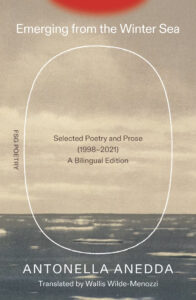
Emerging from the Winter Sea by Antonella Anedda, translated by Wallis Wilde-Menozzi, is available from Farrar, Straus and Giroux.