
My students aren’t fans of Hemingway. They recoil at his misogyny. They balk at the bulls, the blood, and the alcohol that saturate his pages. They detest the Papa persona.
These students aren’t alone in their view. Over the past four decades, Hemingway has slipped from scholarly grace. Beyond the handful of contributors to The Hemingway Review, most academics publish little on the author. And when they do teach his work, they typically confine themselves to In Our Time (1925) or The Sun Also Rises (1926). In serious literary study, Hemingway often seems beside the point.
On the surface, the 100th anniversary of The Sun Also Rises (1926) appears unlikely to reverse this stance or spark casual readers to seek out the Nobel laureate. With only a few notable exceptions, students, instructors, and the literati show scant interest in the milestone. (The centennial surrounding The Great Gatsby receives far more fanfare in comparison.) Yet I regard this moment as meaningful: not to champion Hemingway, but to ask what the prevailing critique of his work may have missed. Despite his flaws, Hemingway was unusually alert to the politics of national belonging and to the jolts of shifting gender roles. His corpus occupies a more unconventional niche in American literary history than many are ready to admit, and revisiting The Sun Also Rises brings some of his idiosyncrasies into sharper focus.
Jake’s troubled masculinity has everything to do with his sense of dislocation, with the difference life abroad inevitably entails.
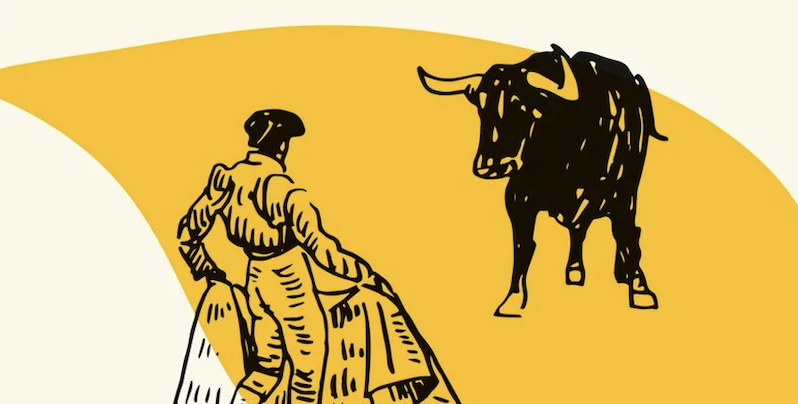
This overtly masculine text—think springtime in Pamplona, rivers of wine—keeps its eye on masculinity from the first page. Jake Barnes, the first‑person narrator, bears a war wound that left him impotent. Unable to consummate his relationship with Lady Brett Ashley, the woman he loves, Jake grows insecure about his own gender. He admires Brett’s short haircut yet soon notices her “curves.” He reacts with hostility toward a group of gay men in Paris, while he also seems drawn to Pedro Romero—the dashing matador with whom Brett has a brief affair. He forms close bonds with his friend Bill Girton and even indulges in jokes about the gay Civil War. When Jake gazes into the mirror and thinks “I looked strange to myself,” readers may sense, as Mikaella Clements noted in a 2018 Lit Hub essay, that this Hemingway figure reads as “distinctly queer.”
That queerness must be read in light of Jake’s expatriation as a central, unspoken lesson of the novel. Jake tries to persuade Robert Cohn that “going to another country doesn’t make any difference…You can’t get away from yourself by moving from one place to another,” yet the book advances an alternate argument. Jake’s unsettled masculinity is tied to his estrangement, to the new forms of difference that come with living abroad. The Americans in Paris hope to discover themselves there, but the move severs their ties to their native ground and leaves their identities in question. When Bill Gorton answers Cohn’s question, “Where are the foreigners?” with the claim “We are the foreigners,” he articulates the core problem: Americans living in Paris, far from home, question who they are and what they are becoming.
In Exile’s Return, the famed account of American writers in the 1920s, literary critic Malcolm Cowley argued that Jake’s generation “was lost because it tried to live in exile.” Yet a parallel argument arises in The Sun Also Rises with a sexual twist when Bill sardonically catalogs the consequences of expatriate life for the American male. “You know what’s the trouble with you?” Bill asks Jake at the outset of their exchange.
You’re an expatriate…You’ve lost touch with the soil. You get precious. Fake European standards have ruined you. You drink yourself to death. You become obsessed by sex. You spend all your time talking, not working. You are an expatriate, see? You hang around cafes…You don’t work. One group claims women support you. Another group claims you’re impotent.
The barb may threaten to end the good-natured ribbing, but the indictment of the American abroad—proud, inebriated, over- or under-sexed—persists as Bill invokes Henry James. “That’s the thing that can’t be spoken of,” Bill says of impotence, “Like Henry’s bicycle.” The oblique allusion to James’s “obscure hurt,” the enigmatic injury behind the writer’s lifelong asexuality, may not add much to the joke, but it hints at a link between Hemingway’s expatriate fiction and James’s European prose. Shifting away from the Spanish river and away from the fishing rods, Hemingway gestures toward Christopher Newman’s attempt to navigate French romance and toward Lambert Strether’s mission to rescue Chad Newsome from decadent Paris.
For twenty‑first‑century readers, this brief nod to a key precursor can spark thoughts of a historical inversion: Papa’s footprint in modern American letters. Many critics and readers connect Hemingway to William Faulkner (“The Bear”), Norman Mailer (The Naked and the Dead), James Jones (From Here to Eternity), and Saul Bellow (Henderson, the Rain King). Yet instead of affirming his ties to other sternly masculine writers, one might reframe the author of The Sun Also Rises as kin to his own circle of expatriate novelists, many of them gay or lesbian. Consider his closest peers among the writers who chronicled life in Paris: Gertrude Stein, who provided the epigraph for Hemingway’s novel and cast him in her own popularized The Autobiography of Alice B. Toklas, with its intimate portrait of a lesbian salon; and D. H. Lawrence’s influence?—no, rather Dujana Barnes, author of Nightwood, an experimental work about lesbian relationships and a potential source for Jake Barnes’s surname; and James Baldwin, who in Giovanni’s Room wrote a novel that—as Jessica Kent recently demonstrated—“shares with The Sun Also Rises a Parisian setting and an expatriate ‘narrator-protagonist’ wrestling with sexuality.”
The Sun Also Risesmay also have touched expatriate fiction set in other geographies. Jake, Brett, and their various lovers haunt Paul Bowles’ The Sheltering Sky (1949), a story about three Americans attempting to work through a fractured dynamic as they traverse North Africa. Hemingway’s ghost also hovers in the margins of Caleb Crain’s Necessary Errors (2013), a novel of expatriates set in 1990s Prague. Crain names his semi‑closeted protagonist “Jacob,” and centers the narrative on a circle of expatriates wandering the Czech capital, frequenting bars, connections formed, and a search for meaning at history’s end.
Hemingway’s life abroad inspired him to ponder other bodies and pleasures…even as he also clung to heteronormativity.
In more recent times, the Hemingway model of expatriation has been invoked and reworked in contemporary novels such as Darryl Pinckney’s Black Deutschland (2016) and Cara Hoffman’s Running (2017)—two works that likewise braid queer desire with experiences of national displacement. Pinckney designates the protagonist as “Jed” and then broadens Hemingway’s legacy by centering Black expatriates in Berlin, devoting the first half of the book to the protagonist’s longing for white German men. In a similar vein, Hoffman nods to Hemingway’s expatriate fiction in a setting—1980s Athens—yet reconfigures it by following a low‑income, multiracial trio whose survival in a strange country triggers, rather than precludes, sexual exploration.
Do expatriates truly depart from the United States? Cowley did not think so. Writing to John C. Farrar, he argued that a stint in Paris only deepened his sense of American belonging. “The chief advantage of two years in France is to give you a taste for America,” Cowley wrote. “I happened to be born on the other side of the water and it will be a sad day when I forget it.” For Cowley, exile could repeatedly yield a renewed bond with one’s homeland. But perhaps the “advantage” of expatriate life, whether in Paris or Prague, isn’t so much a sharpening of what you know as a relief from that knowledge, enabling a new epistemology. Hemingway’s own wanderings fostered a preoccupation with other bodies and pleasures—the posthumously completed Garden of Eden (1986) serves as testament to this—even as he remained tethered to heteronormative expectations. Yet the most famous of his novels stands apart from biography. Hemingway’s tale of male impotence and thwarted love abroad left space for bolder, maybe riskier, articulations of love and sex in foreign cities. Ironically, the very limits of his erotic imagination may have opened doors for queer writers to claim the expatriate legacy as their own. Perhaps the centennial of The Sun Also Rises offers less a celebratory nod to a misogynistic novelist and more an invitation to recognize the beautiful, unpredictable breadth of our literary history.