
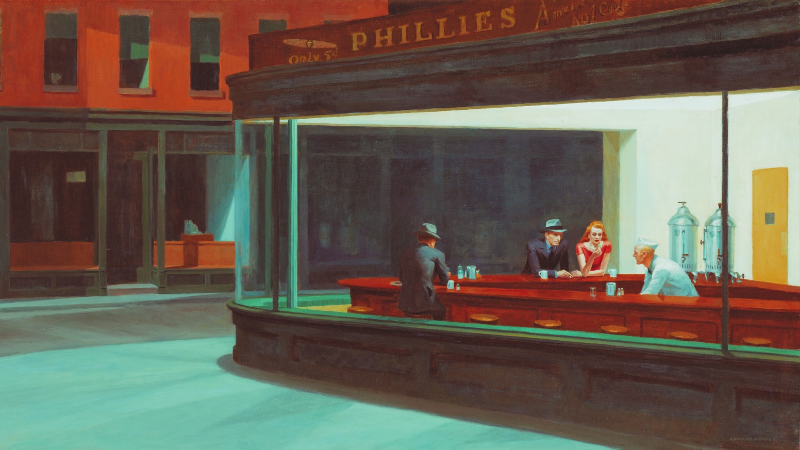
Feature image: Edward Hopper, Nighthawks, 1942. Oil on canvas, 33 1/8 × 60 in. (84.1 x 152.4 cm). The Art Institute of Chicago, Illinois. Purchased using Friends of American Art fund, 1942.51. Photo: The Art Institute of Chicago / Art Resource, NY/Scala, Florence. © 2026 Heirs of Josephine N. Hopper/Licensed by Artists Rights Society (ARS), NY/DACS, London.
By the time late November 1941 rolled around, Hopper had already begun work on Nighthawks, the enduring vision of a sparsely inhabited New York diner bathed in artificial light. When Arnold Newman shot him before an empty canvas that month, Hopper had clearly fixed the painting’s dimensions; he had also almost certainly finished many of the nineteen preparatory sketches, some of which carried numeric notes explaining how to scale the design to its final size.
As winter deepened, Hopper undertook a barrage of field studies, heading to the Midtown Dixie Kitchen to observe the coffee urns, as well as the salt-and-pepper shakers, cups, and napkin dispensers. For the figures, Hopper used a full-length mirror to pose for the two businessmen in suits, while Jo posed for the auburn-haired woman dressed in burgundy. The blond bartender, a character Hopper conceived on the spot, was recognized by Jo as “practically Capt. Ed Staples,” once again hinting at Hopper’s painterly alter ego.
A testament to endurance during the nation’s darkest hours, Nighthawks marks a distinctly American resilience.
Hopper would later say that the diner itself began as “a suggestion from a restaurant on Greenwich Avenue where two streets meet,” adding that “Nighthawks seems to be the way I think of a night street.” A Vogue article from 1954 claimed the work was “based partly on an all-night coffee stand Hopper saw on Greenwich Avenue in downtown New York, though more so.” The belief that the source really existed on Greenwich Avenue has spurred extensive detective work to pinpoint the exact diner that inspired the painting. Proposed sites have included wedge-shaped storefronts at 70 Greenwich Avenue—a newsstand in Hopper’s era and now a florist—and a 1940s eatery named Riker’s at the crossroads of West Fourth Street and Seventh Avenue South, where the Hoppers often dined, as possible sources.
No single conclusion has won universal agreement, though Carter Foster proposed in 2013 that the most likely origin was a vanished establishment called Crawford Lunch, once standing where Greenwich Avenue meets Twelfth Street, just north of the Sheridan Theatre. The presence of the word “Lunch” on a final study for Nighthawks supports this theory, as does the characteristic shape of the building.
Yet Hopper’s diner differs in many respects, not least the large, curved glass window that gives the painting its famous “fishbowl” effect. The panel advertising $5 Phillies American cigars crowning the cornice and the diner’s sleek Art Deco styling are also absent from those suggested sources. This has led scholars to propose that Hopper blended details from several places with elements of invention. The long, uninterrupted window has not been traced to any Greenwich Avenue restaurant, which raises the possibility that Hopper borrowed the concept from the Flatiron Building’s renowned glass-fronted prow, once home to a cigar shop. If correct, Hopper’s aim would have been to fashion a stylized, distinctly New York diner with a strong, urban personality.
Indeed, the painting’s distinctly American character has long been recognized: from the aquarium-like street facade to the sign advertising “America’s no. 1 Cigar,” from cigarettes and coffee to the stern, fedora-clad “nighthawks” within. Beyond its dramatic visual appeal—achieved through a restrained method of light, color, and form—the work’s mood and substance feel palpably American in a way that generations of writers have tried to decode in order to explain its singular aura.
It is essential to place Nighthawks back in its original historical frame to plumb its depths. The work emerged amid an era of acute existential tension across the United States and particularly in New York. Although conceived in the weeks leading up to the Pearl Harbor attack on December 7, 1941, the war’s shocking upheaval markedly redefined the painting’s context: the United States would soon be drawn into global conflict, bringing nightly blackouts and very real fears about aerial bombardment. New York, in particular, loomed as a prime target, a concern Jo wrote about in a December 17 letter to Marion Hopper:
Ed refused to take any interest in our very likely prospect of being bombed—and we live right under glass skylights and a roof that leaks whenever it rains. He refuses to make any more precautions and only jeers at me for packing a knapsack with towels and keys and soap and check book, shirt, stockings, garters—in case we ran to race out doors in our nighties. For the blackout we have no shade over the sky light—so can’t have lights in studio at all—so no way to cook even.
Jo added that, amid the blackouts and the mounting anxiety, Edward had become singularly fixated on his new painting:
He’s doing a new canvas and simply can’t be interrupted! he Rehn gallery invites E to remove some of his pictures to a store house so that the whole collection won’t be in one place. Frank Rehn is very concerned and making many precautionary measures. I can’t say I’m a bit panicy but I’m the kind that believes in precautions, and in a matter that everyone is so concerned in, I can’t see why anyone refuses to take an interest. Hitler has said he intends to destroy New York and Washington. It’s certainly indicated that he will try. We’re right close up to that center of Jewry, the NY University. We should have heavy curtains for front of house to keep glass from smashing in all over the floor—but with glass overhead, what good would they do. It takes over a month for E to finish a canvas and this one is only just begun…E won’t now discuss any emergency Surely, this is the time to think things out…But E. doesn’t want me even in the studio…Can it be that E. Hopper senses in his bones the admonition: “Be still and know that I am God!”
Work continued for more than a month. On January 22, 1942, Jo disclosed that Edward had “just finished a very fine picture—a lunch counter at night with 3 figures. Night Hawks would be a fine name for it. He was about a month and a half working on it—interested all the time, too busy to get excited over public outrages. So, we stay out of fights.”
The sheer degree of Edward’s absorption in Nighthawks suggests the painting arose from an almost obsessive focus, with little of the typical hesitations or doubts that often accompany major works. It seems evident that wartime anxiety created conditions conducive to such sustained labor, with Nighthawks offering both distraction from immediate concerns and a means to express private thoughts and fears. The wartime atmosphere of New York speaks through the painting as a silent but urgent chorus, a temple of neon that persists through the city’s darkest hours. A gesture of endurance through the nation’s darkest hours, Nighthawks celebrates a poignantly American resilience.
Through stoicism, Nighthawks frames the darker aspects of American life as cool; its quiet menace is sleek and seductive, and its solitary, shadowy patrons have become iconic.
Beyond its historical backdrop, Nighthawks reveals depths that continue to captivate—its psychological pull and emotional resonance are endless. Analysts routinely tie the scene to themes of loneliness and estrangement, and today many regard the work as a canonical tribute to the isolation of modern life. Even before the painting’s creation, some critics praised Hopper for conveying “the pathos of the big city, the loneliness of the individual in an impersonal setting.” Years later, Hopper himself suggested that he did not see it as especially solitary, noting that he simplified the scene and made the restaurant feel larger; “Unconsciously, probably, I was painting the loneliness of a large city.”
The artist’s admission of tapping into his subconscious to explain his aims reveals how thoroughly he had absorbed Freudian notions about repressed feelings. Yet he did not hesitate to challenge those who used loneliness too freely to describe his work. “The loneliness thing is overdone,” he told Brian O’Doherty. “It formulates something you don’t want formulated.” For Hopper, words alone could not capture the vast interior life he sought to depict. As he later put it: “If you could say it in words, there would be no reason to paint.”
Nighthawks raises a string of questions and allusions that invite viewers to trace meanings. Critics point to possible cultural antecedents, including Hopper’s earlier dining-room illustrations and depictions of nocturnal cafés by artists such as Van Gogh and Degas—Degas’s desolate Absinthe (1876) being a frequent reference. Others perceive in the painting a continued surrealist thread within Hopper’s broader work, noting touchpoints with the New York shows of Joan Miró and Salvador Dalí in 1941, as well as the enduring influence of Giorgio de Chirico. Critics increasingly highlight surrealist undertones; one observer, a year after the work’s completion, remarked that “he has the psychological insights of the best of the ‘Surrealists’ without their circus methods.”
Although Hopper’s links to Impressionism, Post-Impressionism, and Surrealism are notable, and while Degas’s Café Terrace at Night (1888) provides a striking precedent for the dramatic play of night-time urban lighting at a street-side café, the distinctly American character of Nighthawks places it within a national cultural lineage that has often been overlooked in favor of European models. Urban-dining scenes also flourished in Ashcan works by John Sloan and Robert Henri, with Henri’s mysterious nocturnes of open-air night cafés resonating in this painting. Everett Shinn’s All Night Café (c. 1900) likewise presents the exterior of a lit restaurant on a dark night, though it includes a solitary figure peering in through the windows of the bustling establishment.
In Hopper’s Nighthawks, the observer becomes the isolated spectator, peering into the fishbowl from an empty street with no obvious entrance to this inviting, glowing refuge. As in previous works, Hopper’s diner is pared down, its surroundings stripped to essentials, which heightens its dreamlike quality. Building on the night-café motif explored in earlier paintings such as Soir Bleu, Nighthawks reimagines this trope within a deliberately American setting, bridging Impressionism and Surrealism with a national realist tradition and Hopper’s own transcendental sensibilities.
What sets this painting apart is its resolutely American atmosphere, which lifts it beyond a simple meditation on loneliness and anchors it in a broader conversation about national identity. It radiates a heroic sense of isolation, a quality many audiences have interpreted as emblematic of the American condition. By weaving Emersonian individualism into a modern urban landscape, Hopper presents self-reliance as a constant, fusing enduring values with a new sense of contemporary vitality. Through stoicism, Nighthawks presents the darker side of American life as cool; its understated menace is sleek and magnetic, and its lone, shadowy figures have become iconic.
__________________________________
This piece is adapted from Edward Hopper: A Life by Louis Shadwick, published by Yale University Press. Copyright © 2026 by Louis Shadwick. All rights reserved.
