
During the blazing heat of summer 2024, consumed by fury about my role in Hollywood—where I felt I was treated as a mere diversity token rather than a person with genuine talent—I reached for Vanity Fair, a novel by William Makepeace Thackeray.
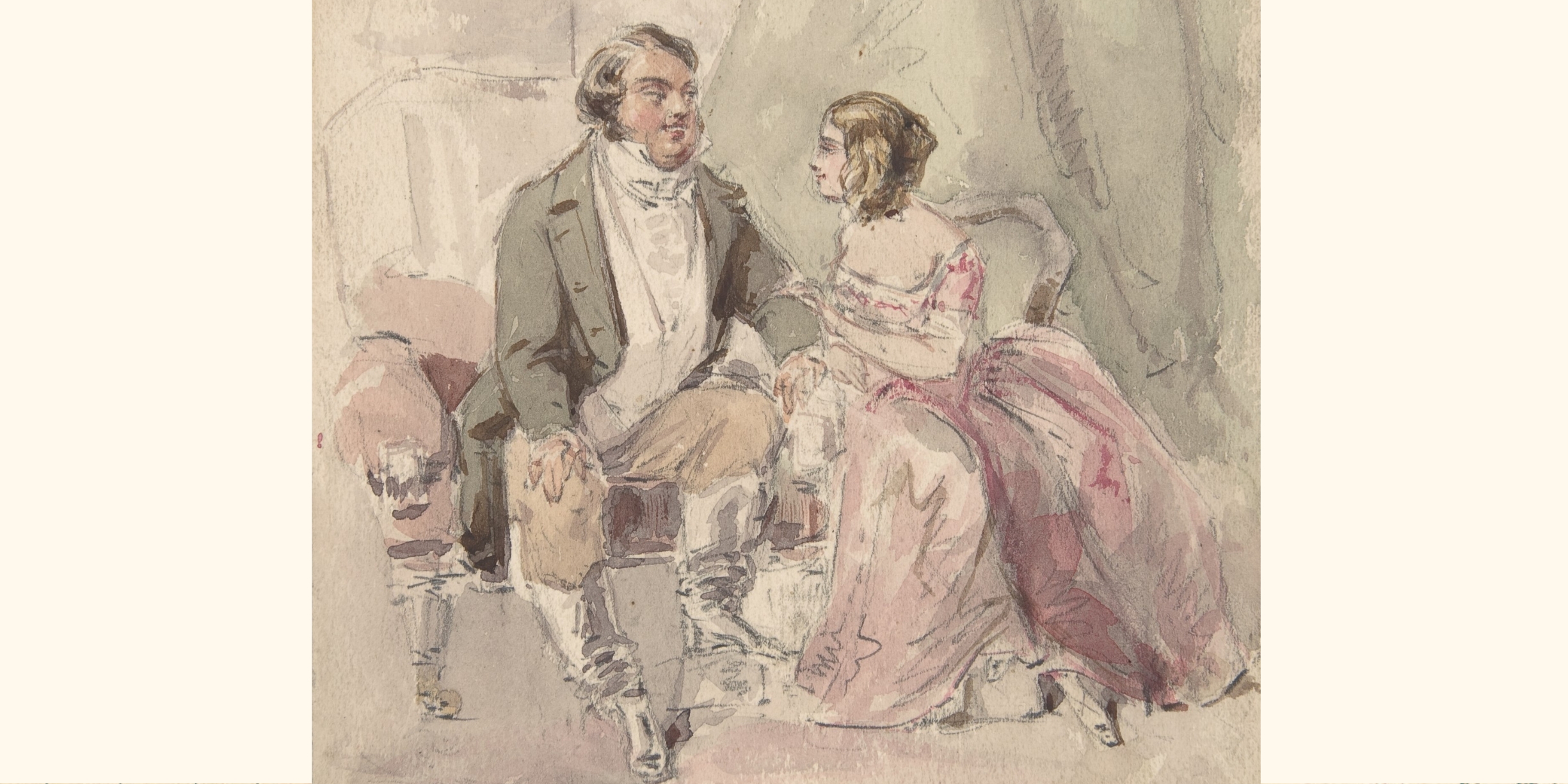
I opened it largely because of the cover: a scene of the British aristocracy losing their balance on a staircase, their garments riding up to reveal glimpses of their underclothes. They begin the descent with a measured poise and finish it as a scattered heap of pale, fleshy forms.
I believed the image captured my own anger. Those figures slipping down the stairs seemed to symbolize Hollywood’s hypocrites—the predominantly white elite who prize their own status while maintaining a system that remains fundamentally unfair. I was, of course, projecting.
Indeed, the subtitle to Vanity Fair is “A Novel Without a Hero.”
I began reading Vanity Fair that very day. The novel opens with a foreword in which Thackeray writes: “There is a great quantity of eating and drinking, making love and jilting, laughing and the contrary, smoking, cheating, fighting, dancing and fiddling.” And for the next eight hundred pages or so, Vanity Fair merrily weaves together a wildly tangled plot, tracing the schemes of a young social climber, Becky Sharp, alongside the parallel misfortunes of her naïve companion Amelia Sedley, who remains largely passive and does little to alter her ever-worsening fate. The reader is meant to root for Becky. For eight hundred pages, Becky schemes while Amelia sighs. Becky is poor; Amelia is well-off.
Ultimately, Becky succumbs and Amelia ascends. Yet the author insists there is no heroine in this book. Indeed, the subtitle to Vanity Fair proclaims it as “A Novel Without a Hero.”
The day after I began Vanity Fair, I started writing The Simp. I had no outline or blueprint; I was simply reimagining this two-h-century-old book. I envisioned the modern Becky Sharp as Raj, an Indian actor navigating the opulent but exclusionary world of Hollywood. He is an impoverished, lifelong hustler who manages to survive among the elites. In the slang of younger generations, he is also a Simp.
There is no Hero in his novel, because there’s no Hero among the rich, lifeless elite who enjoy every advantage for no reason at all.
When I began drafting my story, Hollywood was already losing interest in its own diversity narrative. Still, I did not want to depict a martyr among the oppressed, the victim of a brutal industry. I didn’t want to create an Amelia. That would have deprived Raj of humanity—and it would have been dull. Becky never performs a single sympathetic act in Vanity Fair. Yet she remains the primary victim of a rigid class system that would discard the daughter of a modest art teacher with no money or title. Her schemes are born from the oppression she faces, and that oppression is, in a quiet but essential way, the novel’s point.
I also chose to write Raj that way because I recognized a part of myself in Becky. Being a minority in Hollywood does not automatically make me a straightforward victim or a flawless character. And yet, minorities don’t deserve equal opportunity in Hollywood simply because they are good people—they aren’t inherently better than white people, as far as I can tell. Why does acknowledging this feel so perilous? Because the stories we tell tend to demand minority characters be devoid of fault, which robs them of inner life. The careful, almost benevolent condescension that accompanies such depictions is really a form of venom-laced patronage.
In truth, I have spent years hustling through Hollywood much like Becky, sometimes in ways that might raise eyebrows. For instance, I began my career as a medical consultant even though my medical training consisted of only a handful of weeks in medical school; I told people I was a physician. But what does moral scruple matter when the system itself is broken? Thackeray’s work is deeply concerned with this question. He clearly finds British aristocracy to be profoundly corrupt. There is no Hero in his novel, because there’s no Hero among the privileged, lifeless elite who enjoy every advantage for no reason. And today, in Hollywood, isn’t that observation even more relevant? People who succeed are not always rewarded for talent alone. Considering the prevalence of Nepo babies, many ascendancy stories resemble aristocratic lineage as much as they reflect merit.
Driven by this insight, as unyielding as Becky herself, I moved in step with Vanity Fair. Each day I read about thirty pages of the original while producing roughly three thousand words of my own work. After three weeks, I reached the final page of Vanity Fair on the same day I completed the last page of The Simp.
As I drafted, I adopted a voice I had never before attempted—the sharp, satirical cadence that Thackeray uses in Vanity Fair. Consider Thackeray’s portrait of a character named Jemima: “Honest Jemima had all the bills, and the washing, and the mending, and the puddings, and the plate and crockery, and the servants to superintend. But why speak about her? It is probable that we shall not hear of her again from this moment to the end of time.” And that irreverent, breezy narrator is proven right—we never hear of Honest Jemima again. I told Raj’s story with the same tone. In other words, I did not write out of anger (even though that emotion certainly colored my thoughts). I treated the tale as a comedy, much like the spectacle of affluent whites toppling down a staircase.
I suspect many readers assume the Classics are tedious, which is perhaps why I know few people who have read Vanity Fair. In truth, it’s far less dull than many contemporary literary works because it delivers a brisk, relentless plot without lingering over every detail. For instance, here is the lone description of Amelia in the book: “As she is not a heroine, there is no need to describe her person.” This mirrors the pre-Flaubert sensibility of early nineteenth-century fiction, shared by Dickens, Balzac, and Austen. At that period, readers prized a compelling narrative over lush, atmospheric prose. Writers built cliffhangers with the efficiency of early television, charging ahead before the next commercial break.
Today, that tone isn’t considered especially haute. Elite fiction (and elite cinema) tends to be cool, detached, and visually pristine, with a strong emphasis on mood rather than plot. There’s a hint of embarrassment about telling a story outright—you’re almost discouraged from producing a robust narrative, which feels almost like a lower-class indulgence. High art tends to be aloof, restrained, and sparse in plot; low art embraces grit and a strong sense of story.
Vanity Fair operates as a form of low art—a melodrama through and through—but it endures because it tells a compelling tale. I aimed to capture that same kind of accessible, plot-forward energy in The Simp, which remains richly narrative. If it were treated as High Art by contemporary standards, much of the plot would disappear, and Raj would resemble Amelia—meek, pleasant, and victimized by cruel people. What exactly is “High” about that?
Later, after the feverish rush of drafting a first version, I learned more about Thackeray. I discovered that he was born in India. His parents belonged to the expanding Anglo-Indian class—white Britons of modest origins who accrued wealth through the spoils of empire. They were outsiders within the aristocracy and, as a result, became something of rebels against social boundaries.
Thackeray, who may or may not be fully guiltless in relation to these legacies, built a career by satirizing the rich while living among them. He stood tall—six feet three inches—and loved indulgence, once confessing a habit of “gutting and gorging.” He often appeared, at least on the surface, hypocritical, which perhaps explains why his writing captures his targets so astutely.
That alignment felt almost too neat. Thackeray was, in many ways, a living embodiment of Becky. So too is Raj. And I, in turn, am a possible Becky who has endured the brutality of an industry shaped by race, and who has sometimes benefited from it, albeit in ways sustained by condescension. In Vanity Fair, Thackeray honors the tangled realities created by social hierarchies. He crafts a novel that resonates with the realities of our own lives—it is a book without a hero.
__________________________________
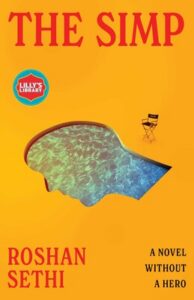
The Simp by Roshan Sethi is available from Simon and Schuster.