
Over the five years I spent studying medicine, death revealed itself to me in many ways. My peers and I filled countless hours in dim, quiet lecture halls trying to grasp the multiple ways a body can fail. From microscopic defects within cells to the signs and symptoms of a vast array of illnesses that seem to lurk on the sidelines waiting to strike, it could feel almost miraculous that people survive at all.
In practical sessions, surrounded by real equipment and what we whimsically called “fake patients,” we acted out crash scenarios and emergency scenes. We attempted to revive silicone dummies and stitched up oranges to practice suturing. Through those long years, as we forced knowledge into our exhausted minds, we learned about every imaginable path to death, what steps might avert it, and how to deliver bad news when there is no fix.
Yet we didn’t truly learn about death until after we finished training.
In the ED, death feels so unlikely.
In August 2010 I stepped onto a ward with a gleaming stethoscope and a mix of pride and fear. Twenty minutes later my pager screamed from my lapel, and I began my first role as a junior doctor. “Could you come to Ward Seven and certify a death?” Not the most glamorous first post, but I knew what was expected. I had been taught. I had completed a session where I certified the death of a pretend patient (who then got out of bed and ate a cheese-and-pickle sandwich) and I had answered several exam questions on the topic without hesitation. It would be fine.
My patient lay in a side room, and the first thing I noticed when I entered was how still the air felt. Beyond the closed door the rest of the ward moved on, but in that room it felt as though time had paused. Surrounding me lay the detritus of a long admission: a pile of magazines and newspapers, get-well cards stuck to the wall behind the bed, crumpled tissues and forgotten cups of tea. I tried to ignore all of these and focused on the task at hand. The patient was an elderly woman with tight grey curls and a face filled with ageing and fatigue. Her death had been quiet and anticipated, yet she clung to the bedclothes with both hands, as if trying to hold onto the world. It was as though she remembered something she had forgotten to do and needed to stay a little longer.
I checked every box I was supposed to check. I shone my pen torch into her milky eyes. I pressed my shiny new stethoscope to her chest, and I listened for any sign of respiratory effort. I recorded everything meticulously in her notes and then I stood for a moment in that still room. It felt wrong to immediately turn and leave. Not to acknowledge her passing in some way. It was then I noticed the book at the side of her bed. It was a paperback, and deep within its pages was a bookmark.
“Now she’ll never know how the story ends,” I thought.
Long after I had left that room, my mind kept returning to the bookmark, and every shift from then onwards, I would gather more and more small memories like this one. I called them my Kodak Moments, and I collected so many, eventually I was dragging them around with me each day like a difficult suitcase.
Of all the places to learn about death, the Emergency Department offers you the richest opportunities. One stormy night, as the rain rattled on the roof, an elderly woman was brought in after suffering a cardiac arrest. Her name was Elsie, and the double doors crashed open as she was wheeled in on a trolley. Elsie and her husband had been watching the television, but when her husband returned to the room with their final cup of tea for the night, he’d found her unconscious in her chair. He waited in the corridor outside the resus room as they worked on his wife, but Elsie’s tired body had had enough of this world, and eventually they called time of death. Elsie was not my patient, and I left resus before the doctors had broken the news to her husband, but I passed him on my way to the next job. Another Kodak Moment. Because draped across his arm, creased and wet from the storm, and waiting to be worn, was Elsie’s navy blue raincoat.
In the ED, death feels so unlikely. All these people whose days started just like any other. The car crashes, the heart attacks, the collapses. No one expects to find themselves in a curtained cubicle, explaining themselves to a doctor, as they both try to work out how an ordinary day became so very un-ordinary.
I was writing up at my notes at the nurses station when Elizabeth was admitted, a thirty-five year-old woman with a racing pulse, tightness in her chest, and a feeling that something very bad was going to happen (a sense of impending doom as doctors describe it). Due to her young age and otherwise good health, Elizabeth’s symptoms were put down to just anxiety (because even now we like to put “just” in front of any mental health condition) and she was put into a cubicle in minors. Spying a potential “learning opportunity” two medical students followed her in there and closed the curtain. Within five minutes, the curtain was flung back again and one of the medical students bolted out of the department in a panic. The other medical student, in a surprisingly calm voice, asked if they could “have some help in here” because Elizabeth had stopped talking, slid from her chair onto the floor, and had gone into cardiac arrest.
Ten years later, long after I left those wards, I still carry these moments around with me.
It just so happened a consultant cardiologist was in the next cubicle and within seconds a resus team had gathered around the patient. If you want to see the definition of efficiency, a crash call is an excellent place to start. Under the supervision of the cardiologist, they pumped drugs and electricity into Elizabeth’s body, and within a few minutes they had brought her back. It was a miracle. Right in front of my eyes. I thought all crash calls would be like this (they are not). The patient even attempted to stand up (lie down Elizabeth! the consultant’s voice bellowed around the department). Elizabeth was eventually wheeled off to the Coronary Care Unit, and the cardiologist turned to his audience and said, “well she was right about the impending doom.” Because cardiologists have an impeccable sense of timing.
I watched him for the rest of my shift, glancing across the department as he continued with his day. I wanted to ask him how it felt to argue with God. What it was like to perform a miracle on the floor of an Emergency Department. However, I kept these questions to myself. I hadn’t been a junior doctor for long, but I had already learned that a doctor’s job is to take histories and order X-rays and insert cannulas. A doctor’s job is not to talk about emotions (at least not until the sanctuary of the psych wards). And so I collected another Kodak Moment, another thing I had learned about death.
Ten years later, long after I left those wards, I still carry these moments around with me. They are small post-it notes I pull out whenever my own trivial problems start to overwhelm me. A legacy of patients long since gone who still bring me comfort and perspective. Because as a doctor the most important thing I learned about death, is you will never understand it until you walk in its presence. The true meaning of death lies in bookmarks and raincoats, not in textbooks and lecture theatres. You may be fluent in the language of anatomy, physiology and pharmacology, but you will only become a good doctor when you recognize that sometimes the very best thing you can do for a dying patient is to stop trying to fix everything, and simply listen.
There are some things which cannot be taught.
__________________________________
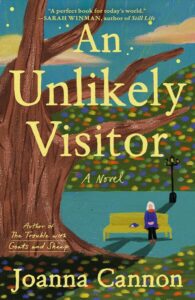
An Unlikely Visitor by Joanna Cannon is available from Scribner.
