
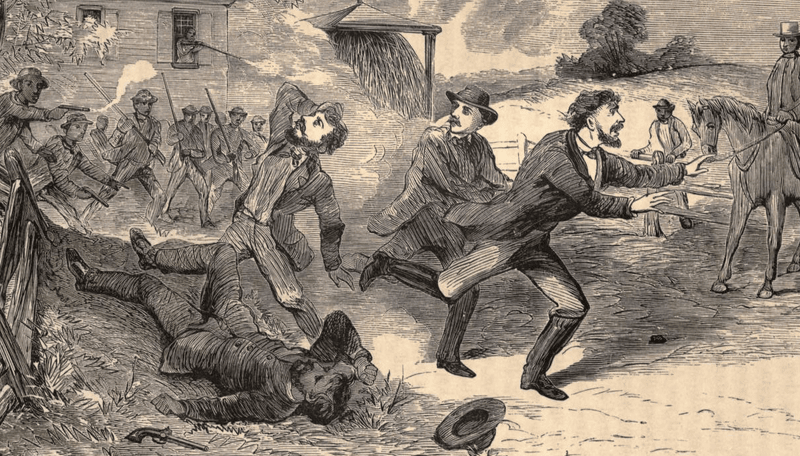
It was the autumn of 1865—a quiet, bitter autumn after four hollowing years of war—when James Gilmore received a manuscript from a ghost. Well, not a ghost exactly. There’d been rumors, of course, about what had become of William Parker. Some had him lynched in a dark woods. Others had him hacked to pieces in New York City. Still more had him living long enough to slaughter Confederates on Southern battlefields. But it had been nearly a decade and a half now since Parker vanished, and no one could ever truly prove what had become of him.
“Civil War—The First Blow Struck,” a local Pennsylvania newspaper had declared shortly after he’d gone missing.
“Unless the Christiana rioters are hung…THE BONDS WILL BE DISSOLVED,” a Southern broadsheet prophesied.
“The partisans of slavery know that they stand upon a powder mine which may explode at any moment,” proclaimed a scornful report from as far away as Sheffield, England, warning that the millions of Black people enslaved in the American South, just as William Parker had been, “once aroused, cannot be subdued at a stroke.”
Despite their differences—in what they were risking and in what they themselves thought reasonable—when it was important, they had each other’s backs.
America in 1851 was held together by the thinnest of compromises. The Mason-Dixon Line served not just as a demarcation separating the slave South from the free North but also as a fault line for a nation threatening to break itself in half.
Here, less than a day’s ride from that infamous boundary, a festering hostility toward the slave-catchers who stalked the hushed, racially integrated villages of rural Pennsylvania finally tipped over into what those involved would later call a “battle.” This bloody standoff between enslavers and the formerly enslaved captured the attention of a deeply divided nation, filling newspapers with lurid accounts.
“We have received a few additional particulars of the dreadful riot at Christiana,” the Evening Post teased. “The owner of the slaves is named Edward Gorsuch, and he and his son Dickinson are both dead. There are besides twenty others dangerously wounded.”
“There were four men, all armed with pistols, it is true,” the Baltimore Sun assured its readers, “opposed to about one hundred infuriated, blood-thirsty, howling demons.”
As the story unfurled, it showcased many familiar archetypes of a pre-Civil War America. There was Edward Gorsuch, the wealthy Maryland plantation owner and church elder; his handsome young son; and the bombastic Philadelphia police officer they’d hired to lead them through unfamiliar territory in search of four men who had, in essence, stolen themselves to freedom. In the North, the story intersected with a surprisingly diverse society of radical abolitionists: well-known figures like Frederick Douglass, William Lloyd Garrison, and Lucretia Mott; but also Philadelphia’s wealthy Black elite, obstructionist Quaker farmers, and the Black rebels themselves, led by their enigmatic leader, William Parker, a man whom it was rumored bullets could not kill.
But the manuscript in James Gilmore’s hands that day revealed elements of this story never before shared: the origins and outrageous adventures of Parker’s armed Black mutual defense organization; their alliance with various white neighbors, including those who would be arrested alongside them in the battle’s chaotic aftermath; and finally, the daring narratives of Parker’s escapes, first from slavery and later from the enraged mobs and hastily deputized law enforcement officers who wanted to make good on the $2,000 bounty the governor of Pennsylvania himself had placed on Parker’s head.
The U.S. government descended on Parker’s small town. Cattle cars would be used to ship dozens of Christiana men to a Philadelphia prison, where they would be charged en masse with “levying war” against their nation—the largest federal indictment in the country’s young history. The president himself would direct the prosecution’s strategy from the White House, while the fearsome wit of congressman-attorney Thaddeus Stevens would bolster the defense. Each side aimed to sway the twelve white men on the Philadelphia jury as to what should be the fate of these traitorous “rioters”—and whether the only way to save an already riven nation was to set a proper example and send them to a hangman’s noose.
But missing among those prisoners was William Parker. As far as anyone knew for sure, shortly after the standoff he left his home, walked past the fly-covered bodies of white Marylanders bleeding in his front yard, and seemingly vanished into the hot September air.
Now, fourteen years later—after the shots that first rang out on Parker’s front steps culminated in a war that left 700,000 Americans dead—James Gilmore, editor-at-large of a new monthly magazine called The Atlantic, had received this manuscript offering to tell Parker’s story. Could it be genuine, the memoirs of a man some thought dead? The manuscript had certainly come to the right place. In its eight-year existence, The Atlantic had already become a platform for many influential abolitionists. It published Julia Ward Howe’s “Battle Hymn of the Republic,” the de facto anthem of the Union Army; Thomas Wentworth Higginson’s compassionate reports on the slave revolts of Denmark Vessey and Nat Turner; and it would soon print Frederick Douglass’s thoughts on the next steps for Black liberation. President Abraham Lincoln himself had once confided that a well-placed article in The Atlantic was “worth as much to us as a half a dozen battles.”
Still, it was a strange moment in the nation’s history for The Atlantic to receive this manuscript. The Civil War had ended only a few months earlier, and the new president, Tennessee’s Andrew Johnson, believed that the future of the country depended on its citizens being reasonable in their expectations moving forward. He encouraged Americans to embrace reconciliation and compromise and let old hurts go. Johnson’s choice not to reconvene Congress in the months after Lincoln’s assassination allowed him to issue thousands of pardons to former Confederates—blanket amnesty proclamations, as well as individual pardons for high-ranking officials, scheming bureaucrats, and wealthy plantation owners—and to welcome Confederate states back into the Union under lenient terms, with no oversight. And all this was without any movement toward a federal plan for the rights now owed to four and a half million Black Americans—four million of whom, until emancipation, had known only a life of enslavement.
Theirs is a story of twists and turns, of progress followed by devastating reversals, of faith kept alive until the beliefs most of their era would consider radical could one day become the rights an entire world would come to see as American.
Publishing Parker’s story would not just challenge the pervasive historical amnesia settling in all around Gilmore—for heaven’s sake, the Southern states planned on sending former Confederate leaders to Congress, as if their rebellion had been a minor indiscretion and not treason!—but also serve as a rebuke of Johnson’s plea for docile reasonableness.
*
“The reasonable man adapts himself to the world, the unreasonable one persists in trying to adapt the world to himself,” Irish playwright George Bernard Shaw would later write, “therefore all progress depends on the unreasonable man.”
The story of what would be called “The Christiana Riot” is a tale of unreasonable men and women who tried to change the world around them, the many ways they failed, and the important ways they succeeded. It’s the story of what happened outside William Parker’s house in the dawn hours of September 11, 1851. But it’s also a much larger story involving decades of tenacious, ever-evolving anti-slavery and Black rights efforts spread out across Philadelphia and rural southeastern Pennsylvania—activist communities divided by class and race, but connected in spirited defiance of laws they knew to be unjust and inhumane. These men and women weren’t perfect: Mistakes were made, innocent people were hurt, and long-fought-for progress was stymied, or worse, rolled back. Words of anger were expressed in print, spat out in person, and hollered from pulpits and podiums. And yet, despite their differences—in what they were risking and in what they themselves thought reasonable—when it was important, they had each other’s backs.
Theirs is a story of twists and turns, of progress followed by devastating reversals, of faith kept alive until the beliefs most of their era would consider radical could one day become the rights an entire world would come to see as American.
In other words, it’s the story of how a nation is moved to change its mind.
*
“The manuscript of the following pages has been handed to me with the request that I would revise it for publication,” Gilmore wrote in his introduction to the piece. “The narrative is a plain and unpretending account of the life of a man whose own right arm—to use his own expression—won his rights as a freeman. It is written with the utmost simplicity, and has about it the verisimilitude which belongs to truth, and to truth only when told by one who has been a doer of the deeds and an actor in the scenes which he describes.”
After summarizing the battle at Christiana—its harrowing genesis and its staggering aftermath—Gilmore grew worried he was “holding the reader at the threshold.” He needed to get out of the way and let the citizens of this newly reunited nation learn from Parker’s story whatever lessons it needed to teach them—that it needed to teach us.
“With these few remarks, I submit the evidence,” Gilmore penned, “to that impartial grand jury, the American people.”
____________________________
From The Ballad of the Fugitive William Parker: A True Tale of Love, Murder, Treason, and Ordinary Folks Who Saved America by Cristin O’Keefe Aptowicz. Copyright © 2026. Available from Simon & Schuster.