
I believe offering even a glimmer of hope to someone confined behind bars, and giving them motivation to become a better citizen during their sentence, is crucial; if their conduct improves, they will leave as a more able citizen.
–Johnny Cash, testifying before the House Committee on the Judiciary, 1972
*
A trio of banners hung from the crimson wall behind the stage in the north dining hall, bearing a handful of words and musical motifs drawn in rounded lettering and dusted with silver glitter. They looked a touch flashy, were slightly undersized for the vast space, and were affixed so low that reading them would be challenging once the performance began. Yet, with the stage empty, their message was unmistakable:
San Quentin
Welcomes
Johnny Cash
The dining hall loomed large and damp, yet buzzed with activity in anticipation of the concert. Cash conferred with members of his entourage and with his wife and collaborator, June Carter Cash, across a long table as road crews prepared the stage and the Carter Family, the Statler Brothers, and the rockabilly singer Carl Perkins readied their sets. A crew of filmmakers and sound engineers arranged recording gear, while photographer Jim Marshall captured the swirl of motion surrounding the event.
Cash had long tied his public persona to crime and confinement, and at San Quentin he presented himself as their emblem—an avatar for their anger and their pain.
February 24, 1969 brought with it Cash’s reputation for capriciousness. For more than a decade he had relied heavily on stimulants, and the toll on his health had been severe. He had looked almost skeletal in recent years, his voice often a gritty whisper, and it was impossible to predict whether he would show up as planned or which version of himself would appear onstage. On the best days, he stalked his audience with a wounded, feral intensity—growling and strumming relentlessly at his guitar. On other days, he shuffled about like a tired penitent, as if every song might be his last.
That was then, though. He was aiming for sobriety and arrived in solid form. He’d regained some weight, his voice carried a gravelly richness, and he was eager to perform with a clear mind.
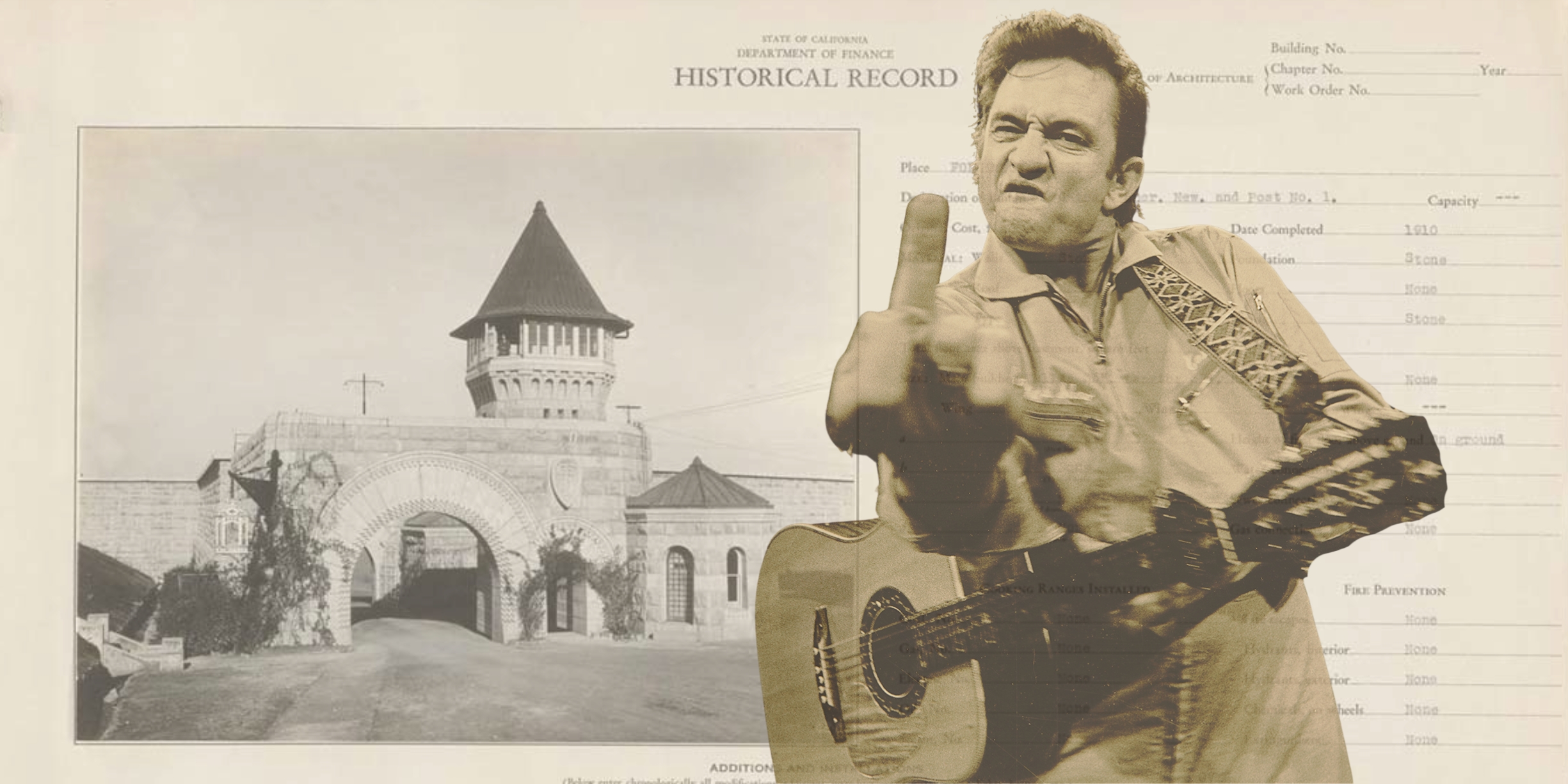
When the stage was ready, the musicians took their places for a sound check, and Jim Marshall began to shoot. He captured Helen Carter, one of June’s sisters, gazing downward, her hair tucked in curlers beneath a thin white cloth. A shot from behind showed W. S. Holland, the drummer, scanning an otherwise empty room—one drumstick resting on the rim of his snare, the other near a cymbal. And as Marshall watched Cash chatting with June, he called out, “Let’s do one for the warden.” Cash obliged. He fixed the camera with a fierce glare and distorted his mouth into a hard, aggressive line before letting the expression linger.
*
As showtime neared, people began filing into the dining hall. They filled the seats, then moved to claim spots on the floor and along a low flight of stairs by a wall. Their attire was practical: jumpsuits, worn denim shirts, aged and softened from long use, or dark sweatshirts; most appeared clean-shaven with short hair. A man near the stage smoked a pipe; another wore dark sunglasses. Guards stood in small clusters throughout the room.
San Quentin carried immense weight in public imagination, reputed to house California’s most dangerous inmates. It housed the state’s death row and many lifers. Yet the film crew’s interviews with inmates on the day of Cash’s performance offered portraits that complicated that stereotype.
The crew spoke with men in their cells, the camera lens zooming in on their faces as they spoke. One inmate noted that many of them have wives and children waiting for them elsewhere, and that they arrived here for crimes that sometimes echo those of ordinary people. “They’re hiding us,” another inmate declared. “Society out there created many of us; I’d say the worst crime many of us here have committed is being born into poverty.”
“Every time a bell rings, it means something,” one inmate said with resignation. “You can do too much time, and it makes you institutionalized, erasing your ability to think for yourself.” Another added, “Everyone’s playing their own game, trying to get out of this madhouse.” All lamented the violence they’d witnessed; one man said several people had been killed during his first week there. Another admitted that even witnessing someone in pain no longer unsettled him; “I’m getting to the point where it hardly affects me anymore.”
Carl Perkins stepped out to begin the show, approaching the microphone. The hall bristled with the din of fourteen hundred men packed into a stone chamber—voices, shoes shuffling on the floor, hands sliding across tabletops—but quieted the moment he spoke.
“We think you’re going to enjoy yourselves tonight,” he said with a humble, Tennessee drawl. “That’s our hope.” He then launched into a brisk, uproarious rendition of “Blue Suede Shoes.” After his set, the Statler Brothers and the Carter Family took the stage as Cash watched from a corridor. Sensing the charged atmosphere, he stepped out, greeting the crowd as he moved along the front rows of tables.
Looking out over the sea of inmates, he felt, in that instant, the potential to push them toward violence.
____________________________
Excerpted from The Midnight Special: The Secret Prison History of American Music by Colin Asher. Copyright© 2026 by Colin Asher. Used with permission of the publisher, W. W. Norton & Company, Inc. All rights reserved.
