
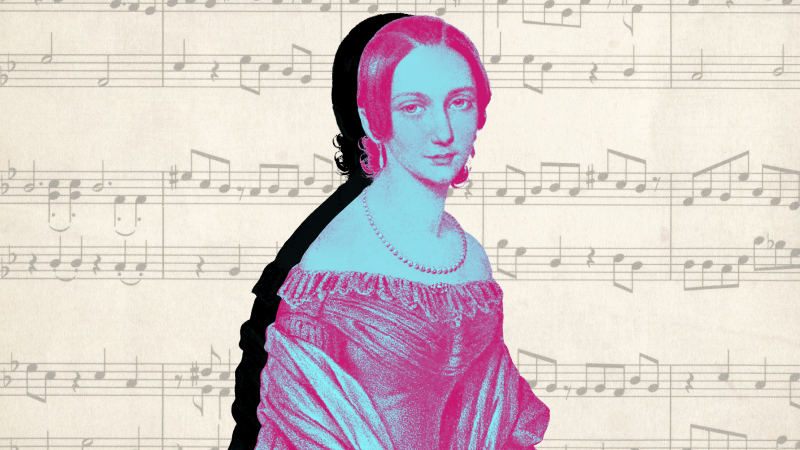
Fiction about women from earlier eras—whether it leans toward historical drama or romance—currently enjoys greater popularity than ever, yet nonfiction about women’s histories, especially in biographical form, does not fare as well. Although I make my living writing biographies, when I pick a book for leisure, I’m repeatedly drawn to fictionalized retellings of women’s pasts rather than nonfiction ones. They tend to be more gripping (as fiction often is when the author can weave a story instead of merely citing sources), and they invite readers to bring more of themselves to the pages. The fiction creates a more immersive sense of a woman’s perspective.
In non-fiction about women’s histories, particularly biographies, there remains a stubborn tilt toward male viewpoints. Practical reasons abound—from incomplete source material to the long-standing appeal of men’s histories to readers and critics who favor male-centered narratives. I would argue that this skew toward men’s voices is a central reason why women readers are less drawn to such biographies. Yet even as prize committees continue to honor works about Clara Schumann that prioritize a male vantage point, there is little incentive to change course. Still, when I write my own historical non-fiction, I committed to making women’s voices the priority, not merely a side note. I wanted to produce a book I enjoyed reading, one in which I—and other women readers—felt seen and central, not secondary.
Another major obstacle, often confronted by the woman’s biographer, is her own self-perception.
Even though the Bechdel test was not created for nonfiction, I decided to apply it to my Pegasus Books biography: Madame Composer: The Virtuosic Genius of Clara Schumann. Every time I found brief mentions in diaries and letters of Clara conversing with other women composers, I kept them in, even when they could have been cut. I also challenged myself with a game—could I craft a biography that never lets go of Clara’s perspective for a single page? I think I achieved that, though not without considerable effort and without facing a multitude of obstacles.
Fortunately, with Clara Schumann, the problem of missing information—the difficulty that often plagues research on women in history—was not an issue. Her father, Friedrich Wieck, intended her to be a prodigy on par with Mozart, the Paganini of the Piano, and so he kept diaries written from the vantage point of “his creation.” He recorded all her achievements as if they were his own, culminating in her ascent to the imperial title of Court Virtuosa to the Austrian Emperor.
I’ve therefore demonstrated the trap into which most prior writers of Clara Schumann’s story have fallen—experts who told the tale of her prodigious years from her father’s eyes. To present the reader with Clara’s own feelings, thoughts, and actions required reorienting the narrative: a childhood told through Clara’s voice, not her father’s. It demanded turning a thousand diary pages around, so that what had been scripted in her father’s hand could be presented through Clara’s own consciousness.
Another major obstacle, frequently faced by the biographer of women, is the way she is perceived. In the nineteenth century, a wife’s diary often served as a chronicle of her husband’s life, especially when the wife belonged to someone deemed a genius. Clara’s marriage diary extolled her husband’s compositions to a degree that appeared to eclipse her own gifts. Generations of historians have used her adulation as proof of her husband’s supremacy and her own supposed inferiority. Even feminist writers have faulted her for a lack of self-belief. Yet this discrepancy reflects the era more than the truth of her character. The biographer of women’s history must peel away the misogynistic conventions of the time to tell a more accurate story.
It’s hard not to feel a kinship with my subject who performed the men’s works more than her own.
This contextual web forces the writer to confront (or at least navigate) our own internalized misogyny with every page. All too often, the author’s bias toward men’s histories slips into the prose. In earlier Clara Schumann biographies, readers are likely to encounter more admiration for Robert Schumann’s or Johannes Brahms’s music than for Clara’s, even while acknowledging her influence. Madame Composer is the first biography to regard Clara Schumann as a composer in her own right—a title she herself once feared would be an act of arrogance.
During the years I spent building a following on social media, I faced numerous charges of a feminist agenda for sharing facts like Clara’s virtuosity outshining Liszt’s or noting how Johannes relied on Clara to critique his works. The romance between Clara and her male contemporaries wasn’t the true scandal, I discovered. The pressure to justify every deviation from the traditional male-centered histories pushed me to anticipate further accusations. Challenging long-held myths is unsettling; it lays bare the patriarchal aims that still linger among us.
The fear of losing male readers also shaped my writing, as I carefully framed the narrative so that these hypothetical male readers wouldn’t feel attacked, even as I laid bare the structural oppression faced by the era’s most celebrated female composer in nineteenth‑century Germany. Some men did recognize her value, but none risked his reputation for her, whereas she repeatedly risked hers for others, including her husband and Johannes.
After voraciously reading biographies of these two men, where Clara’s own compositions were sidelined or relegated to invisibility, I contemplated pushing back with a response that also gave equal weight to their works. Yet my readers’ expectations—formed by the all-male canon of classical music, a lineage Clara helped shape over a six-decade career—make her central role unavoidable. Clara inspired, critiqued, edited, arranged, premiered, and performed their works; shaping the reverence afforded to their legacies was inseparable from her story, even when her own contributions were often erased or minimized in theirs.
It’s hard not to feel a kinship with my subject who performed the men’s works more than her own. Nineteenth-century critics—who believed women could only imitate and never be composers—praised Clara for letting go of composing in favor of supporting her husband’s works, as befits the ideal dutiful wife and widow. If she had heralded herself as a composer on equal footing with the men, she would have lost their respect. In the parallel logic of our own era, with its ongoing expectation that we defer to men’s histories, my own books would likely have gone unread—or remained unpublished—if I had told a woman’s story uninterrupted by male precedents.
__________________________________
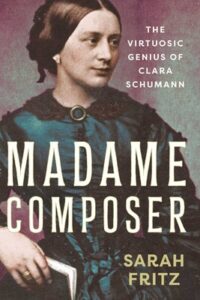
Madame Composer by Sarah Fritz is available from Pegasus Books, distributed by Simon and Schuster.
