
“The people have an indubitable, unalienable, and indefeasible right to reform or change their government, whenever it be found adverse or inadequate to the purposes of its institution.”
–James Madison, failed First Amendment to the US Constitution introduced into Congress, 1789
*
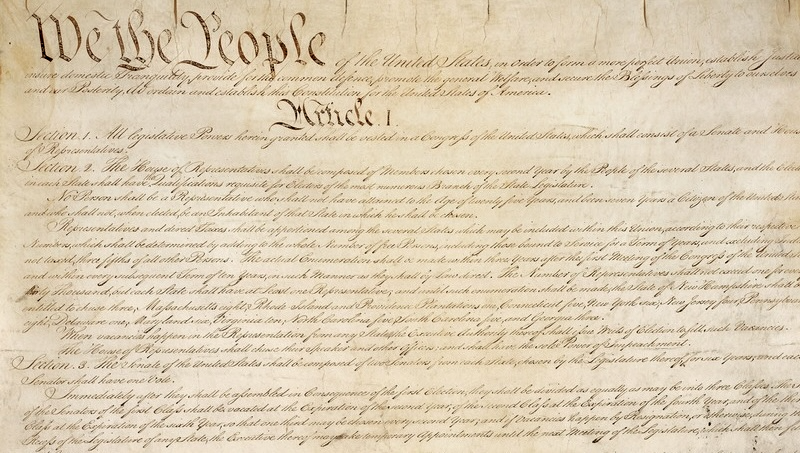
We the People. The Constitution of the United States comprises things that come into existence, live, flourish, fade, and vanish: insects, creatures, vegetation, concepts. In order to form a more perfect Union. Each element began long ago in the fertile soil, emerging by creeping, sliding, or wriggling forth from the mind’s womb. Establish justice, insure domestic tranquility. The document is penned on parchment from sheep, their wool washed away, their hides treated with lime, stretched, and dried. Provide for the common defense. The ink traces back to oak buds, swollen to the size of lead musket balls by the eggs of wasps. Promote the general welfare. Its language was shaped by quills cut from feathers of molting geese. Secure the blessings of liberty. Its high, grave ideas were born in the minds of dead men and from the books they studied. To ourselves and our posterity. Among nearly two hundred written constitutions, the United States Constitution—-the most influential of them all—-is also among the oldest, a relic, as delicate as bone and as solid as stone. Do ordain and establish.
But the U.S. Constitution is neither bone nor stone. It embodies a burst of ideas. Parchment may decay and ink may fade, yet ideas endure; they also evolve. The Constitution sought to address ancient problems that concerned not only the relationship between the people and those who ruled them but also the structure of government, the nature of rights, and the durability of law. Ingeniously, it anticipated the passage of time.
The U.S. Constitution is neither bone nor stone. It is an explosion of ideas. Parchment decays and ink fades, but ideas endure; they also change.
The document was designed with the possibility of amendment in mind. “The whole purpose of the Constitution,” as Justice Antonin Scalia once remarked, “is to prevent a future society from doing whatsoever it wants to do.” This statement, however, misrepresents the truth. One of the Constitution’s early aims was to resist change in some respects; another aim was to permit change without resorting to violence. The act of amending—the process by which changes can be made—forms such a central part of the American constitutional tradition that it can be described almost as a philosophy, a method by which endurance through adaptation can be achieved.
This volume, a historical account of the Constitution, contends that the amendment philosophy lies at the heart of modern constitutionalism. It presents amendment as a safeguard against upheaval, a way to preserve order while allowing transformation. The book seeks to trace how amendment originated, to identify the conditions in which it becomes feasible, to examine why this practice has sometimes fallen into neglect, and to address the question of whether the Constitution can endure in the absence of amendment.
A government of laws and not of men
Every organized society relies on a core set of rules, conventions, and principles. This holds true for any species living within a structured community: wolves in a pack, whales in a pod, bees within a hive, ants in a colony, deer in a herd, geese in a flock, elephants within a clan, apes in a village, and even a forest of trees. Humans alone devise constitutions. The act of creating fundamental laws is so intrinsic to human society that one might describe the human community as a “constitution of people.”
From the earliest times, humans built governments, codified laws, named rulers, enacted or forbidden religious practices, formed or dissolved political units, claimed lands, and asserted sovereignty. Once writing emerged, rulers began inscribing laws so that one generation would bind the next. The oldest known written code, the Sumerian Ur-Nammu code, was inscribed on sun‑baked clay tablets four thousand years ago this spring. It asserted that the king had banished malediction, violence, and strife from the land. About three centuries later, the Hammurabi code was carved on a towering black stone stele, declaring Hammurabi—chosen by divine authority—to bring about justice in the land so that the strong would not oppress the weak. Around 1300 BCE, Yahweh, the Hebrew God, is said to have given Moses ten commandments, inscribed on two tablets of stone, according to the Book of Deuteronomy. Ancient Chinese law appears as early as the Zhou Dynasty, etched onto bamboo slips known as jiǎndú.
Law governs people; constitutions govern governments. Nearly all constitutions are composite documents—assemblies of institutions and customs derived from fixed principles of reason and aimed at the public good. The notion that a constitution serves the common good dates back to antiquity. When Aristotle, around 350 BCE, wrote Politics and set down his observations with reed pens on papyrus, he categorized constitutions as those that aim for the common advantage and are just, those that aim only at the rulers’ advantage and are unjust, with most falling into the latter category.
Many legal instruments fuse the creation of governments with the allocation of territory and the proclamation of laws. Whether these records should be called constitutions is contested; some resemble treaties, others resemble criminal codes. The Prophet Muhammad drew up in 622 CE the Ṣaḥīfa, a now-lost charter of pact between certain Muslims and the Jewish community of Medina. In 1215 CE, outside London, King John of England sealed a parchment known as the Magna Carta, guaranteeing “all the liberties written out below” to his noblemen and their heirs. Intended to endure, it was almost immediately annulled, though later generations would refer to it as England’s ancient constitution.
Some ancient constitutions endured longer than others. Around 1450 CE, Dekanawidah, the Great Peacemaker, and delegates from the Iroquois Confederacy—the Haudenosaunee, comprising the Seneca, Cayuga, Oneida, Onondaga, and Mohawk nations—adopted the Great Law of Peace, a document sometimes described as a constitution. It was recorded on wampum belts and began with the line, “I plant the Tree of Great Peace,” with the intention that it should grow and spread outward like a living tree.
Committing a constitution to writing offers stability…but it also presents a problem: how is a government established by a written constitution to be altered except by its destruction?
The revolutionary notion that those governed should decide the rules—rather than those who ruled—emerged slowly. In 1765, Catherine the Great of Russia began drafting the Nakaz, or a constitution, to declare her sovereignty and to assure her subjects liberty and equality. To explore this idea she convened an assembly of 564 elected delegates—elected by all groups, including women and peasants, with Muslims occupying fifty-four seats—to meet in Moscow in 1767. The real turning point came in 1776 when the American colonies proclaimed independence and asserted self-evident truths that Thomas Jefferson described as inalienable: Life, Liberty, and the pursuit of Happiness; that all men are created equal and derived rights from the Creator; and that governments derive their just powers from the consent of the governed, with the People’s right to alter or abolish a government that becomes destructive. Four years later, Massachusetts adopted a new constitution drafted by John Adams, whose aim was to establish “a government of laws and not of men.” They saw this constitution written down in ink on parchment. It remains in force and is preserved in a Boston museum—sealed in a double‑paned, gas‑filled case to shield it from decay: water, oxygen, and sunlight.
All written constitutions incorporate unwritten elements that are as invisible as the gas in a sealed display case. “The sacred rights of mankind are not to be rummaged for, among old parchments, or musty records,” Alexander Hamilton advised in 1775. “They are written, as with a sunbeam, in the whole volume of human nature.” A written constitution derives its power not merely from its verbiage but from the life breathed into it, or what Montesquieu called “the spirit of laws,” which can feel almost magical. James Madison warned that early state constitutions—first drafted in 1776—supplied little more than parchment barriers to those who might seek to disregard them. “The Constitution of a country is not the paper or parchment upon which the compact is written,” John Quincy Adams agreed. “It is the system of fundamental laws, by which the people have consented to be governed, which is always supposed to be imprinted upon the mind of every individual, and of which the written and printed copies are nothing more than the evidence.”
Nevertheless, a written constitution remains a different creature from an unwritten one. Committing a constitution to writing offers stability and a kind of inherited endurance, yet it also raises the question of how a government established by that written framework can be altered without being undone.
Amend your ways
The Constitution of the United States drew on ancient ideas, but it also introduced something entirely new and fundamentally transformative: a foundational legal body crafted and ratified by representatives of an imagined political community—the People—binding them to their government through a consent-based act. It was designed to transcend ordinary law by codifying core principles, structural arrangements, powers, and rights. The document was intended to be printed, copied, and widely circulated among a highly literate population, acting as a formal covenant and enabling distant governance. The U.S. Constitution is not a mere list of commandments like Hammurabi’s code or the Mosaic laws; nor is it a religious scripture.
Unlike those, and much like the Massachusetts Constitution of 1780, which has seen more than a hundred amendments, it was meant to be revised, updated, and refined. The eighteenth century was an era of sweeping changes—revolutions, empires, science, technology, and moral reform—driven by the belief in progress. The most radical aspect of the U.S. Constitution, and of state constitutions more broadly, was the provision for ongoing self-renewal through amendment, allowing the document to remain a government of laws rather than of men.
This capacity for improvement is what we call amendment. In English, the verb amend traces back to the twelfth century, meaning to correct a fault, fix an omission, repair what is broken, or morally improve something—to make it better. It shares its origin with mend, four of whose five letters, and nearly all its sense, come from the Old French amender.
_______________________________
Excerpted from We the People: A History of the U.S. Constitution by Jill Lepore. Copyright © 2025 by Jill Lepore. Used with permission of the publisher, Liveright Publishing Corporation, a division of W. W. Norton & Company, Inc. All rights reserved. We the People has been shortlisted for the 2026 Cundill History Prize.