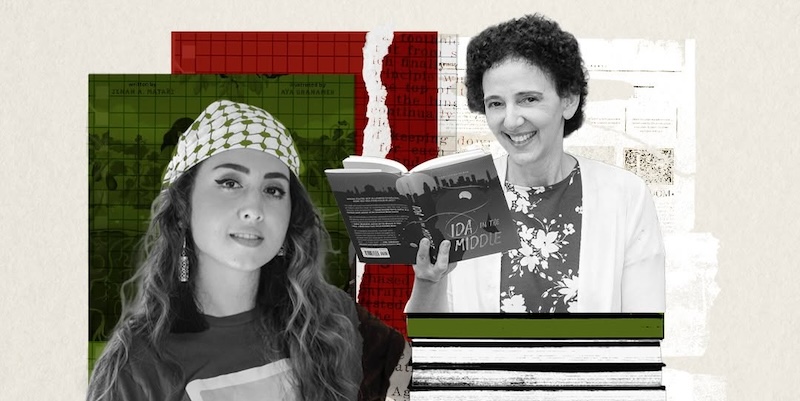
Jenan Matari and Nora Lester Murad are award-winning authors with children’s books featuring Palestinians. They have filed a lawsuit against the City of Los Angeles after their invited author talk for teen patrons at Los Angeles Public Library was cancelled without explanation three days before the scheduled date of December 6, 2025. In this edited transcript, Jenan and Nora discuss what it feels like to be censored, the pervasiveness of anti-Palestinian racism, and their reasoning for filing the suit in order to save the integrity of libraries.
*
Nora Lester Murad: You and I connected because we’ve both faced censorship rooted in anti-Palestinian prejudice. The Los Angeles Public Library invited me to discuss my young adult novel Ida in the Middle, and you were asked to speak about your picture book Everything Grows in Jiddo’s Garden.
Jenan Matari: The entire aim of Read Palestine Week is to carve out room for Palestinian narratives in a climate rife with censorship. When they asked me to participate, I assumed the library would be aligned with the cause. Aren’t libraries supposed to stand against censorship, oppose book challenges, and oppose racism?
Nora Lester Murad: While assembling my recently released co-edited volume, Resisting Erasure: Libraries in Palestine and Palestine in Libraries, I learned a great deal about how censorship targets Palestinians in libraries.
Jenan Matari: It’s almost ironic that you were censored and simultaneously published a book about censorship!
Nora Lester Murad: Indeed. Libraries are under attack not only from right-wing actors beyond their walls but also from internal forces with political agendas. They function as spaces for both censorship and resistance to censorship.
I don’t view the lawsuit as an attack on the library. I see it as a defense of the library’s integrity and credibility.
Jenan Matari: Some folks argue that pursuing legal action against the City of Los Angeles weakens libraries. They claim our aim should be to defend libraries, not to sue them.
Nora Lester Murad: We aren’t attacking the library itself. Rather, we’re defending the mission of public libraries and the principles of librarianship. When we hold libraries—along with schools and various government entities—accountable, we’re urging them to remain relevant, safe, and welcoming for everyone.
Jenan Matari: I hadn’t fully grasped this when censorship first struck. Palestinian authors and speakers have faced various degrees of censorship. My own cancellation from a bookstore in New Jersey drew New York Times coverage, but I now recognize that censorship by a public library is distinctly dangerous. A healthy democracy relies on public libraries strong enough to resist racist political pressure from inside or outside.
Nora Lester Murad: And it’s disheartening that, although anti-Palestinian censorship is highly visible, many anti-censorship groups don’t explicitly support Palestinians.
Jenan Matari: Our formal complaints to anti-censorship organizations about the Los Angeles Public Library went unheard, or worse.
I can’t imagine any other group being mass-murdered live on social media while their voices are ignored the way Palestinians’ voices are when we speak our truth.
Nora Lester Murad: I’ve got a particular grievance with nonprofits that build their reputations on defending people—raising funds from supporters who care about the mission—yet they exclude Palestinians. It was troubling that the very groups meant to shield us against racist censorship acted in the same exclusionary way.
Jenan Matari: It feels as though we Palestinians are continually negotiating for the right to exist. I can’t picture another group facing this degree of violence broadcast publicly while being silenced when sharing their truth.
Nora Lester Murad: We did receive around twenty statements of support, including from the National Coalition Against Censorship, the ACLU-Southern California, the Authors Guild, Palestine Legal, and others.
Jenan Matari: More than 100 Los Angeles Public Library staff signed a solidarity letter backing the librarians who invited us and opposing the administration’s decision to cancel. Over 7,000 letters were sent to library officials protesting censorship, and people showed up at Library Board of Commissioners meetings to demand a reinstatement of the event.
Nora Lester Murad: The library never engaged with our multiple requests for a conflict-resolution meeting—one that our speaker contracts explicitly allowed. The library’s response to inquires from press was a consistency of bland statements that didn’t address the underlying concerns. Was the decision about resource allocation, about whether the event aligned with the library’s mission, or about unspecified administrative procedures?
Jenan Matari: Or was it retaliation for my advocacy against genocide?
Nora Lester Murad: Hence, the lawsuit.
Jenan Matari: Hence, the lawsuit.
Nora Lester Murad: How did it feel to be barred from speaking about one’s own life experiences as a Palestinian?
Jenan Matari: It makes me think I must be doing something right to provoke such pushback from institutions of this magnitude. Yet it’s painful. As a mother of Palestinian children, it hurts to be barred from spaces I’m raising them to participate in. I wonder if I can fix this before my kids face the same obstacles.
Nora Lester Murad: And the question remains—can we fix racism?
Jenan Matari: Yes. Not only for Palestinians’ sake. I hate that you’ve been dragged into this, but I don’t want to harm anyone else’s ability to make ends meet. I’d rather dismantle the prejudice than silence it.
Nora Lester Murad: You didn’t threaten my livelihood, but the library’s actions affected mine, and I see this as my fight too—tied to my responsibilities as a mother to Palestinian children and to my own commitment to universal liberation. I’m Jewish, and I’ve been smeared as antisemitic for speaking out.
Jenan Matari: An internal email circulated that claimed we had “strong terrorist ties” and “virulently antisemitic views.” That’s a lie intended to ruin our reputations.
Nora Lester Murad: Hence, the lawsuit.
Jenan Matari: I don’t want the Los Angeles Public Library to get away with this. Libraries have always been my safe place. My mother took us to every library event. In college, I spent countless hours there, studying and writing. Even while abroad, I lived in an ancient English abbey for six months and largely based my life around a library. It’s where I’ve brought my own children and where I began writing my next book.
Nora Lester Murad: I loathe the message that canceling our teen event sends to Palestinian kids. It’s as if the library is saying, “Palestine isn’t welcome here,” or that Palestinian voices aren’t fit to be heard. Cancelling implies that their stories are inherently dangerous and their presence is unsafe for others.
Jenan Matari: That’s the lived reality I’ve described my entire life. If I suppress a part of myself—the Palestinian part—everything can seem fine with neighbors and within social circles, yet the moment they deem me too Palestinian, I’m pushed out.
Nora Lester Murad: By canceling the event, the Los Angeles Public Library effectively told Palestinian youth that they cannot bring their full selves into the library. It sent a message that their identities aren’t welcome there.
Jenan Matari: Exactly. The library’s public statement claimed it strives to keep information open while ensuring programs promote inclusion and safety for every patron. In other words, the Read Palestine Week event would have created an unsafe, unwelcoming environment for some patrons—though they fail to realize that canceling creates a similar environment of fear for others.
Nora Lester Murad: And what about non-Palestinian kids? They might think the authors are dangerous simply because of who they are. The cancellation sends a message that Palestinians are dangerous or their stories are dangerous, which is plainly racist.
Jenan Matari: It’s a blatant act of racism.
Palestinian children have the right to see themselves represented in books and to have their stories told.
Nora Lester Murad: I anticipated backlash and the accusation of antisemitism, which seems to be the default charge whenever someone advocates Palestinian rights. I didn’t expect the administration to ghost and gaslight us to this degree.
Jenan Matari: The librarians themselves are divided. Some who invited us support Palestinian inclusion, while others smear us with racist slurs to undermine our work and control what Palestinians can say about their own lives. The library administration should listen to the pro-censorship voices far less than to librarians who oppose censorship. If there’s a credible question about a speaker’s fit, it should be investigated and handled based on actual evidence. We weren’t even allowed to defend ourselves.
Nora Lester Murad: Hence, the lawsuit.
Jenan Matari: And I know it’s going to be a long road to achieve our goals. The library will hope people drift away from the issue and move on to something else. They expect us to quit.
It’s almost as if Palestinians are being erased from humanity before our very eyes.
Nora Lester Murad: If it were only my own harm at stake, I might have given up. There are more urgent crises in the world—wars, genocides, police abuses, and the housing and healthcare crises—that demand attention.
Jenan Matari: Yet the stakes are there. A thread runs from racist censorship of Palestinians through dehumanization and erasure, not only in literature but in life itself. It’s as if Palestinians are erased from people’s understanding of humanity; when genocide occurs, it often fails to register. We must challenge this here in the United States and in Palestine.
Nora Lester Murad: Many Jewish people also want to see a free Palestine within our lifetimes. The idea is to show that our well-being is not mutually exclusive; it’s intertwined.
Jenan Matari: I wrote a picture book about the intergenerational bond between Indigenous people and the land. I know how to speak to children. We aren’t “brown savages” who can’t control themselves in front of young readers. It’s frustrating that people portray voices like mine as irrational simply because our political views differ. I’ve built my platform by knowing what I’m talking about.
Nora Lester Murad: And we need your voice.
Jenan Matari: It’s incredibly irritating to be silenced. We have essential work to do, and censorship tactics only derail us. Still, we must resist censorship to discuss the issues that demand attention.
Nora Lester Murad: From the documents obtained via public records requests, it seems they weren’t particularly worried about what you would say. They simply didn’t want you there.
Jenan Matari: Exactly.
Nora Lester Murad: They imply that your political views disqualify you as a person. Your ideas render you unworthy.
Jenan Matari: It’s profoundly racist.
Nora Lester Murad: Some still contend there exists a neutral, objective “normal” on one side, and Palestinians who are allegedly biased on the other. Yet the supposed objective normal is Zionism, a political ideology that deserves critique just like any other. Presenting a critique rooted in lived experience should not brand someone a troublemaker; that’s a misapplication of the norm argument.
Jenan Matari: I’ve embraced that identity. There’s little else to do.
Nora Lester Murad: You express it well, and it resonates with many people.
Jenan Matari: We’ll keep advocating. I’m determined to make my presence known in spaces some people don’t want to see me in. I sometimes wear a thobe and a keffiyeh on my street just to assert who I am, even if it annoys my neighbors—or perhaps because it does.
Nora Lester Murad: I don’t think non-Palestinians have the right to assess how we demand respect for our lives, and I don’t believe the library has that right either.
Jenan Matari: So, what would you wish to see as the outcome of the lawsuit? If you could have everything you want, what would you request?
Nora Lester Murad: I’d like to make it nearly impossible for other libraries to censor Palestinians. I want them to conclude, “We’d better tread carefully with Palestinians because of what happened to the Los Angeles Public Library.” If the library’s reputation suffers or some people lose their jobs, that’s acceptable, but it won’t suffice to merely replace a few individuals if the system—policies, procedures, and structures—stays unchanged.
If public institutions are meant to serve and protect us, their integrity must not be eroded by external or internal pressure.
Jenan Matari: I envision accountability on many fronts. In an ideal world, the librarians who wrongly accused us of terrorist ties should be fired and held financially responsible for damage to our careers.
Nora Lester Murad: There must be repercussions that reach all the way to the top.
Jenan Matari: The statements about us from Los Angeles Public Library employees were not harmless. Activists accused of links to “designated terrorists” have faced death threats; such rhetoric is not a joke.
Nora Lester Murad: The internal handling of that racism was discriminatory. Do they have a written policy that social media posts automatically disqualify an author from speaking, or does this only apply to Palestinians? Is there a uniform procedure to vet every speaker’s online presence, or is this applied selectively? If the library claims your posts are inaccurate, who decides what is accurate and on what basis? Are the same standards used for all speakers or only for Palestinian ones?
Jenan Matari: We’re fairly certain we know the answers.
Nora Lester Murad: I think library patrons, the public, taxpayers, and policymakers who care must be willing to hold institutions accountable. If we want public institutions to truly serve and protect us, we can’t let their integrity erode under pressure from outside or inside. Holding the Los Angeles Public Library accountable is, in fact, pro-library, not anti-library.
Jenan Matari: So yes, the lawsuit is part of a larger fight, but there are many everyday ways people can push institutions to be accountable without taking legal action.
Jenan Matari: People can request Palestinian books for the library’s collection, advocate for displays and programming that feature Palestinian authors, and purchase Palestinian titles as gifts for teachers or to read to children. The aim is to normalize Palestinian inclusion on par with everyone else.
Nora Lester Murad: Jenan, if we had gone ahead with the December 6 event, what did you want the children to take away?
Jenan Matari: A great question. Everything Grows in Jiddo’s Garden is about reconnecting with the land. I recently staged a garden-centered library event that turned out to be the library’s biggest crowd ever, even though I feared cancellation and kept promotion minimal. It involved planting seeds native to the kids’ region, with a joyful, chaotic burst of activity as they learned to nurture life and bring a plant home. It reminded parents that there’s more to raising good humans than stories alone.
Nora Lester Murad: That scene was powerful. It’s hard to imagine the library’s leadership claiming such an inclusive moment wasn’t appropriate.
Jenan Matari: That’s how every conversation around my book has gone—until racism complicated things because the protagonist and her grandfather happen to be Palestinian.
Nora Lester Murad: Exactly.
Jenan Matari: What I would have told the young readers at Read Palestine Week is that if they can text, they can write, and if they can write, they can become authors. I always stress that nobody else can tell their story or narrate their life—so their voices matter.
Nora Lester Murad: Kids absorb what they hear and ask questions. My book offers a path for them to grow curious and reflect on their own lives, asking who they are and how they can shape who they become. I hope it sparks adults to learn more about Palestine and its people too. Palestinians are more than victims of Nakba and ongoing violence, but we cannot diminish what they’ve endured and continue to endure today.
Jenan Matari: The talk they canceled would have been a genuine chance for dialogue. You and I share rich exchanges; canceling deprived children of witnessing that.
Nora Lester Murad: They really did. And by smearing us with false statements, they may also deprive other young readers of learning from our perspectives.
Jenan Matari: Hence, the lawsuit.
Nora Lester Murad: Hence, the lawsuit.