A Table for Fortune centers on September 11. As its narrative unfolded, tracing the origins of that crime in one direction while tracking its poisoned harvest in another, the work split into two halves. The first half aims to be a cerebral, ideational novel; the second turns out to be an investigation of feeling. I sought to fuse the two halves into a single, coherent whole, only to discover that they could not be, should not be—yet they had to be.
Reader, my wish is that the book’s densely contemplative darkness in the first half (whose memo-driven portrayal of a single CIA analyst’s decades-long, deskbound career can only be justified by the patterns it reveals) will be tempered by (1) gleams of archival curiosity and (2) SECRET foreshadowings of geopolitical substructure that might indeed surface, along with (3) a few playful exploits of this very spy and his sister-in-law Lorene. As for the second half, I did my best to write with enough daylight, even if it sometimes fell in showers, to carry you through several sentences and perhaps into a sub-subsection. (Needless to say, the seventh floor would rather see both halves treated as a single work.)
I vow that A Table for Fortune is as truthful as I could render it. The subject was abhorrent, yet I could not escape it. Early on I was fortunate enough to befriend Juan Tomas, a poet from Equatorial Guinea, who addressed a gathering and said: “A poet’s duty is to speak out not because he is a poet but because he is a member of the community.” From that, I conclude that I must speak out not because I can speak but because I am an American.
(Who, indeed, am I to judge American foreign policy from 1966 through 2022?—Nobody, save for an American.)
I attempted to trace the flow of decision-making across that span as accurately as my own unCLASSIFIED misreadings allowed; and if some judgments taste like acid, that was simply because ACIDITY SELLS. How did we arrive at September eleventh, and into how many filthy quagmires did we descend from there? My personal answer (this book) revolves around lessons left unlearned, the expediencies of power, and above all, consciences that have been dulled on every side, but also around chance, whose effects, when combined with everyday human fallibility, especially during crises, can be malevolent—such as when the U.S. government, rattled by Islamic terrorist atrocities, capitulated to torture and an unjust war that it saw the possibilities. As I’ve said, I did my best to be accurate, but I’m grateful Fortune allowed this to be fiction, so that my mistakes can masquerade as imagination. Moreover, the causes and effects of many concrete events remain disputed. For instance, did the Soviets invade Afghanistan out of (a) fear of Muslim insurgency, (b) Iran-aware Realpolitik, or (c) a desire for a port on the Persian Gulf? Then there are still more SECRET matters: What mortal can chart the evolving ties between the Red Army Faction and the Stasi, or between Donald Rumsfeld and Saddam Hussein?
I felt obligated to at least attempt to understand where we began and where we appeared to be heading. Why not wander and loiter a bit, at nearly every turn?
In its CIA portions, this book resembles a science-fiction tale from the 1940s about Venus. In other words, I did my utmost to extrapolate from the scant knowledge I possessed, tolerating errors about surface conditions, climate, and the fauna and flora of Langley—those pitiful guesses I will almost certainly never be able to VERIFY or INVALIDATE. (Were the “blue” elevators truly blue, and what color are they now? What exactly was the East Germany Desk called in 1968 and what name did it bear afterward?) My gratitude to the CIA-affiliated individuals who helped me peer a few kilometers deeper into Venus’s impenetrable haze is spelled out in the acknowledgments. And let me add that despite my loathing for torture, assassinations, invasions based on dishonest premises, long-term SECRET surveillance of ordinary citizens, betrayals of allies and dependents, and a persistent lack of accountability, I do not oppose the CIA or the broader “intelligence community” as such. We operate in dirty waters; so do our rivals and adversaries. I wish the CIA and FBI had forestalled September eleventh. I’m grateful they tried. What troubles me most about the American case is executive overreach, especially when conducted in darkness. Anyone who argues that the CIA alone bears responsibility for covert actions would do well to read the concealed (yet fortunately leaked) Pike Report, where one can observe a domineering White House pressuring a resistant CIA into another long, needless bloodbath. As for the “War on Terror,” well, my views need not hide themselves.
*
Some parts of Venus are so darkly cloaked that when I attempt to understand Bush II’s stubborn negligence just before September eleventh, or his morally repugnant “enhanced interrogation” practices, or Obama’s SECRET drone strikes, or Trump’s boisterous rhetoric about making America great again, all I can chart are actions and their ripples. I will gamble, as carefully as I can, about various half-probable motives for the fictional figure named Cheney.
*
Reader, do you find War and Peace overly lengthy? What about that hundred-page epilogue on the insignificance of heroes within the flow of history they accompany? I’ve heard Tolstoy “needed an editor.” If you share that view, this book may not suit you.
Recently a number of my peers on a literary panel declined to read submissions exceeding two hundred pages. Perhaps that was always the way.
As for me, I resolved that remembering Cheney’s America was my obligation (even though Cheney, with high probability, would have preferred fewer vile uses of my unremarkable intelligence). I felt obligated to at least attempt to determine our origins and our destination. Why not wander and drift on about it, at nearly length? You see, torturers and counter-torturers, victims, ideologues and perjurers, and even well-intentioned people who cut moral corners and other known unknowns should all get their due. So, to be respectful, I inserted a hint, and perhaps even added some extra detours here and there. After uncovering additional facts, opinions, and interpretations, I then naturally pad a few more hundred pages of livid prose onto my characters’ digital skeletons, because otherwise what kind of Venusian beings would they be?
My editor at Viking, who had indulged me for years, grew increasingly uneasy the more he read. He never could see how the Angola sections fit. He also reminded me (as he had since 1986) that the cost of paper was rising. Worse yet, he informed me that the various fonts I had used to craft my visual language for A Table for Fortune (typewriter-like for spook reports, italics for news-like passages, and so forth) could no longer be accommodated. I retorted that Viking could keep paying me a modest wage, for I had never cared about a conventional income; but driven by a certain entitled stubbornness, I also did not care about the cost of paper or fonts. He remained silent about that, implying I would likely lose that battle. Meanwhile I promised to reread the manuscript with a more open mind, to see if it could be shortened—if only by five hundred pages, or better yet two thousand. Was I perhaps aiming to imitate Kissinger himself? So I cut and hacked and amputated and condensed; I really really did, yet during these deletions, A Table for Fortune somehow grew longer by a few hundred manuscript pages. So I fired my editor. I still regard him as a friend, as I hope he feels the same about me. He did try to rescue me from myself. And in the grand spirit of Bush II: MISSION ACCOMPLISHED!
Truth be told, Viking and I both (and, reader, perhaps you as well) would have preferred A Table for Fortune to be a sleek little end table bearing a candy dish—instead of the sprawling banquet-furniture it has become (cobwebs and bloody chalices guaranteed—beware the poison-tipped silverware!). And if you find this prospect as drearily obsessive and overstuffed as my former editor did, let me reassure you as I did him: “Don’t worry; I promise that the real hero of the story will emerge around page eight hundred!” A hypothetical printer named Matthew, who is certainly no more real than the book itself, may with medium-high probability appear sooner than that—unless I toss in another megadigression tomorrow (the terrorists made me do it!).
*
My CIA protagonist DAVE began as a few lines in the September eleventh inquiry. You see, somebody with his codename once did something REDACTED. If he ever reads A Table for Fortune, I would like to say that though my character bears only a faint resemblance to him, I have grown rather fond of DAVE. If I ever worked inside an intelligence agency (given my limited success at Viking, I’m in medium-high demand, at least among cockroaches), I would aim to tell the truth as I perceived it, not as the Executive demanded it to appear.—Here the seventh floor expresses medium confidence that I, too, could be persuaded into producing a dishonest work through (a) my own tendency to please others, and (b) my preexisting loyalties (for example, to “America” as I understand her). On the other hand, I might be saved by my stubbornness, as happened when I refused to allow Viking to mutilate this book into coherence and readability. DAVE, as I imagine him, would be more intelligent than I, more collaborative (at least until the Berlin Wall fell), genuinely a better relative and neighbor, tolerating abuse, mediocrity, and even small talk, while continually accomplishing practical acts of kindness; (4) mechanically skilled, like my father and both grandfathers, at what I do poorly, and (5) superb at keeping SECRETS. How, I wondered, might a DAVE-like figure experience the sudden end of the Cold War, our failure to prevent September eleventh, and the crimes we committed in our War on Terror, thereby GUARANTEEING (I truly believe this) more terrorism against us?* And how might he adjust to developing insights he could never pass on to his family?
Of course his trick memory, his long career, and borrowings of Pravda from the colleague known as CYCLOPS are, frankly, ridiculous, especially since the latter (don’t tell Venusian Cheney) bore two functional eyes. Mea culpa. His colleagues’ occasionally parodic office personalities, however, do spring from my occasional study of human hives, in one or two of which I have been compelled to swarm, though never all the way to the seventh floor’s honeycomb; and on a related note, I swear that all of the most insane utterances of patriots in this novel were, in fact, given to me verbatim by real-life Amcits.
In developing his office life as a CIA analyst, I supposed that when DAVE first began working up East Germany, i.e., the German Democratic Republic, his assigned mentor-boss was a kindred and intelligent figure who taught, loved, pushed, trusted, and sometimes protected him, lifting his mind to vivid flights over a bustling observational terrain (call it the Night Land) and enriching his grasp of the big picture. When he shifted to Iraqi analysis, I paired him with a doctrinaire, domineering supervisor and left him to an observational field of misdirection and hopelessness. Again, I know nothing about the real people who performed this work. Nor will I ever learn (not my department!) which CIA team leaders, if any, willingly or passively enabled the slander linking Saddam Hussein to September eleventh. Was our second invasion of Iraq another Angola-like misadventure, with the Executive dragging the CIA into error? Or did true believers, such as my invented COULSON, drive the hostilities with criminal zeal? A novelist can only embody plausible ideologies in specific fictional figures. None of my invented time-servers, kill chain feeders, and petty tyrants are meant to cast doubt on the employees of Iraq Issue or any other particular department.
*
And what about DAVE’s son Matthew? I made him even less intelligent than I am, and cheerfully, physically tougher, nobler in his earnest quest for America, and as brave, ethical, and mechanically gifted as his father. In the first draft he could carry on an argument about politics with DAVE, but the more I observed his actions, the more that accord seemed to fail his destiny, because Matthew, you see, had limitations.
I too aspire to be brave. I can whistle past countless graveyards—but what would I feel if I outlived my savings? Like DAVE, I developed colon cancer, and paid for survival with a third of my intestinal tract (a harsh weight-loss method endorsed by REDACTED). At the start of 2025 the disease returned in an incurable form. My initial response was relief, for I pity those who must endure the large-scale reality we are creating. And should anyone wish to punish me for this book’s not-quite-adoring portraits, I need not suffer long. Like Cassandra, I keep predicting the worst and not being believed. We have set a table for Fortune, so I expect misfortune, always hoping to be mistaken. Meanwhile I get to pretend to be brave, but I may never need to act on it, unless my opioid pills run out.
*
I once had a daughter named Lisa. She mattered deeply to me. When I obtained part of my FBI file (700 pages, 500 of which are REDACTED), I first found amusement in the wholly hostile distortions of my motives, deeds, achievements, and hopes. The FBI had once investigated me for terrorism. After they captured the Unabomber, I became a suspect in anthrax cases too, simply because I had once been a suspect in the Unabomber case. After I stopped laughing, I realized that the file’s vicious unfairness, coupled with the fact that I had already been detained twice, endangered my freedom. Lisa was then a child. I told her, “Please remember that even if they take your Daddy away, Daddy did nothing wrong.” I wanted her to understand this not for my sake but for her own.
(To this day my incoming mail is delayed, stolen, torn open. Sometimes a package of foreign translations arrives with every spine slit. My Japanese translator quit writing me years ago because I never answered her. I never answered because her letters never came.)
In 2022, Lisa ended her bulimic and alcoholic self-destruction with a brain bleed. She was twenty-three. At her memorial, her pious aunt declared, “Bill, don’t worry; she’s in a better place.” “She sure is,” I replied. “She’s in a box on the piano.”—So I need not worry about myself or Lisa. Fortune indeed seems to take care of us in strange ways. (Don’t you think?) And with that sentiment, I suppose I will take another opioid.
Lisa was far smarter than Matthew, and exceptionally articulate, but less inclined to physical labor, which she cared little for, though she had once been athletic. Unlike him, she was apolitical and thus lacked his sense of necessary purpose. He wandered homeless for a long stretch. She was homeless only briefly. Once Matthew left his parents, he tasted happiness, along with addiction and death. Lisa suffered so profoundly that I can scarcely bear to remember her final years. I hope it is brave of me to admit that I outlived her rather than failing her by dying first.
As noted, Matthew’s break with his father over Abu Ghraib began as an intellectual dispute. It soon began to feel unnecessary, because one either feels and believes that torture is wrong, or else one is diminished. Matthew did not need to be clever to stand on the right side. Nor did he need to achieve outcomes. So why not inscribe his pathology into his ideology? With the big picture far beyond his grasp, he likely started his journey out of resentment, self-loathing, and painful bewilderment—never mind that he was deeply loving, which made him compassionate, and that he hoped to learn about America to better love her. That was my way of making him live. Yet in every version of A Table for Fortune I intensified Matthew’s family tragedy with Lisa’s desperate blood, and, for fun, sprinkled in some of her parents’ anguish—for this will be a fun book all the way through.
Should anybody wish to punish me for this book’s not-quite-adulatory views, I need not suffer long. Like Cassandra, I keep predicting the worst and not being believed.
(I would not have touched on family matters here at all if private grief were still private. I am not DAVE, and Matthew’s mother is not Lisa’s. Matthew is not Lisa, although I have clothed some of his wretchedness in her sorrows. He would have disgusted her, loved her, and called her truly really nice. I wish she could have drifted as cheerfully as he into the poisonous Venusian fog of homelessness. And while I am at it, why not wish that there were no September eleventh, no Iraq War, and a decent, honest President?)
*
Most locations referenced (Angola aside; I wish I could have visited) derive their descriptions from on-site notes I kept. (For example, my skepticism about Saddam Hussein’s supposed weapons of mass destruction grew during my first visit to Iraq in 1998, which I’ve related in my essay Rising Up and Rising Down. Descriptions of Baghdad come from unused passages in my notebooks for that project.) Many interviews, etc., including those in supposed CIA reports, are likewise my own work, as explained in the “Sources” section, which attempts to show not only where I obtained my facts and conjectures but also how and why I diverged from the historical record. The reports themselves are likely to be more caustic than the CIA would permit, although only the seventh floor can say for sure.
While some of the most savage ISIS acts in Volume 4 were developed from specific atrocity videos (for instance, the live burning of the Jordanian pilot Muath al-Kaseasbeh in 2015 really occurred, and I have described as accurately as possible what I observed in that revolting footage), most of the CIA’s targeted killings in that “caliphate” are invented, still CLASSIFIED. The 2010 drone strike in Yemen, supposed to eliminate an al-Qaeda nest but instead killing the Deputy Governor of Marib Province, did happen (see the source-notes). The SECRET liquidations of anonymous Muslims by the U.S., and the evidently frequent “collateral damage” accompanying these actions, I have tried to convey by studying photographs of local people in affected areas and imagining (based on morgue and war-zone observations) how they would look after being detonated, burned, or pulverized. For the sake of his reputation, anyone whose likeness appears in this book is VETTED and declared innocent by DAVE.
Even with the narrative embellishments, my depictions of Iraqi-East German relations remain, I hope, realistically plausible—though, as poor DAVE learned, plausibility and precision are not the same thing. I applied the same care, and the same imperfect competence, to portraying the GDR’s secret police (the Ministerium für Staatssicherheit der DDR, MfS, or “Stasi”), and their views on the CIA, Angola, and other topics. Two former Stasi-affiliated colleagues (who, like their CIA-aligned counterparts, are thanked in the Acknowledgments) were kind and candid, giving me a glimpse of the Cold War from their perspective. Because their country collapsed, making Stasi documents accessible to a civilian researcher like me, I may have gained a clearer sense of the Stasi’s mindset than of the CIA’s—but certainly achieved a certain clarity about CIA, or the illusion thereof. Most Stasi documents in this book derive from real sources—such as the fascinating material on Otto Skorzeny—though I shortened, embellished, and so on.
(I wish you could have joined me in that white-walled reading room, which was warm and hushed, with the top of the H2 Hotel visible through a windowed panel, and the blonde Rubenesque librarian, in denim, socks, sandals, and a short-sleeved blouse, slowly turning page after page of documents in a manila folder; the traffic’s hum, the two-tone wail of an ambulance; then another caseworker wheeled in a dolly of documents, including a brittle folder, brownish-orange with age, its bottom edge torn, and a necktie-shaped clip holding a white slip addressed to my archive tigress Killinger, Eva, note REDACTED by WTV, Tgb-Nummer 000229/19Z.)
Since there was no Stasi material available concerning my sub-hero Dr. Gerald Bull (or, for that matter, about DAVE), why not create it? The extent of GDR activities in Angola is likewise Venus-misted to those with my SECURITY clearance, but I know that GDR cadres ran the Luanda docks, trained Angolan paratroopers, and infiltrated the SECRET police. The occasional bloody clashes I imagined between FAPLA’s Stasi partners and their enemies (SADF and UNITA) are among the most plausible guesses I could offer given the paucity of source documents (I understand that many foreign policy records were vacuumed by the CIA). GDR activities in Afghanistan are thus also poorly documented in the Stasi archive, so I have been driven to conjure up my own anti-Socialist insinuations. Real people such as East German Ambassador Kurt Krüger and verified GDR acts in Afghanistan are cited in the source notes.
My descriptions of homelessness, riding the rails, hitchhiking, moonshine, desert life, lurking in flood tunnels, camping on Delta islands, and day-labor come partly from personal experiences and mostly from listening to those who have survived these conditions. Friendship with some of them has brightened my life while darkening it when I see what they have endured. Supposed CIA interviews with Iraqi Kurds and ISIS refugees were conducted by me in Iraq, in California (with the assistance of my angel Alana Levinson-Labrosse) and Austria (with my dear friend Georg Bauer, one of the book’s earliest readers). In all three places I changed some names to protect identities.
To aid the reader, the names of hostile organizations and weapons und sofort have been bolded to contrast with our own or allied counterparts: a Soviet T-34 tank versus an American B-52 bomber, Stasi HV A against the CIA, the PKK versus the pro-American Kurdish PUK. Obvious but necessary distinctions are often left in roman type. Location numbers and letters, such as “NW N Street” or “the I‑5 freeway,” are bolded to heighten their DAVE-like resonance.
For verisimilitude this book preserves the German letter ß, which sounds almost like “ss.” Thus, “Straße” [pronounced shtrasseh] equals “Strasse,” “street.” An umlaut (¨) over a vowel is to be read as an immediate following “e.” Hence “Thälmann” [tehl munn] corresponds to our transliteration “Thaelmann.” Meanwhile, in our language, “POTUS” may always be (SECRETly) pronounced as Cheney.
___________________________________________
*For instance, I believe with high confidence that the drone technology we have carelessly, greedily dispersed will soon be turned against us. Artificial “intelligence” will intensify mass killing in ways that are even more wonderful.
**Stasi style, I must warn you, is almost stunningly opaque. And this warning comes after I have completed the arduous work of cutting and cutting again, only to discover any hypothetical lattice of meaning still draped in creeping abstrusities! Yet to simplify a “lattice of meaning” into a tidy read would be pandering—indeed, a platitudinous concept. Please console yourself that your efforts to comprehend Stasispeak will grant you a glimpse into an alien historical reality. (And might I offer you a discreet microfilmed copy of racier enemy SECRET? Just send fifty thousand Deutschemarks to the nearest dead drop.)
______________________________
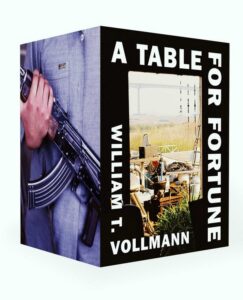
From the author’s note to A Table For Fortune by William T. Vollmann. Copyright © 2026. Available from Arcade Publishing, an imprint of Skyhorse Publishing.