
On World War II battlefields, many soldiers kept a so‑called “heart shield bible”—a compact, government-issued scripture bound in metal or simply tucked into a G.I.’s shirt pocket. In at least one notable instance, this pocket Bible proved to be life-saving armor. More often, though, the Bible fulfilled its traditional role: easing a troubled conscience and offering a sense of spiritual meaning beyond the immediate danger.
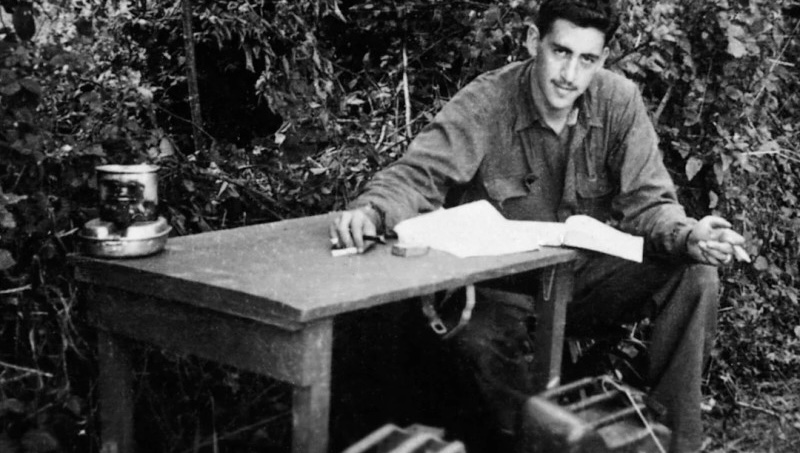
When Jerome David Salinger, at age 23, was sent to the front, he rejected conventional Christian allegories and instead composed his own story, enriching his battlefield kit with sheets of blank paper and a portable typewriter. There was a moment when his squad came under heavy fire, and a comrade taking cover caught sight of Salinger hunched beneath a table, tapping away as if a deadline loomed over him like a newspaper editor.
Now revered worldwide as J.D. Salinger, the young draftee endured many of the era’s most harrowing episodes. He stormed the shores of Normandy, battled through the Battle of the Bulge, and assisted in the liberation of Kaufering, a subcamp of Dachau. Fragments of his writing traveled with him, damp with his sweat and infused with his raw, instinctive responses to warfare. Those reflections were later refined into some of the earliest American works that unabashedly questioned the sanctified image of the G.I. and the rosy myths surrounding combat. Salinger’s words also undermined America’s intoxicating ideal of masculinity—the very force that propelled U.S. military recruitment for decades.
Salinger’s piercing tales soon made him one of the most influential voices of the Silent Generation. Like many of his peers, he emerged from the war with deep trauma. He processed his wartime experiences almost exclusively through his fiction. He rarely spoke or wrote about his own service, though the occasional intimate remark was chilling. “You never really get the smell of burning flesh out of your nose entirely,” he once told his daughter. “No matter how long you live.”
Salinger’s words likewise undermined the alluring template of masculine virtue that powered the U.S. military recruitment machine, then and now.
His thoughts and theories about World War II often hid within domestic plots or within distant settings rather than on the front lines. Only once did Salinger address active combat directly, in an unpublished short story titled “The Magic Foxhole,” which chronicles the severities—both physical and psychological—faced by American “soldier boys” during the Normandy bombing. It’s a stark tale for its era, seemingly a personal meditation on survivor’s guilt. Perhaps writing it was his way of questioning whether his extraordinary survival could be chalked up to luck, fate, or some form of providence.
“The Magic Foxhole” opens with a striking image of war’s profanity: a military chaplain crawling frantically on all fours amid shelling, searching for his glasses. God is nowhere to be found. We then meet a young soldier named Gardner who somehow slips into foxholes spared from bombing. Gardner remains physically unscathed, yet his mind begins to unravel. At one moment he envisions another man in his foxhole wearing a futuristic helmet, whom he believes is his unborn son, Earl.
While Gardner may appear unhinged, Salinger clarifies that he “wasn’t a loon.” Rather, Gardner is seized by a form of battle fatigue “when you look as good as dead, or when you start telling everyone out loud that you wish you were a civilian and not in some goddamn Army.” Near the story’s end, Gardner vows to shoot his imagined son to spare him the war’s toll, but retreats when the young man pleads to stay a soldier rather than become a hero. “I was going to shoot him,” Gardner explains coldly, “but he said he wanted to be here.”
Much of Salinger’s other war writing circulated through a thinly fictionalized version of himself named Holden Caulfield. Holden is witty, skeptical, and fiercely anti‑war, a self-proclaimed atheist who scathingly attacks the war and its institutions. After the armistice, Salinger returned to Connecticut and refined his fragments into a cohesive novel, The Catcher in the Rye, now marking its 75th anniversary. The book places Holden at Pencey Prep, a private school outside Philadelphia that stands in for Salinger’s real alma mater: Valley Forge Military Academy. Salinger first arrived at the Forge in 1934, after leaving the Manhattan prep school McBurney on Central Park West, at age fifteen.
The Forge largely catered to “problem students” and could be punishing. Just before Salinger enrolled, a cadet died from a fall at the academy under murky circumstances. As with many cadets, Salinger wrestled with ambivalence toward the place. He authored a sentimental poem for his yearbook that remains read at school gatherings, and in letters, he shows a deep affection for the cadets who shared his years there. Yet he also expressed sharp frustration about the school in Catcher. While the Boy Scouts’ in‑house publication, Boy’s Life, advertised Pencey as a beacon of military leadership, Holden presents it as a refuge for misfits. “They don’t do any damn molding at Pencey, any more than at any other school,” Holden notes on page one. “And I didn’t know anyone there who was splendid and clear-thinking and all. Maybe two guys. If that many. And they probably came to Pencey that way.”
In Salinger’s narrative, Pencey is haunted by a mix of troubled youths, inept teachers, and spoiled rich kids, a combination that often bred abuse. The Forge itself becomes a distorted echo of America’s premier military academy, West Point, cast onto a younger student body. The school then boasted a solid curriculum and substantial extracurriculars, including a world‑class band that performed for many dignitaries, a tradition that would include President Richard Nixon later in the century. But the hazing culture could be brutal, driven by a large cadre of unruly cadets of varied ages and backgrounds. Among them, for a time, was King Simeon, the exiled Bulgarian boy monarch. While polishing his boots one autumn day in 1958, Simeon told a local reporter of his longing to regain power abroad. “I was born to wear the crown,” he muttered, “and I never abdicated, nor signed any papers giving up my reign.”
While service at the Forge wasn’t mandatory—like at many similar schools—it did host a strong voluntary commissioning program and a pipeline to the service academies. In this sense, Pencey and similar institutions helped forge a new type of military man: privileged, resourceful, and marked by scars—just as Holden Caulfield would be.
Holden eagerly rebels against Pencey Prep, gets expelled, and escapes to New York City, a place with its own temptations and hazards, but lacking the school’s carefully curated sheen that hides its darker underside. Like many private schoolboys who join the armed forces, Holden is still a youth. At sixteen, he speaks with the weary resignation of a battle‑weary veteran. He wrestles with suppressed sexual energy, a smoking habit, and a bleak outlook. In a 2013 biography by David Shields and Shane Salerno, Catcher is described as heavily informed by Salinger’s front‑line experiences. They note that he was hospitalized for psychiatric treatment during his time as an Army intelligence operative, where he undertook harsh interrogations, among other duties.
From this period, he emerges “incapable of believing in heroic, noble ideals” that society tends to claim about its institutions. This skepticism about World War II appears early in Catcher, when Holden recounts his brother D.B.’s Army service and notes that the U.S. Army is “nearly as full of scoundrels as the Nazis were.” On furlough, D.B. was despondent, spending most of his time in bed and rarely appearing in the living room. The moment resonates with Salinger’s own state of mind as a serviceman, particularly on a day that should have brought exhilaration. On May 8, 1945, when Germany surrendered, Salinger spent the day in Europe alone, lying on a cot with a .45 pistol in his hand, contemplating the possibility of shooting himself. When Catcher was released in 1951, it quickly became one of the most censored books in the United States.
By the mid‑1950s, the fever for military validation among American youth was cooling, though not everyone recovered fully. Ernest Hemingway stood as a emblematic figure of the older generation’s soldier’s ideal. Like many of his cohort, he had believed from childhood that war was a universal male duty. His early notions of combat were hazy, his vision blurred by imperfect eyesight that ultimately prevented him from enlisting. He instead joined the Red Cross as an ambulance driver, navigating the frontline in Italy during World War I and sustaining injuries from mortar and machine‑gun fire.
Hemingway later pursued a second route to combat as a journalist. In August 1944, while covering World War II, he joined the ranks supporting Paris’s liberation. Shortly afterward, he encountered Salinger in the liberated city of romance, most notably at the Ritz Bar, where he had spent a great deal of liberated time, presiding over conversations and sipping Perrier‑Jouët champagne. Hemingway praised Salinger’s short stories, and the two talked for hours. “You have a marvelous ear,” Hemingway later wrote to Salinger. “And you write with tenderness and love without losing your nerve.”
Salinger saw in Hemingway a writer‑god and a kindred spirit. Yet he sometimes bristled at Hemingway’s unyielding bravado, which he believed often obscured the full truth of a soldier’s reality. In Catcher, Holden dismisses Hemingway’s A Farewell to Arms as a “phony book.” Holden also watches a war movie whose sentimentality nearly makes him ill. Salinger told a friend that he disliked Hemingway’s overemphasis on physical courage—“guts” as a virtue—and admitted that he himself was “short on guts”—a rare confession about the masculine ideal that haunted him.
Hemingway clearly recognized truth in Salinger’s central argument: that war destroys not just bodies but vital parts of the self—childhood innocence, inner peace, and hope.
Behind Hemingway’s swagger lay real pain. His fiction is permeated with the tension between a nation’s attraction to militarism and the darker, more complicated relationship men have with it. The clearest illustration is The Sun Also Rises, the novel about a war veteran whose wounds render him impotent. Despite differences between the two writers, Salinger left the Ritz reinvigorated to write, and he found Hemingway’s gentler, more approachable demeanor unexpectedly comforting. Hemingway, for his part, is said to have kept a dog‑eared, personally inscribed copy of Catcher in his Havana home, recognizing some shared truth in Salinger’s thesis that war erodes essential parts of the self.
In an unpublished 1995 letter to