
I wasn’t in any mood to greet anyone when Korine arrived. I perched in a chair within my sublet on Aldersgate Street in central London—a last-ditch effort, a kind of Hail Mary. The rain hammered down outside. It was late May, chillier than it should have been for the season. A sash window to my right looked out on an alley, or rather, the outer wall of the neighboring building. Water streamed down the black brick, splashing from the gutter. This was the moment Korine chose to appear, at least in my judgment. He stepped through the front door as if he owned the place. He was taller, thinner, which is saying something given that I myself struggled to keep my posture on this chair: a hard-plastic shell, cracked red with other, more somber tones, designed for people smaller than me. I curled my lower legs in a futile effort to find comfort. Korine stood directly in front of me, leaving damp marks on the floor: grey marble-like linoleum laid in the sixties, still surviving wave after wave of gentrification.
I fell back on a common gesture of civility and invited him to sit on the empty chair facing mine—as if the room were an open house.
He could not, Korine said. His thoracic cage was prone to jolts. It hurt when he sat still in any one position. He would rather lie on the sofa. He had grown fond of it: its teak frame, greenish leather cushions, a crease where it hurt.
Please, I urged. The chair. I was trying to contain him. It was a futile aim, as it turned out.
He obliged, reluctantly. Sat there with his legs crossed, arms wrapped around his torso, on the brink of collapsing in on himself, I surmised. He appeared to be in his late forties. Younger in appearance, if I measured against myself. His dark brown hair was somewhat long and wavy. He wore a novelty T-shirt (the specifics of which are better left unsaid) and pajama bottoms. And sandals, in this weather. If ever we were seen together, I thought, we would reflect badly on both of us.
“Lewis,” I said by way of introduction. “Aubrey Lewis.” A former actor whose career had not amounted to much, I did not say. A husband who had lost his wife and then himself, I did not lead with that either.
“Lindsey Korine,” he replied. “Pleased to meet you.” Then he admitted he was cold.
What was I supposed to say. Weren’t we all. I showed him the cream-colored tracksuit bottoms I wore, the mismatched top, which I had tucked in to protect and keep warm my pelvic girdle—a musculoskeletal vulnerability, I explained, perhaps to demonstrate that one can endure such conditions. I even displayed my footwear: brown Oxford shoes, oddly puffed up, almost pillowed, as if the leather had been soaked to swell. I didn’t know who made them. What factory. What sweatshop—the thought was almost unimaginable.
“Can we turn on the heating?” Korine asked. His clothes wouldn’t dry at this rate.
“No,” I said. It was spring. The communal heating had been switched off.
Korine, I learned, couldn’t tolerate his discomfort for more than a minute. He rose from his chair, which was an achievement in itself. Nothing with him was simple. He moved toward the crowded coat stand by the door, ready to layer up.
Two years into my subtenancy, I had yet to approach the various outerwear pieces piled there. They did not belong to me. Hardly anything in the flat belonged to me or the life I had led before moving in: that’s what drew me to it. Some concessions: my Equity trade union card on the windowsill—an active member once, long ago. A Kumari Burman print of a neon-lit tiger with bindis and stickers of animal astronauts, a gift from my wife, which I’d torn from its frame and sellotaped to the bare wall. In an otherwise clinical space, I had learned to value these objects. Meanwhile Korine pulled one of several tweed overcoats from the stand, a gray herringbone, full length, and examined it. The way he rejected it. The contempt. Not giving it a second thought, he dropped it. He pulled out a similar piece, waist-length this time: a possible candidate. He seemed attracted by the idea of a better option—optimism, the impulse to leap before looking, a complete lack of self-awareness: I learned a lot about Korine by watching him. He flung this latest coat over his shoulder and rummaged deeper. The scent of the room changed as he disturbed the long-settled order: damp lanolin, decaying mineral oil, a blueberry hint, all intermingled. Korine found a scratched wax jacket, olive in color, with a corduroy collar. He tried it on. The sleeves were too short. He took it off. He returned to the waist-length tweed coat, square-cut, and kept it on. It fit better in the arms but was still short in the torso. Still, he kept it on. He added the wax jacket on top. I closed my eyes and counted backward from ten. Five. Three. And then: what next. Korine, layered twice, rummaged through one of the cardboard boxes beside the sofa. He pulled out a Christmas angel—out of all things—and set it on the table. Made of brightly colored foil, the thinnest of metals, it was blowing its trumpet in Korine’s direction. Of course, its back faced me: I was on the receiving end of its wings, the sharp edges grazing me, and I felt insulted by that sight.
The turquoise-and-brown vase my wife had cherished and I had despised? Korine picked it up and placed it on the table as well.
“What are you doing,” I said, meaning: please don’t.
Korine declared that the room felt spiritually frosty.
Bare and unwelcoming. He was fixing it.
Old tinsel: not that. The thing probably made of lead, I used to catastrophize. Christmas was killing us, I insisted every year. Cancer—the real killer of Laurie, not Christmas—had taken her, and this spring seemed increasingly ominous as well.
I don’t think I looked happy; if Korine noticed, he raised his hands in surrender and closed the box. He promised to stop. Yet he left what he had taken out of the box on display, including the angel with the trumpet. I imagined I heard its silly fanfare.
It was madness. And by that I mean all of it. I began to entertain the possibility that none of it—least of all Korine—was real. Perhaps there was nobody here: perhaps there never was, that was the point. More likely, I was losing my mind: just a delusional episode. It would pass quickly, I told myself.
I tried to follow Laurie’s breathing exercises: close my eyes, breathe in, breathe out. In. Out. Again, in. Out. When I opened my eyes, he would be gone.
Ok, no. He was still there. He lay on the sofa, clearly comfortable, on his side with his head resting on an elbow. His legs stretched off the end. Restlessly, he rolled onto his back, hands folded behind his head, still as a blanket cradling him.
Neither option worked: he stayed. I would go to the bathroom, splash some water on my face, and return to find him vanished. I rose, flipped the bathroom switch, and the light came to life. Fine. I studied my reflection in the mirror, then looked at the mirror again—the coating was flaking away at an alarming rate. My eye looked tired, and my left eyelid was swollen. Other than that, nothing seemed different from yesterday or the day before. I washed my hands and face. I resolved to rinse later with a towel, a routine hygiene ritual—ordinary things, normal things. I adjusted the hood of my track top and smoothed the line again. That small, scrupulous act gave me reassurance.
I remembered the moment I first slipped into the tracksuit. Just over a year earlier. A year and a half after I quit acting. Two years after Laurie’s death. On that day, the bathroom mirror ceased showing me as I was: I no longer recognized the person reflected back. The jeans I had worn without a second thought felt unbearable now. The plain shirt. Even the belt. The good news: I had already discarded the trainers with the distinctive “N.” I found them repulsive. The belt came off next. The jeans followed, kicked into a corner as soon as they slid off. Then the shirt. A hesitation: could I salvage the vest? Any salvageable qualities? Gray, once white, washed countless times. It felt acceptable? No. The vest came off too. I peeled it away and added it to the pile of rejects in the corner. Into the wardrobe rummaging went the cream-colored track top I spotted first. No—the garment chose me. The beige bottoms didn’t match perfectly, but they offered a way to unite these disparate items. I selected the Oxfords for their soft leather, unaware of their downsides—an absence of ankle support—the problem wasn’t present at the time, but it would become a problem.
One final look in the mirror: relief. I looked like someone I could tolerate seeing myself as. A stranger, perhaps—the best possible outcome. A long-winded way of saying how a fresh outfit can change everything. I say it in Korine’s defense.
When I returned to the living room, he remained there. Definitely, unmistakably still there. In cahoots with the Christmas angel, heralding spring.
__________________________________
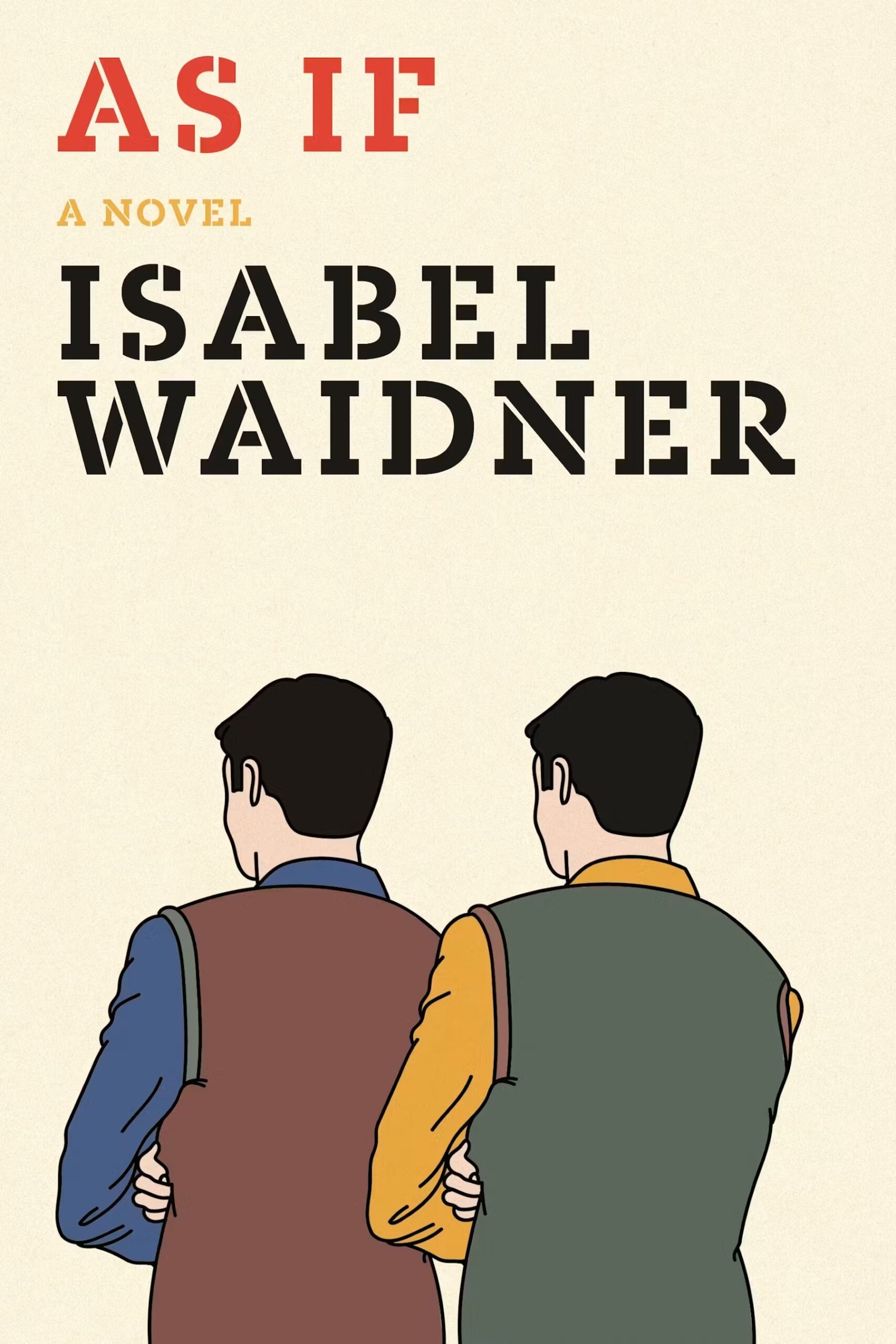
From As If by Isabel Waidner. Used with permission of the publisher, Farrar, Starus & Giroux. Copyright © 2026 by Isabel Waidner.